6.2 - Ionic Lattices & Properties of Ionic Compounds
- 1
How ionic bonds are formed
- 2
The structure and properties of ionic compounds
- 3
Lattice enthalpy and factors affecting it
Ionic bonding occurs between oppositely charged ions
- An ionic bond is the electrostatic force of attraction between oppositely charged ions, usually a metal and a non-metal.
- These bonds are very strong.
- When ions bond this way, an ionic compound is formed.
Structure of ionic compounds
Ionic compounds have giant lattice structures where positive and negative ions pack together.
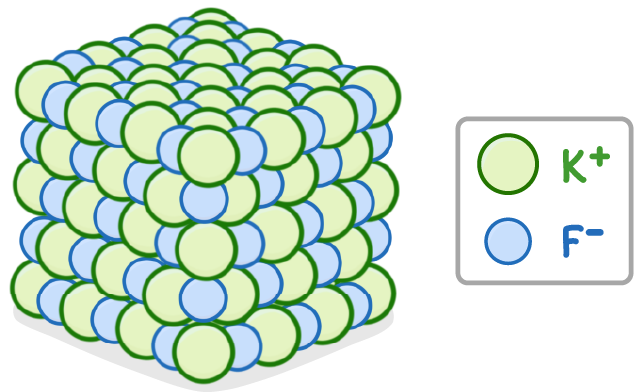
A 3D model of potassium fluoride’s giant ionic lattice structure with alternating K+ and F- ions is shown above.
Key features of a giant ionic lattice:
- Each ion is electrostatically attracted to ions of the opposite charge in all directions.
- It takes significant energy to overcome these strong electrostatic forces between the ions.
Properties related to ionic structure
The properties of ionic compounds result from their lattice structure:
- Low volatility - The strong electrostatic attractions between the positive and negative ions in the giant lattice must be overcome for the ions to escape the lattice and enter the gaseous phase. This requires a lot of energy, resulting in high boiling points.
- Conduct electricity when molten or in solution - When melted or dissolved, the ions can move freely and carry electric charge through the liquid.
- Do not conduct electricity as solids - In the solid lattice structure, the ions are firmly locked in place and unable to move to carry electric charge.
- Dissolve in water - Water molecules, which are polar, attract the charged ions in the lattice via ion-dipole forces, pulling them away from the lattice and dissolving the structure.
Lattice enthalpy measures ionic bond strength
Lattice enthalpy (ΔH⦵latt) is a measure of the strength of the electrostatic forces holding ions together in an ionic lattice. It is defined as the enthalpy change when one mole of a solid ionic compound is formed from its gaseous ions under standard conditions (298 K, 100 kPa).
For example: Na+(g) + Cl-(g) ➔ NaCl(s) ΔH⦵latt = $-$787 kJ mol-1
Lattice enthalpy values are always negative (exothermic) because energy is released when the oppositely charged ions come together to form the solid lattice.
The more negative the lattice enthalpy, the stronger the ionic bonding in the compound. For instance, MgO has a more negative lattice enthalpy ($-$3,791 kJ mol-1) than NaCl ($-$787 kJ mol-1), indicating that MgO has stronger ionic bonds.
Factors affecting lattice enthalpy
The lattice enthalpy of an ionic compound depends on two key factors.
1. Ionic charge
- Ions with higher charges experience stronger electrostatic attractions than ions with lower charges.
- This leads to more energy being released when the lattice forms, resulting in a more negative lattice enthalpy.
- For example, MgCl2 has a much more negative lattice enthalpy ($-$2,526 kJ mol-1) than NaCl ($-$787 kJ mol-1) because the Mg2+ ion has a higher charge than the Na+ ion, resulting in stronger electrostatic attractions in the lattice.
2. Ionic radius
- Smaller ions have a higher charge density and can pack more closely together in the lattice.
- This increases the strength of the electrostatic attractions between ions.
- Consequently, compounds with smaller ions tend to have more negative lattice enthalpies.
- For example, LiCl has a more negative lattice enthalpy ($-$853 kJ mol-1) than NaCl ($-$787 kJ mol-1) because the Li+ ion is smaller than the Na+ ion, allowing closer packing in the lattice.
So in general, compounds with small, highly charged ions have the most negative lattice enthalpies.