1.2 - States of Matter
- 1
The arrangement of particles in solids, liquids and gases
- 2
Changes of state
- 3
The Kelvin temperature scale
Arrangement of particles in solids, liquids and gases
The states of matter of substances are indicated by letters in brackets after the formula: (s) for solid, (l) for liquid, (g) for gas, and (aq) for aqueous solution.
For example:
- Water is a solid below 0°C - H2O(s)
- Water is a liquid between 0 and 100°C - H2O(l)
- Water is a gas above 100°C - H2O(g)
- Sodium chloride dissolved in water - NaCl(aq)
The properties of solids, liquids and gases depend on how the particles are arranged:
- In a solid, particles are packed closely together in a regular structure. This gives solids a high density and makes them difficult to compress. The particles vibrate about fixed positions and cannot move freely.
- In a liquid, particles can move around freely but are still fairly close together. Liquids have similar densities to solids and are also difficult to compress.
- In gases, particles have much more energy and are separated by large distances. This gives gases low density and high compressibility. The fast-moving particles can diffuse rapidly to fill a container.
The arrangement of particles and properties in solids, liquids, and gases is summarised in the table below.
| State | Particle arrangement | Particle motion | Properties |
|---|---|---|---|
| Solid | Closely packed, organised structure | Vibrate about fixed positions | High density, hard to compress |
| Liquid | Particles can move around freely, still close together | Random motion | Similar density to solids, hard to compress |
| Gas | Particles have lots of energy and large separations | Rapid, random motion | Low density, highly compressible |
Changes of state
Substances can change between the three states of matter as they absorb or release energy. These changes of state occur at specific temperatures and pressures, which vary for different substances.
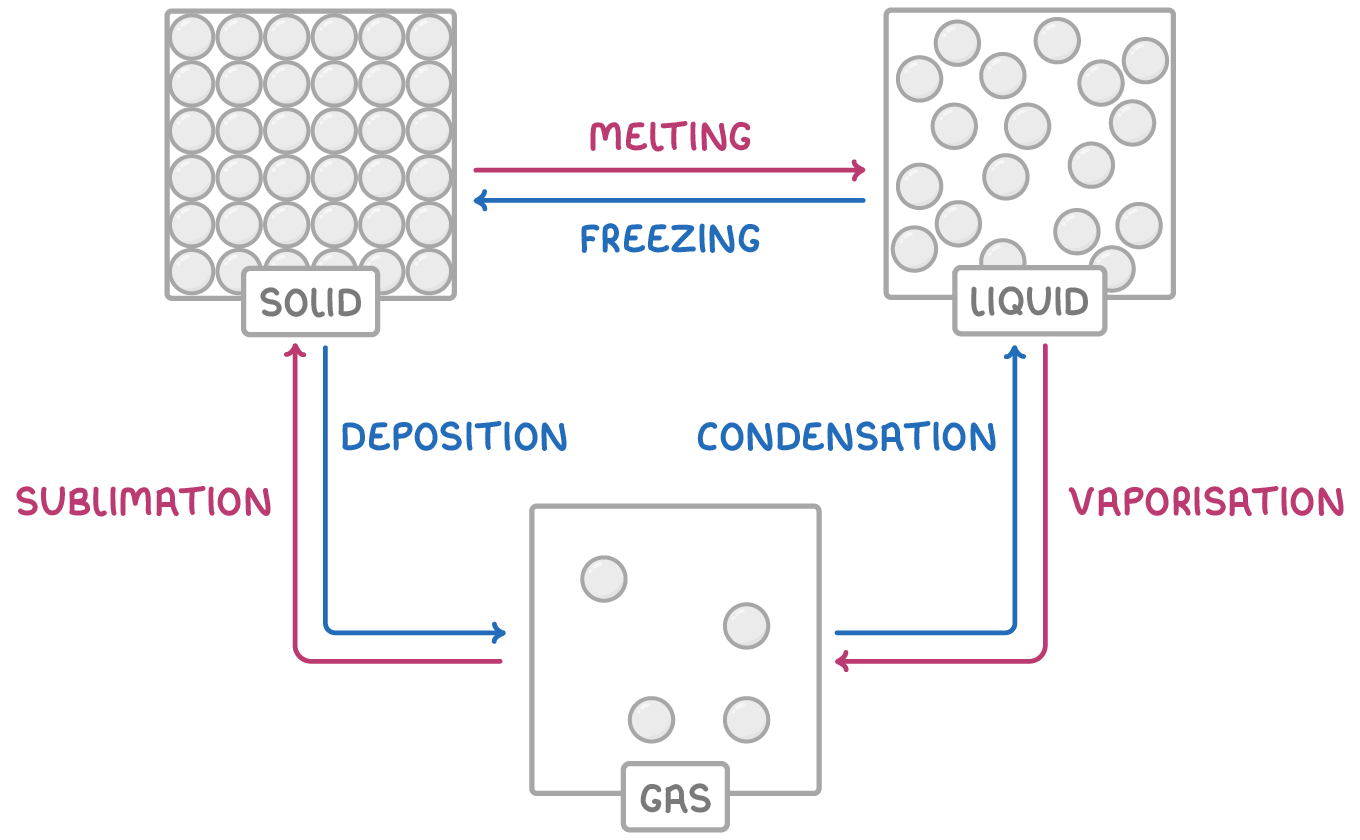
The six changes of state are:
- Melting - Solid to liquid (e.g., ice to water).
- Freezing - Liquid to solid (e.g., water to ice).
- Vaporisation - Liquid to gas (e.g., water to steam).
- Condensation - Gas to liquid (e.g., water vapour to liquid water).
- Sublimation - Solid to gas without passing through the liquid state (e.g., dry ice to carbon dioxide gas).
- Deposition - Gas to solid without passing through the liquid state (e.g., water vapour to snowflakes).
Melting, vaporisation, and sublimation are endothermic processes - they involve energy absorption from the surroundings to overcome intermolecular forces.
Conversely, freezing, condensation, and deposition are exothermic processes - they involve energy release to the surroundings when intermolecular forces become stronger.
The Kelvin temperature scale
Temperature is a measure of the average kinetic energy of particles in a substance. The Kelvin (K) is the SI base unit for temperature and is widely used in scientific contexts. The Kelvin scale is an absolute temperature scale, meaning it starts at a theoretical minimum temperature called absolute zero (0 K), where particles have the least possible kinetic energy.
Key points about the Kelvin scale:
- The Kelvin scale is related to the Celsius scale, with the same increment size between degrees.
- To convert a temperature from degrees Celsius (°C) to Kelvin (K), add 273.
- This means that the melting point of water, which is 0°C on the Celsius scale, is 273 K on the Kelvin scale.
- Similarly, the boiling point of water, which is 100°C on the Celsius scale, is 373 K on the Kelvin scale.
Heating curves
A heating curve shows how the temperature of a substance changes as it gains energy.
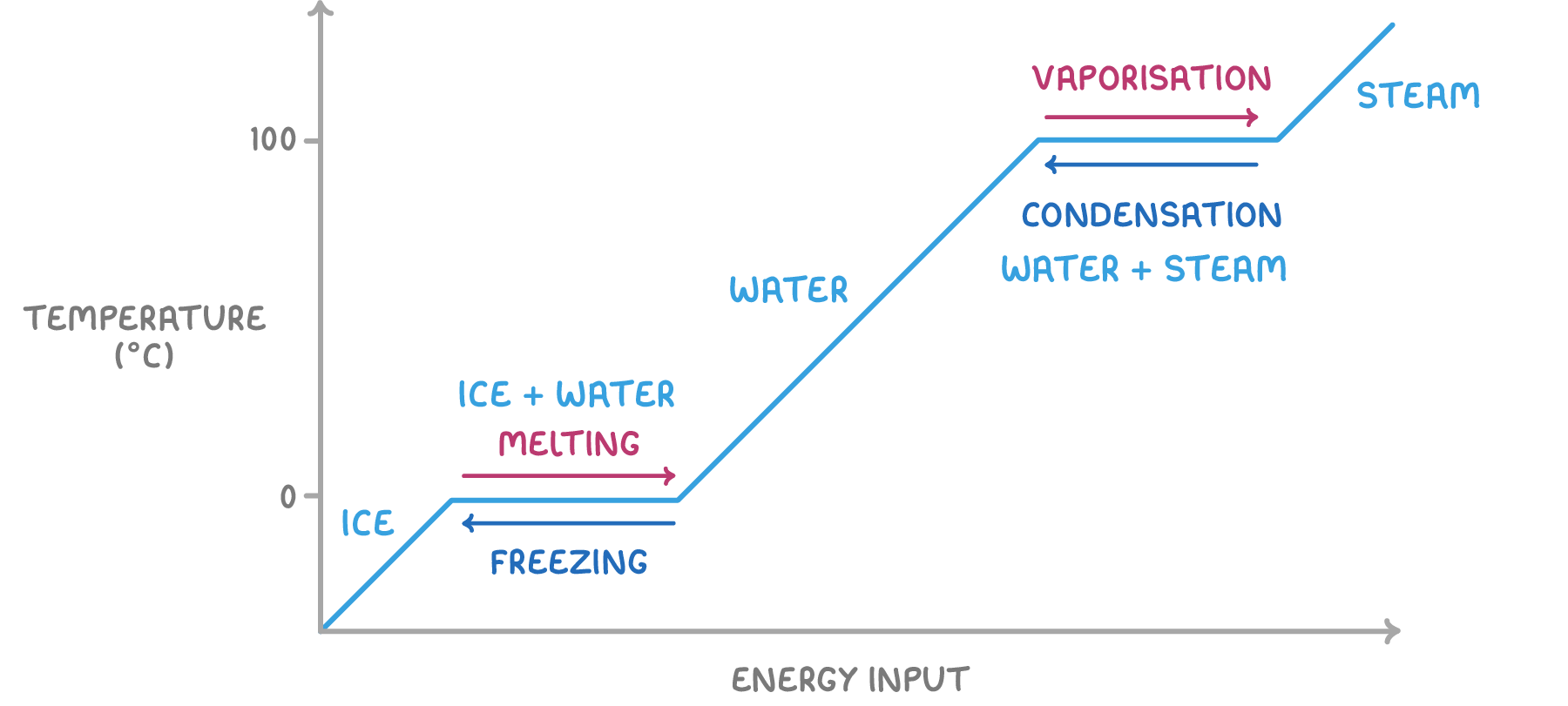
The heating curve for water has several distinct features:
- The temperature rises gradually as ice is heated in the solid state.
- The temperature remains constant at 273 K during melting as the ice changes to water.
- The temperature increases gradually again as the water is heated in the liquid state.
- The temperature stays constant at 373 K during boiling as the water changes to steam.
- The temperature rises gradually once again as the steam is heated further in the gas state.
During changes of state (melting and boiling), the temperature remains constant even though energy is still being added. This is because the added energy is used to overcome the intermolecular forces between the particles, allowing them to change state.
- In melting, the energy breaks the bonds in the solid structure, enabling the particles to move more freely as a liquid.
- In boiling, the energy overcomes the attractive intermolecular forces between the liquid particles, allowing them to escape as a gas.
Only after the change of state is complete does the additional energy go towards increasing the kinetic energy of the particles, causing the temperature to rise again.