9.1 - The Bonding Continuum
- 1
The concept of the bonding continuum
- 2
Using triangular bonding diagrams to represent the bonding continuum
- 3
Determining the position of a compound in the bonding triangle
- 4
Predicting the properties of compounds based on their position in the bonding triangle
The bonding continuum
In reality, bonding in materials is not always purely ionic, covalent, or metallic. Instead, it is best described as a continuum between these three bonding models. This means that the bonding in a substance can have characteristics of more than one bonding type.
Triangular bonding diagrams
The bonding continuum can be represented by a triangular bonding diagram, also known as a "bonding triangle".
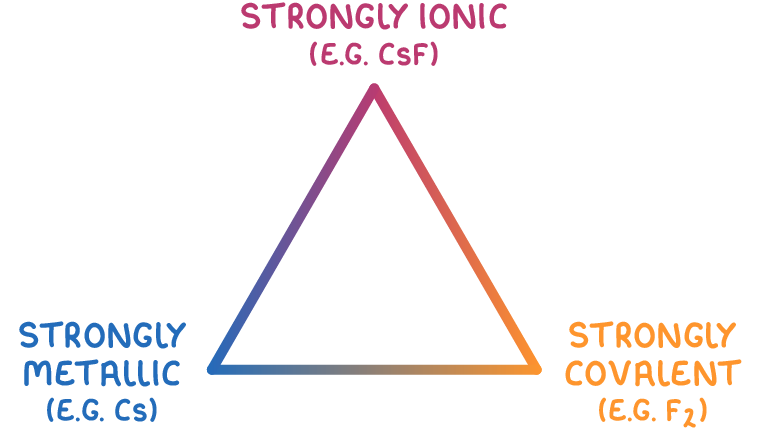
In this diagram:
- The three corners represent the "pure" forms of ionic, covalent, and metallic bonding.
- The sides of the triangle represent the intermediate bonding types between these extremes.
The properties of a material can be explained using bonding models based on its position within the bonding triangle.
For example:
- Compounds near the ionic corner, like CsF, have high melting points and are good electrical conductors when molten or in aqueous solution.
- Compounds near the covalent corner, like F2, have low melting points and are poor electrical conductors.
- Substances near the metallic corner, such as Cs, are good conductors of electricity and heat, and are malleable and ductile.
Determining position in the bonding triangle
The position of a compound in the bonding triangle depends on the relative contributions of ionic, covalent, and metallic bonding to the overall bonding in the compound.
Examples of several substances are included in the bonding triangle below:
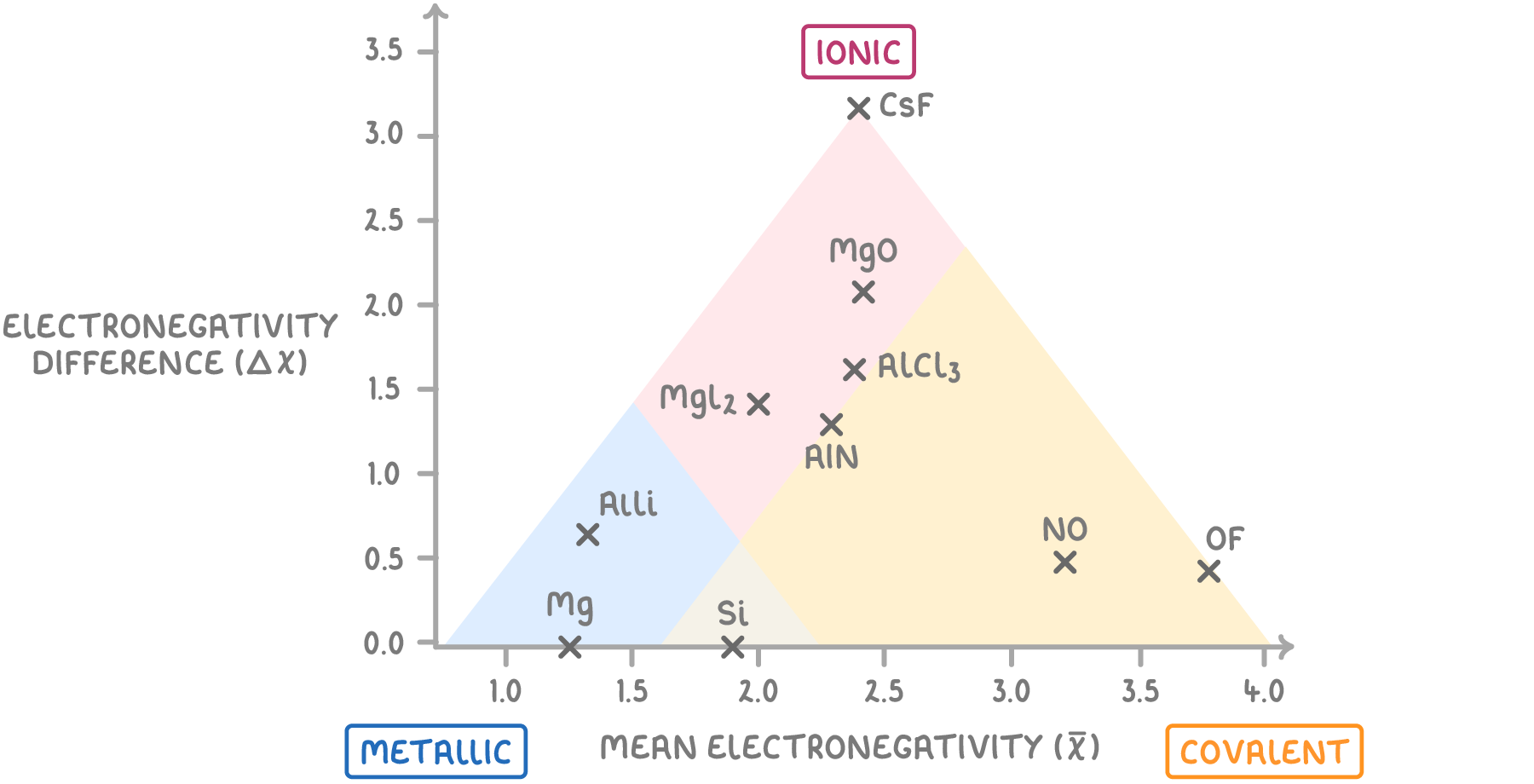
To determine this position, we use the electronegativity values of the elements in the compound. Electronegativity is a measure of an atom's ability to attract electrons in a covalent bond.
The two key parameters calculated from the electronegativity values are:
- Electronegativity difference (Δχ) - Determines the ionic-covalent character of the bond. A larger Δχ indicates greater ionic character.
- Mean electronegativity (χ̅) - Determines the metallic-covalent character of the bond. A lower χ̅ indicates greater metallic character.
By plotting these parameters on the bonding triangle, we can locate the position of the compound and predict its properties.
Worked example 1 - Determining the position of MgCl2
Determine the position of magnesium chloride (MgCl2) in the bonding triangle.
The electronegativity values are:
- Mg: 1.3
- Cl: 3.2
Step 1: Calculate the electronegativity difference (Δχ)
Δχ = 3.2 - 1.3 = 1.9
Step 2: Calculate the mean electronegativity (χ̅)
χ̅ = $\frac{(1.3+3.2)}{2}=2.25$
Step 3: Plot values on bonding triangle
Plotting these values on the bonding triangle, MgCl2 lies between the ionic and covalent regions, with more ionic than covalent character.
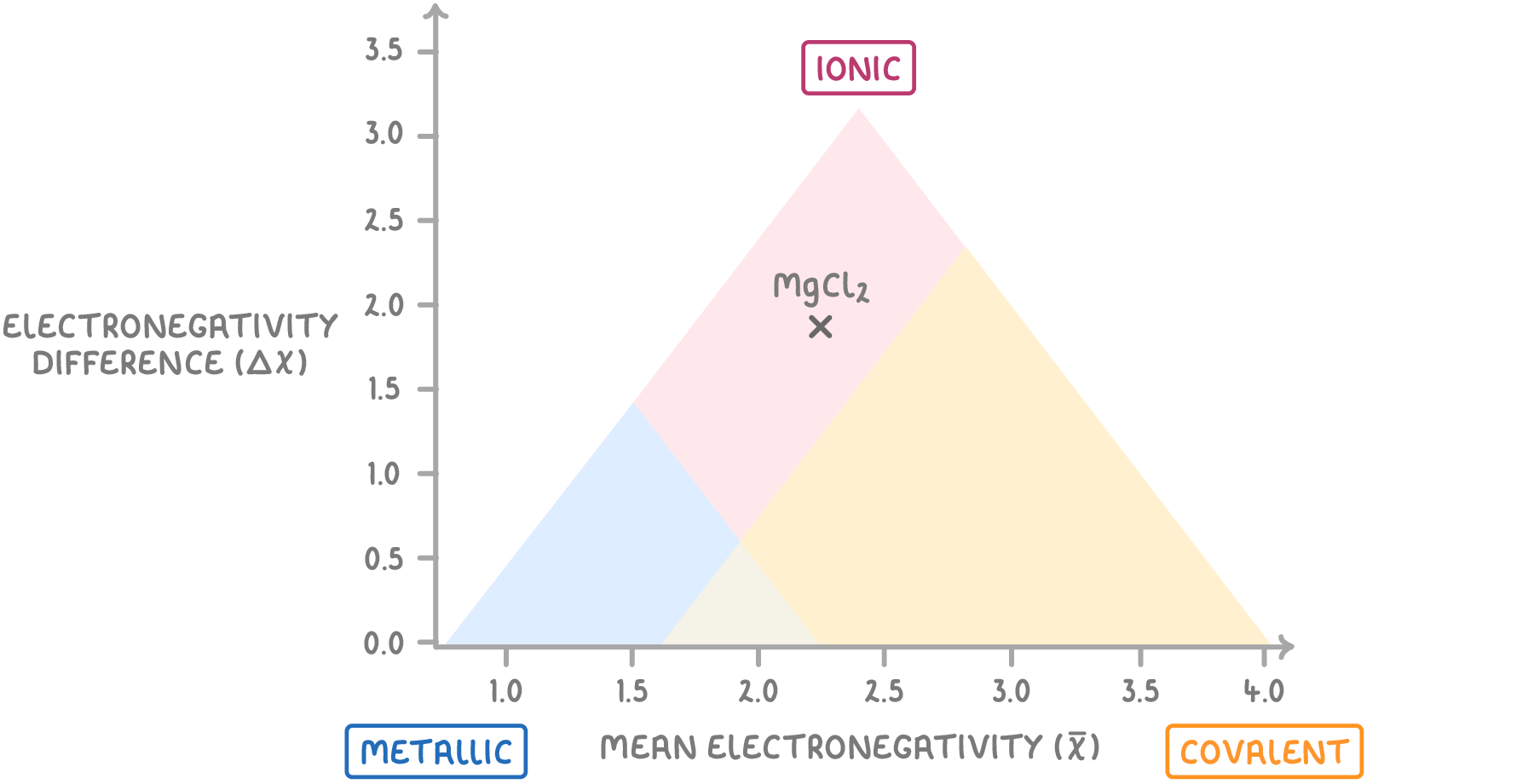
Therefore, we can predict that MgCl2 will have properties intermediate between ionic and covalent compounds, but more similar to ionic compounds. It will have a relatively high melting point and behave as an electrical conductor when molten or in aqueous solution.
Properties of materials with different bonding types
The properties of a substance can be explained by considering the type of bonding, structure, and intermolecular forces present.
The table below summarises the typical properties of substances with different bonding types:
| Ionic | Metallic | Molecular covalent | Covalent network | |
|---|---|---|---|---|
| Bonding | Ionic | Metallic | Covalent | Covalent |
| Melting & boiling points | High | High | Low | Very high |
| State at room temperature | Solid | Solid | Usually liquid or gas | Solid |
| Electrical conductivity | Conductive when molten or in solution | High conductivity | Non-conductive | Non-conductive (except graphite and graphene) |
| Solubility in water | Soluble | Insoluble | Depends on polarity of molecule | Insoluble |
It's important to note that this table serves as a general guide, and there are exceptions where substances do not exhibit the typical behaviour for their bonding type.
Bonding character and properties of example compounds
Here are some example materials that illustrate different combinations of ionic, covalent, and metallic bonding character:
Silicon (Si)
- Silicon lies between the metallic and covalent regions in the bonding triangle, exhibiting properties of both bonding types.
- It has a shiny, metallic lustre but forms a covalent network structure.
- Silicon is brittle like a covalent compound and forms a weakly acidic oxide.
- Its electrical conductivity is intermediate between metals and non-metals, making it a semiconductor. Semiconductors have poor conductivity, but it can be increased by heating, illumination, or adding impurities.
Magnesium iodide (MgI2)
- For MgI₂, the electronegativity difference (Δχ) is 1.4, and the mean electronegativity (χ̅) is 2.0.
- This indicates roughly equal ionic and covalent character.
- As a result, MgI₂ has an unusually high lattice enthalpy compared to purely ionic compounds.
Aluminium chloride (AlCl3)
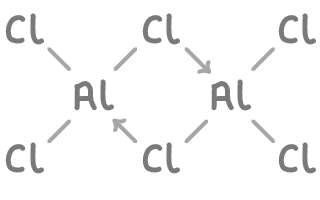
- AlCl3 is classified as ionic but has significant covalent character.
- Unlike MgI2, AlCl3 has an unusually low melting point despite appearing in the same region of the bonding triangle.
- This demonstrates that the bonding triangle does not always reliably predict properties, especially for compounds with mixed bonding character.
- For AlCl3, Δχ = 1.6 and χ̅ = 2.4, placing it at the border between ionic and polar covalent regions.
- Consequently, AlCl3 displays both ionic and covalent properties. It forms ionic lattices in the solid state but melts into Al2Cl6 dimers at a relatively low temperature (190°C) under high pressure.
- Unlike purely ionic compounds, AlCl3 is soluble in non-polar solvents.