17.1 - The Rate of Reaction
- 1
What the rate of reaction is and how to calculate it
- 2
How to determine reaction rates from experimental data
- 3
The difference between average and instantaneous reaction rates
- 4
How to calculate instantaneous and initial reaction rates
Defining the rate of reaction
The rate of a chemical reaction, $\nu$ measures how fast the concentrations of reactants and products change over time.
It is defined as the absolute value of the change in concentration, |Δc|, of a reactant or product per unit time, Δt:
$\nu=\frac{|\Delta{c}|}{\Delta{t}}$
This equation gives the average rate of reaction over a specific time interval, rather than at a particular moment. Reaction rates are typically expressed in units such as mol dm^-3^ s^-1^.
When calculating the rate of reaction, always use the absolute value of the concentration change to ensure a positive result.
Worked example 1 - Calculating average rate of reaction
Nitrogen dioxide decomposes into nitrogen monoxide and oxygen according to the equation:
2NO_2(g)_ ➔ 2NO_(g)_ + O_2(g)_
Under certain conditions, the concentration of nitrogen dioxide in the reaction mixture decreases from 0.40 to 0.20 mol dm-3 over 20 seconds.
Calculate the average rate of reaction, in mol dm-3 s-1, with respect to NO_2_.
Step 1: Equation
$\text{rate }=\frac{|\Delta{c}|}{\Delta{t}}$
Step 2: Substitution and correct evaluation
$\text{rate }=\frac{|0.20 - 0.40 |}{20}=\frac{0.20}{20}=0.010\text{ mol dm}^{-3}\text{ s}^{-1}$
Determining reaction rates from experimental data
Directly measuring concentrations during a reaction can be difficult. Instead, reaction rates are often determined from changes in other quantifiable parameters over time, such as:
- Mass of reactants consumed or products formed.
- Volume of gases produced or consumed.
- Pressure changes in a reaction vessel.
The units for the reaction rate will depend on the measured parameter. For example:
- If the mass of a reactant or product is measured over time, the rate might be expressed in units such as g s^-1^.
- If the volume of a gas produced or consumed is measured over time, the rate might be expressed in units such as cm^3^ s^-1^.
- If pressure changes are monitored over time, the rate might be expressed in units such as kPa s^-1^.
To convert these rates into units of mol dm^-3^ s^-1^, additional information like molar mass, gas laws, or stoichiometric relationships may be needed.
Worked example 2 - Calculating average rate of reaction
The graph below shows the mass of a reaction vessel measured at regular intervals during a chemical reaction.
Calculate the average rate of reaction, in cm3 min-1.
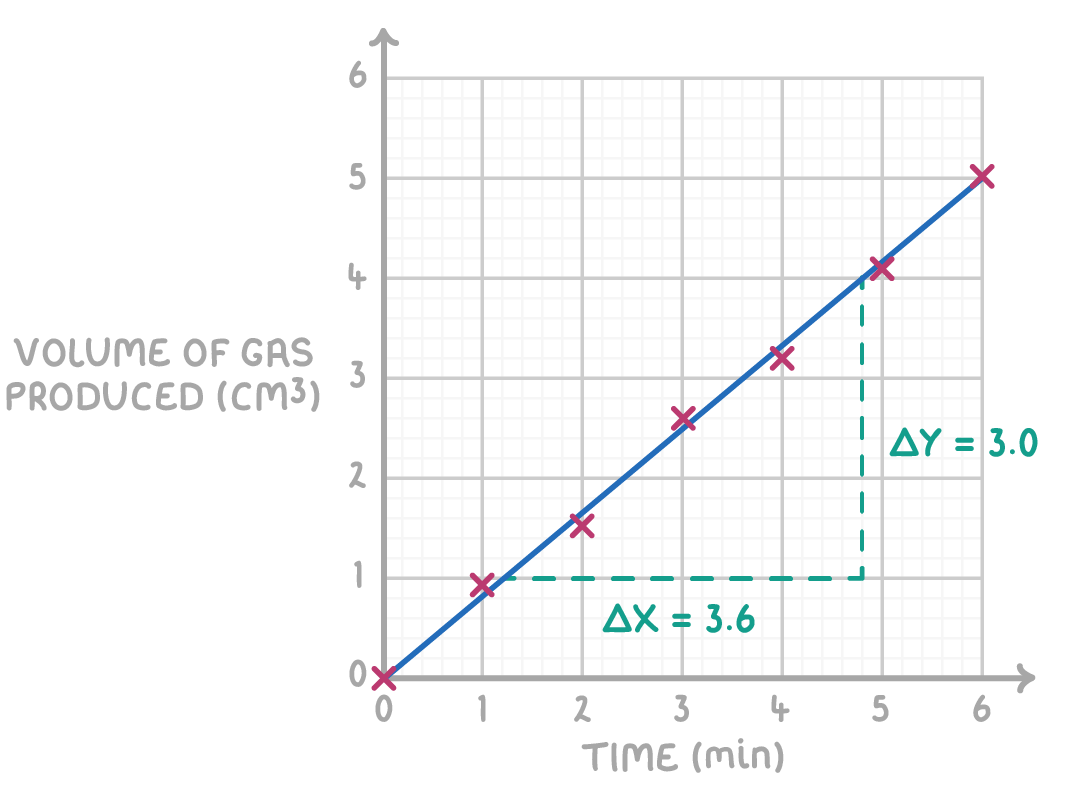
Step 1: Draw a line of best fit
Draw a line of best fit through the data points, starting from the origin (0,0).
Step 2: Choose two distinct points on the line
Identify and choose two points where the line of best fit intersects a gridline distinctly.
Step 3: Create a triangle
Connect these points using vertical and horizontal lines to form a right-angled triangle.
Step 4: Rate equation
$\nu=\text{ |gradient| }=\frac{|\Delta{y}|}{\Delta{x}}$
Step 5: Substitution and correct evaluation
$\nu= \frac{|4.0 - 1.0|}{4.8 - 1.2}=\frac{3.0}{3.6}=0.83\text{ cm}^\text{3}\text{ min}^\text{-1}$
Average vs. instantaneous reaction rates
The average rate of reaction represents the average rate over the time interval Δt. It does not indicate how fast the reaction is proceeding at any specific instant.
To describe the reaction rate at a particular moment, the instantaneous rate, $\nu_{\text{inst}}$, is used.
The instantaneous rate is defined as the change in concentration (dc) over an infinitesimally small time interval (dt):
$\nu_{\text{inst}} = \frac{|dc|}{dt}$
Here, dc represents an infinitesimally small change in concentration over an infinitesimal time period, dt.
The initial reaction rate, $\nu_{\text{init}}$, is the instantaneous rate at the very start of the reaction (t = 0).
Determining instantaneous and initial rates
To find the instantaneous rate at a specific time (t), follow these steps:
- Plot the concentration of a reactant or product against time.
- Draw a tangent line to the curve at the desired time point.
- Calculate the gradient of the tangent line using the equation gradient = $\frac{\Delta{y}}{\Delta{x}}$. The absolute value of the gradient equals the instantaneous rate at that particular time.
Similarly, the initial rate can be determined by finding the gradient of the tangent line at t = 0.
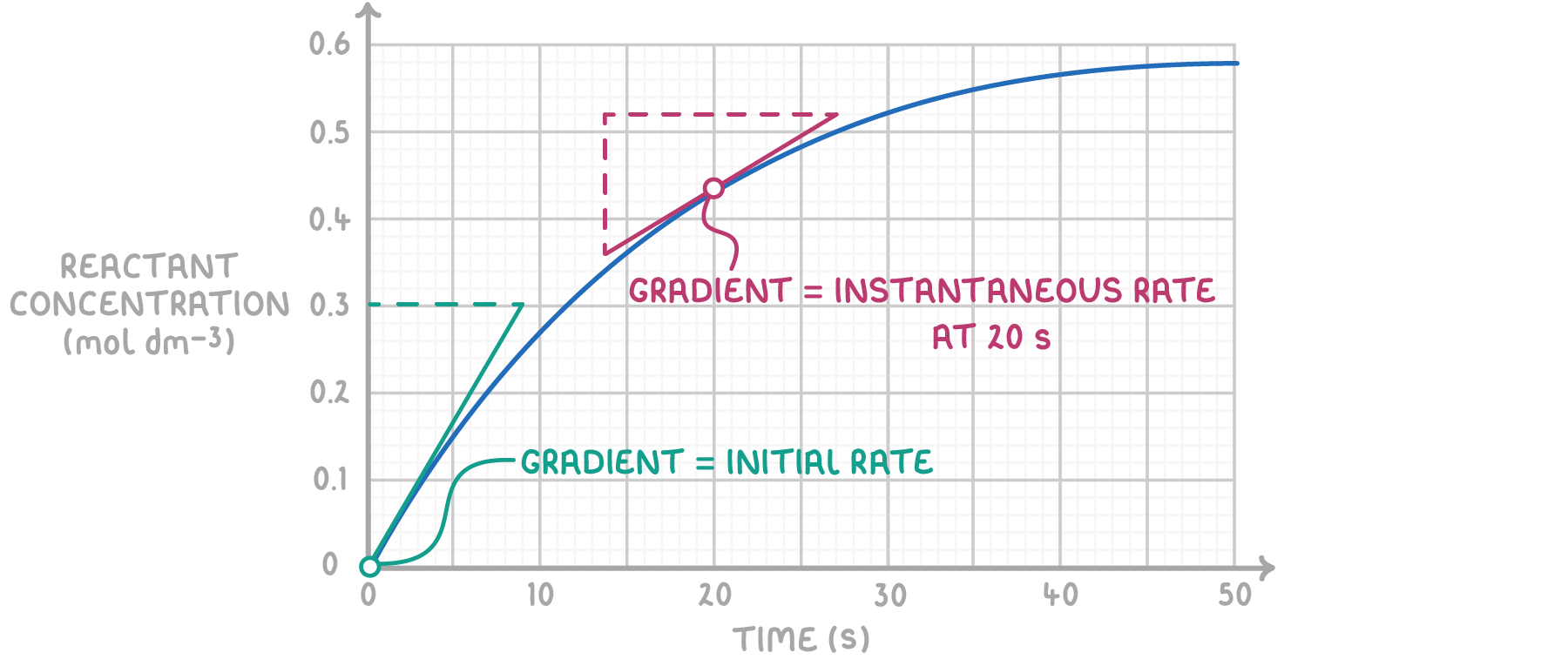
In some cases, reaction rates may be expressed in terms of changes in volume, mass, or other measurable parameters, instead of concentration. The units of the rate will then be determined by the chosen parameter. For example, if the volume of a gas produced is measured over time, the reaction rate might be expressed in units such as cm3 s-1.
Worked example 3 - Calculating instantaneous rate of reaction
The graph below shows the mass of a reaction vessel measured at regular intervals during a chemical reaction.
Calculate the instantaneous rate of reaction, in g min-1, at 3 minutes.
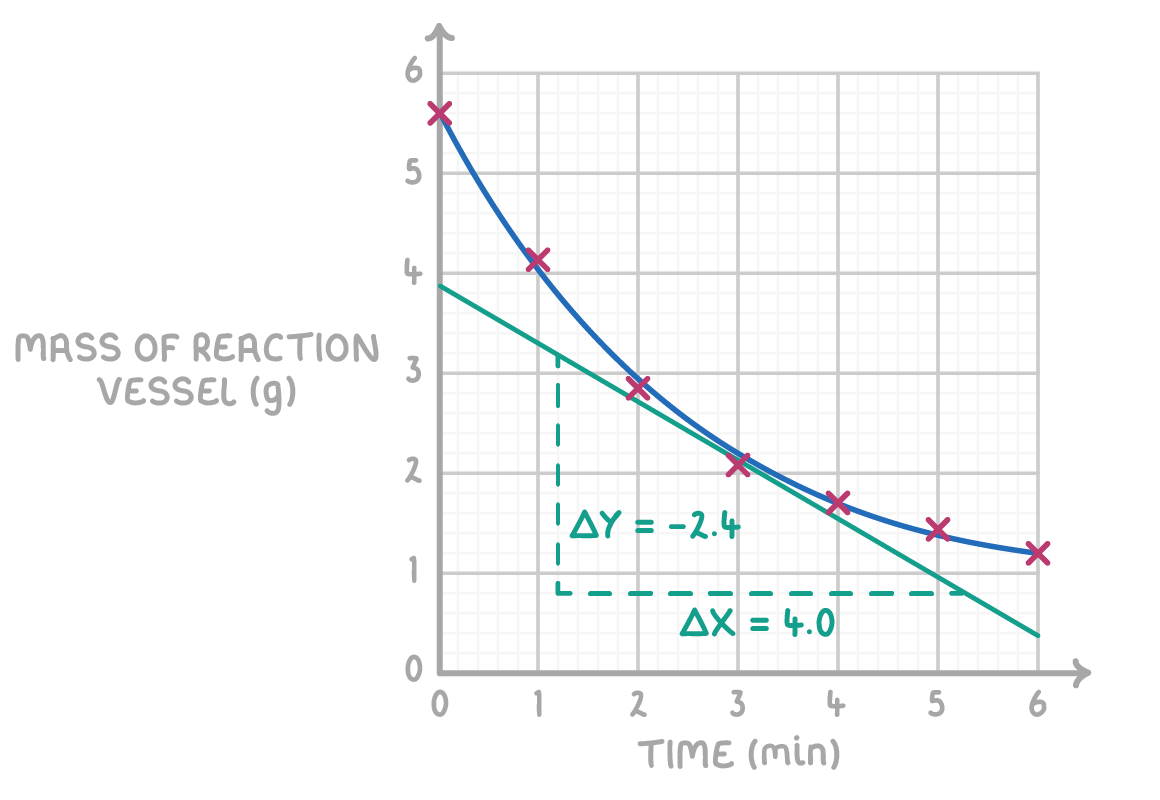
Step 1: Draw a tangent at 3 minutes
Use a ruler to carefully draw a tangent to the curve at the 3 minute mark on the graph. Extend the tangent across the graph.
Step 2: Choose two distinct points on the tangent
Identify and choose two points where the tangent intersects a gridline distinctly.
Step 3: Create a triangle
Connect these points using vertical and horizontal lines to form a right-angled triangle.
Step 4: Rate equation
$\nu=\text{ |gradient| }=\frac{|\Delta{y}|}{\Delta{x}}$
Step 5: Substitution and correct evaluation
$\nu=\frac{|0.8 - 3.2|}{5.2 - 1.2}=\frac{2.4}{4.0}=0.60\text{ g min}^\text{-1}$