18.1 - Dynamic Equilibrium
- 1
What dynamic equilibrium is
- 2
Characteristics of dynamic equilibrium
- 3
Physical and chemical equilibria
- 4
Achieving chemical equilibrium
- 5
The equilibrium position
Reversible changes lead to dynamic equilibrium
Many physical and chemical processes are reversible, meaning they can occur simultaneously in both the forward and reverse directions. In equations representing reversible changes, the reaction arrow (→) is replaced by the equilibrium symbol (⇌).
For instance:
Br2(l) ⇌ Br2(g)
This equation shows that liquid bromine can evaporate to form gaseous bromine (forward process) while gaseous bromine can condense to form liquid bromine (reverse process) at the same time.
If a reversible change takes place in a closed system, it will eventually reach a state of dynamic equilibrium. At equilibrium, the forward and reverse processes occur at equal rates, leading to no net change in the amounts of reactants and products.
Characteristics of dynamic equilibrium
Systems at dynamic equilibrium have several key features:
- The system must be closed, meaning no substances can enter or leave, for equilibrium to be established.
- Forward and backward reactions continue at the microscopic level, with species constantly interconverting.
- The rates of the forward and backward reactions are equal.
- Macroscopic properties like colour and density remain constant.
- The concentrations of reactants and products stay constant over time (but do not have to be the same as each other).
Altering the conditions of the system (e.g. pressure, temperature) can disrupt the equilibrium and cause the concentrations to adjust until a new equilibrium is established.
Features of a reversible reaction:
| Before equilibrium | At equilibrium | After equilibrium (when conditions change) | |
|---|---|---|---|
| Concentrations of reactants and products | Changing over time | Remain constant | Adjust to new constant levels |
| Rates of forward and backward reactions | Unequal | Equal | Unequal initially, then re-equilibrate |
| Appearance of reaction mixture | Visibly changing | Appears unchanging | Visibly changes then new equilibrium forms |
Types of dynamic equilibrium
Dynamic equilibrium can be observed in both physical and chemical systems:
- Physical equilibrium involves the interconversion of a substance between different phases without a change in chemical composition. Examples include:
- Liquid-gas equilibria, such as the evaporation and condensation of bromine:
Br2(l) ⇌ Br2(g)
- Solid-solution equilibria, like the dissolution and precipitation of sodium chloride:
NaCl(s) ⇌ Na+(aq) + Cl-(aq)
- Chemical equilibrium involves the reversible interconversion of reactants and products in a closed system. An example of a chemical equilibrium system is the synthesis and decomposition of ammonia:
N2(g) + 3H2(g) ⇌ 2NH3(g)
Achieving dynamic equilibrium
Consider the ammonia synthesis reaction:
N2(g) + 3H2(g) ⇌ 2NH3(g)
Dynamic equilibrium is achieved in this reversible reaction through the following steps:
- The forward reaction initially proceeds rapidly due to the abundance of reactants (N_2_ and H_2_).
- As the reaction progresses, the concentrations of N_2_ and H_2_ decrease, causing the forward reaction rate to slow down.
- Simultaneously, the concentration of the product (NH_3_) increases, enabling the reverse reaction to occur more rapidly.
- Eventually, the rates of the forward and backward reactions become equal, and the concentrations of N_2_, H_2_ and NH_3_ no longer change.
- At this point, dynamic equilibrium is established.
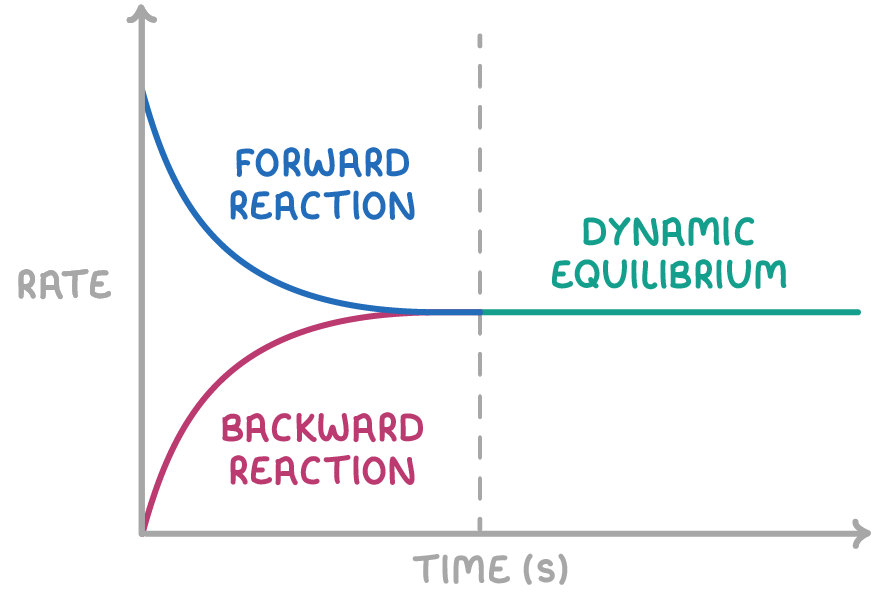
Regardless of the initial concentrations of reactants or products, the system will always reach the same equilibrium concentrations.
What the position of equilibrium tells us
The position of equilibrium refers to the relative amounts of reactants and products present at equilibrium. It indicates whether the equilibrium favours the formation of products (right) or the reformation of reactants (left).
- If the equilibrium position lies to the right, the concentration of products is higher than that of reactants.
- If the equilibrium position lies to the left, the concentration of reactants is higher than that of products.