7.2 - The Valence Shell Electron Pair Repulsion Model
- 1
How the number and type of electron domains determine molecular shape
- 2
The valence shell electron pair repulsion model
- 3
Predicting the geometry of molecules and ions
- 4
The effect of multiple bonds on molecular shape
Molecular shape depends on electron domain arrangement
The three-dimensional shape of a molecule or ion depends on the number and arrangement of electron domains surrounding its central atom. An electron domain is a region of high electron density due to the presence of electron pairs.
These electron domains can be classified into two types:
- Non-bonding domains - Lone pairs of electrons that remain on the central atom.
- Bonding domains - Bonding pairs of electrons involved in forming covalent bonds with other atoms.
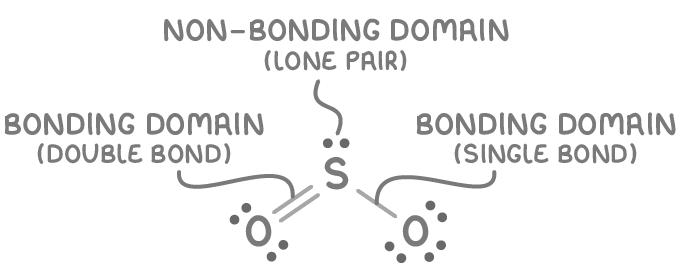
For instance, the sulfur dioxide molecule (SO2) has three electron domains around its central sulfur atom: two are bonding domains, and one is a non-bonding domain i.e., a lone pair. One of the bonding domains is a single bond, the other is a double bond.
The valence shell electron pair repulsion model
A molecule adopts a shape that minimises the repulsion between its electron domains due to their negative charge:
- Electron domains, whether bonding or lone, repel each other.
- Non-bonding domains cause more repulsion than bonding domains because they are closer to the nucleus.
- Electron domains arrange themselves as far apart as possible to minimise repulsion.
Repulsion decreases in this order:
Lone pair-lone pair > Lone pair-bonding pair > Bonding pair-bonding pair.
Consequently, lone pairs occupy more space, affecting the molecule's shape by compressing bond angles. This principle underpins the valence shell electron pair repulsion (VSEPR) model, which helps predict molecular geometry.
Examples include methane (CH4), ammonia (NH3), and water (H2O), which differ in bond angle and shape despite each having four electron domains around the central atom due to the varying number of lone pairs.
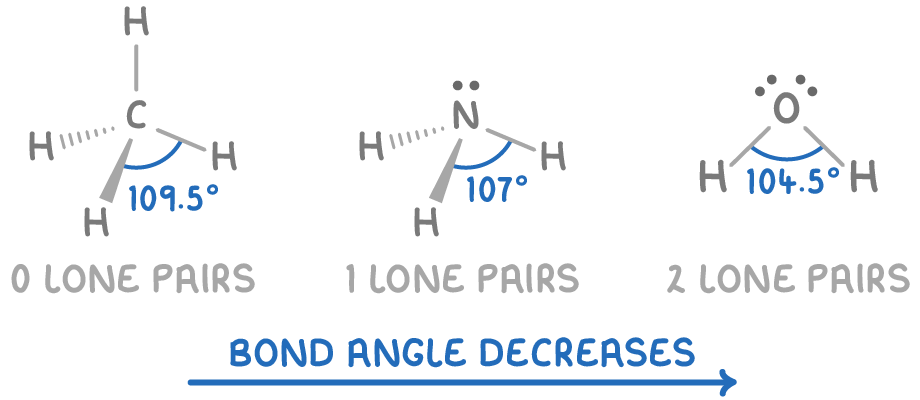
| Molecule | Electron domains | Bond angle (°) |
|---|---|---|
| CH_4_ | 4 bonding, 0 lone | 109.5 |
| NH_3_ | 3 bonding, 1 lone | 107 |
| H_2_O | 2 bonding, 2 lone | 104.5 |
Determining the number of electron domains
To predict the shape of a molecule or ion, first determine the total number of electron domains (bonding + non-bonding) on the central atom using these steps:
- Identify the central atom bonded to all other atoms.
- Find the number of valence electrons of the central atom using its group number.
- Add one electron for each bonded atom.
- If the species is an ion, add one electron for each negative charge or subtract one electron for each positive charge.
- Divide the total number of electrons by two to get the total number of electron domains.
- Subtract the number of bonding pairs from the total number of electron domains to determine the number of lone pairs.
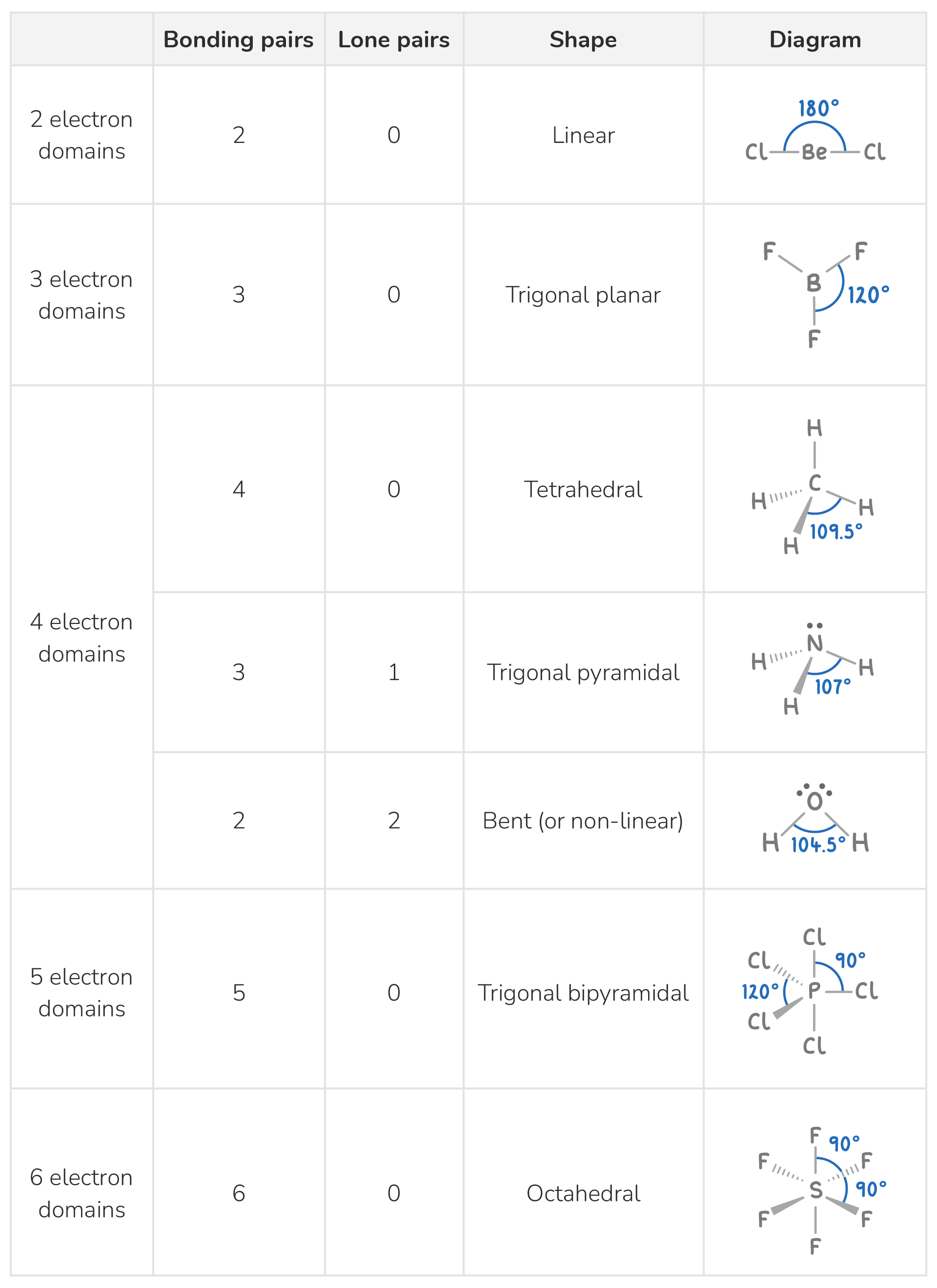
Based on the electron domain arrangement, the molecular shape can be predicted as follows:
Shapes of species with multiple bonds
When determining the overall shape of molecules or ions containing multiple bonds, treat each multiple bond as if it were a single electron pair.
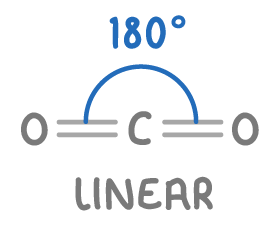
Example 1: Carbon dioxide (O=C=O)
- Each C=O double bond is treated as one electron pair.
- The central carbon atom therefore has 2 bonding pairs and 0 lone pairs.
- The CO2 molecule is linear with a 180° bond angle.
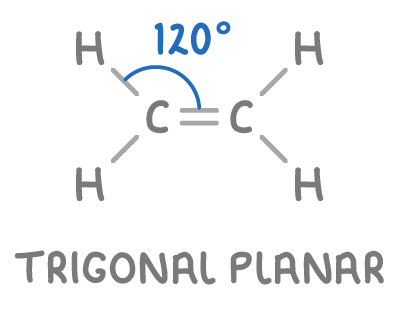
Example 2: Ethene (H2C=CH2)
- The C=C double bond is treated as one electron pair.
- Each carbon atom therefore has 3 bonding pairs and 0 lone pairs
- The ethene molecule is trigonal planar with 120° bond angles.
The effect of multiple bonds on molecular shape
Multiple bonds, such as double and triple bonds, count as a single electron domain despite containing multiple electron pairs. However, due to the increased electron density, multiple bonds exert a greater repulsive force compared to single bonds. This increased repulsion can cause bond angles to deviate from predicted values based on the number of electron domains alone.
For example, in ethene (C2H4), each carbon atom has three bonding domains: two C-H single bonds and one C=C double bond.
Although the valence electron pair repulsion model predicts a trigonal planar geometry with 120° bond angles, the actual H-C-H bond angle is slightly less than 120°, while the H-C=C bond angle is slightly greater.
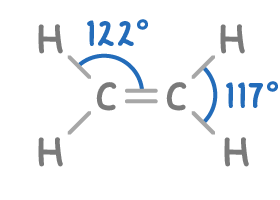
This deviation is caused by the greater repulsive force exerted by the double bond, which pushes the single bonds closer together and increases the angle between the double bond and the single bonds.
Worked example 1 - Predicting the shape of the OF2 molecule
Let's apply the steps to predict the shape of a oxygen difluoride (OF2) molecule.
Step 1: Identify the central atom
Oxygen (O) is the central atom.
Step 2: Calculate total valence electrons
Oxygen is in group 6, hence it has 6 valence electrons
Step 3: Add electrons for each fluorine atom
Each fluorine atom contributes one electron, adding 2 electrons for 2 fluorines
Total electrons = 6 (from O) + 2 (from 2 F) = 8 electrons
Step 4: Calculate total electron domains
$\text{Total electron domains }=\frac{8}{2}=4\text{ electron domains}$
Step 5: Deduce bonding and non-bonding domains
2 fluorine atoms mean 2 bonding domains, so 4 $-$ 2 = 2 lone pairs.
Step 6: Predict the molecular shape
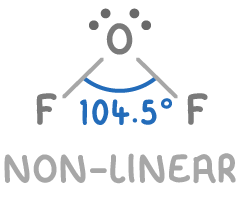
With 2 bonding and 2 non-bonding domains, OF2 has a bent or non-linear shape with an approximate bond angle of 104.5°.
Worked example 2 - Predicting the shape of the NH4+ ion
Predicting the shape of an ammonium (NH_4_^+^) ion involves similar steps.
Step 1: Identify the central atom
Nitrogen (N) is the central atom
Step 2: Calculate total valence electrons
Nitrogen is in group 5, hence it has 5 valence electrons
Step 3: Add electrons for each hydrogen atom
Each hydrogen atom contributes one electron, adding 4 electrons for 4 hydrogens
Total electrons = 5 (from N) + 4 (from 4 H) = 9 electrons
Step 4: Adjust for charge on the ion
The ammonium ion has a +1 charge, meaning we subtract one electron
Total electrons after charge adjustment = 9 $-$ 1 = 8 electrons
Step 5: Calculate total electron domains
$\text{Total electron domains }=\frac{8}{2}=4\text{ electron domains}$
Step 6: Deduce bonding and non-bonding domains
All 4 electron domains are used for bonding with hydrogen atoms, leaving 0 lone pairs.
Step 7: Predict the molecular shape
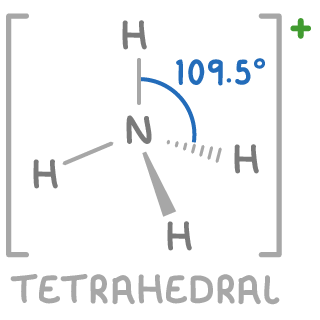
With 4 bonding domains and 0 non-bonding domains, the NH_4_^+^ ion has a tetrahedral shape with bond angles of approximately 109.5°.