19.2 - The pH Scale
- 1
The pH scale and its relationship to [H+]
- 2
Calculating pH from [H+] and vice versa
- 3
Measuring pH using pH meters and universal indicator
- 4
The ionic product of water (Kw)
- 5
How acids and bases affect [H+] and [OH-]
The pH scale
The concentration of hydrogen ions ([H+]) in aqueous solutions can vary over a wide range. To simplify working with these values, [H+] is often expressed using the pH scale:
$pH = -log[H^{+}]$
Where [H+] is the concentration of hydrogen ions in mol dm^-3^.
The pH scale typically ranges from 0 to 14 in aqueous solutions, although extremely acidic solutions can have negative pH values.
Aqueous solutions can be classified as acidic, neutral, or basic according to their pH values:
| Solution type | pH value | Relative ion concentrations |
|---|---|---|
| acidic | pH < 7 | [H^+^] > [OH^-^] |
| neutral | pH = 7 | [H^+^] = [OH^-^] |
| basic | pH > 7 | [H^+^] < [OH^-^] |
Calculating pH from [H+] and vice versa
To calculate the pH of a solution from its [H+], use the equation:
$pH = -log[H^{+}]$
For example, the pH of a 0.1 mol dm-3 HCl solution would be:
pH = $-$log(0.1) = 1
Conversely, to find [H+] from pH, use the inverse logarithm:
[H+] = 10^-pH^
For example, the H+ concentration in a solution with pH 3 would be:
$[H^{+}] = 10^{-3}= 0.001\text{ mol dm}^{-3}$
Worked example 1 - Calculating the pH of a HCl solution
Calculate the pH of a 0.005 mol dm-3 HCl solution. Give your answer to 2 decimal places.
Step 1: Equation
pH = $-$log10([H+])
Step 2: Substitution and correct evaluation
pH = $-$log10(0.005) = 2.30
Worked example 2 - Calculating [H+] of a HCl solution
Calculate the hydrogen ion concentration of a HCl solution with a pH of 1.60. Give your answer to 3 significant figures.
Step 1: Equation
pH = $-$log10([H+])
Step 2: Rearrange equation
[H+] = 10-pH
Step 3: Substitution and correct evaluation
$[\text{H}^+] = 10^{-1.60} = 2.51 \times 10^{-2}\text{ mol dm}^{-3}$
Measuring pH
pH can be precisely measured using a pH meter, which consists of an electrode connected to an electronic meter that measures and displays the pH reading.
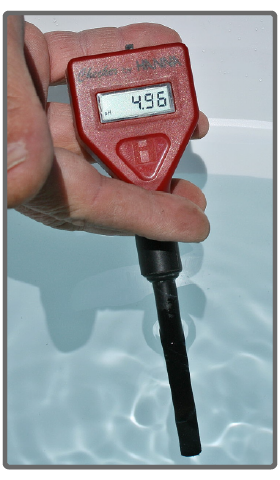
For more approximate measurements, universal indicator solution or paper can be used. Universal indicator changes colour depending on pH, allowing the pH of a solution to be estimated by comparing the colour to a standard chart.
The ionic product of water (Kw)
Pure water dissociates into H+ and OH- ions to a small extent:
H2O(l) ⇌ H+(aq) + OH^-^_(aq)_
The equilibrium constant (K) for this process is:
$K = \frac{[H^{+}][OH^{-}]}{[H_2{O]}}$
Rearranging gives:
K × [H2O] = [H+][OH-]
In dilute aqueous solutions, [H2O] is approximately constant at 55.5 mol dm^-3^.
Therefore, the product K × [H2O] is also a constant, denoted Kw:
Kw = [H+][OH-]
Kw is known as the ionic product of water. At 25°C, Kw has the value 1.00 × 10^-14^ mol^2^dm^-6^.
In pure water at 25°C, [H+] = [OH-], so each concentration equals the square root of Kw:
$[H^{+}] = [OH^{-}] = \sqrt{(1.00\times10^{-14})} = 1.00\times10^{-7}\text{ mol dm}^{-3}$
This corresponds to a pH of 7 (neutral).
Effect of acids and bases on [H+] and [OH-]
Adding an acid to water increases [H+], as acids donate protons. This shifts the water autoionisation equilibrium to the left, reducing [OH-] to maintain the Kw relationship.
For example, adding HCl to water:
HCl(aq) ➔ H+(aq) + Cl-(aq)
The resulting solution has [H+] > [OH-], and pH < 7.
Conversely, adding a base to water increases [OH-]. This reduces [H+], shifting the equilibrium to the right. The solution then has [H+] < [OH-] and pH > 7.
Worked example 3 - Calculating the pH of a NaOH solution
Calculate the pH of a 0.025 mol dm-3 NaOH solution at 25°C, given that Kw at this temperature is $1.0 \times 10^{-14}\text{ mol}^2\text{ dm}^{-6}$. Give your answer to 2 decimal places.
Step 1: Determine [OH-]
NaOH completely dissociates in water to release one OH- ion per molecule, meaning [OH-] = [NaOH] = 0.025 mol dm-3
Step 2: Rearrange Kw equation
$[\text{H}^+] = \frac{\text{K}_{\text{w}}}{[\text{OH}^-]}$
Step 3: Substitution and correct evaluation
$[\text{H}^+] = \frac{(1.0 \times 10^{-14})}{0.025} = 4.0 \times 10^{-13}\text{ mol dm}^{-3}$
Step 4: Calculate pH
$\text{pH }= -\text{log}_{10}([\text{H}^+]) = -\text{log}_{10}(4.0 \times 10^{-13}) = 12.40$