7.1 - Covalent Bonding & Molecules
- 1
What covalent bonding is
- 2
Lewis formulas
- 3
Double and triple covalent bonds
- 4
Relationship between number of bonds, bond strength and bond length
- 5
Coordination bonds
Covalent bonding allows atoms to share electrons
A covalent bond is the strong electrostatic attraction formed between a shared pair of electrons and the nuclei of the bonded atoms.
This bonding creates a stable molecule - a group of two or more atoms held together by covalent bonds.
Examples of covalently bonded molecules include:
- Chlorine (Cl2)
- Ammonia (NH3)
- Water (H2O)
- Methane (CH4)
Lewis formulas
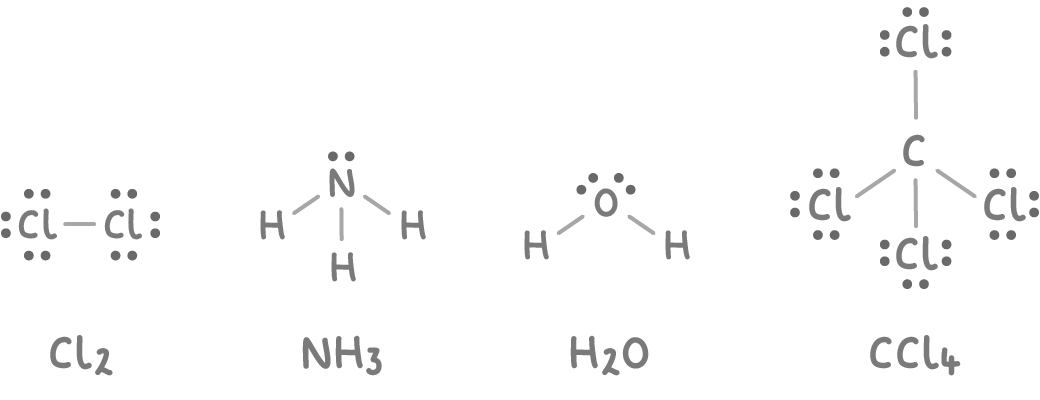
Lewis formulas are diagrams that show how valence (outer shell) electrons are arranged in a molecule, with electron pairs represented as dashes, dots, crosses, or a combination of these.
In these formulas:
- Only valence electrons are shown.
- Electrons are arranged in pairs.
- Each pair of electrons shared between two atoms represents a covalent bond.
- Bonding electrons are positioned between the bonded atoms.
- Non-bonding electrons (lone pairs) are positioned away from the bonded atoms.
Generally, atoms in Lewis formulas follow the octet rule, meaning they have 8 valence electrons (like noble gases).
Examples of lewis formulas include:
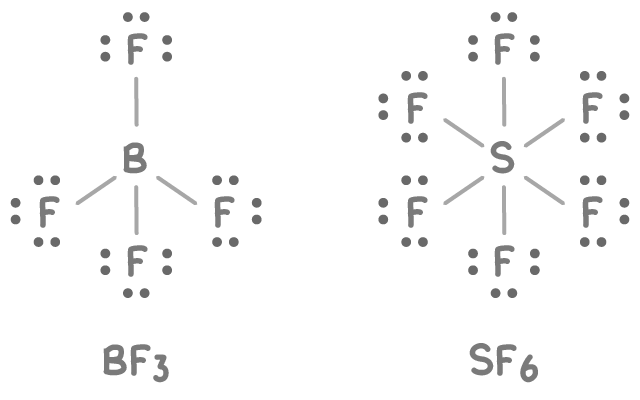
However, there are exceptions to the octet rule:
- Some atoms can form stable molecules with fewer than eight valence electrons (e.g., BF3).
- Larger atoms can form expanded octets (more than eight valence electrons, e.g., SF6).
Follow these steps to draw Lewis formulas:
- Calculate the total number of valence electrons for each atom in the molecule.
- Divide the total by two to determine the number of electron pairs.
- Arrange the atoms, placing the least abundant element in the centre. Hydrogen atoms always surround the central atom(s).
- Connect the central and peripheral atoms with single bonds (one electron pair each).
- Assign non-bonding pairs to the peripheral atoms until they achieve noble gas configurations.
- Assign any remaining electron pairs to the central atom(s).
- Ensure the central atom has a full octet. If not, try reassigning non-bonding pairs from peripheral atoms to form additional bonds or check if the molecule is an exception to the octet rule.
The Lewis formulas of polyatomic ions are enclosed in square brackets, with the charge indicated as a superscript outside the brackets. When counting valence electrons, add an electron for each negative charge and subtract an electron for each positive charge.
Worked example 1 - Drawing the Lewis formula of carbon dioxide
Draw the Lewis formula of carbon dioxide, CO_2_.
Step 1: Calculate total valence electrons
Carbon has 4 valence electrons, and each oxygen has 6 valence electrons.
Total valence electrons = 4 + 6 + 6 = 16
Step 2: Determine electron pairs
Number of electron pairs = $\frac{16}{2}$ = 8 pairs
Step 3: Arrange the atoms
Place the least abundant element (carbon) in the centre:

Step 4: Form single bonds
Each bond represents one electron pair (2 pairs used, 6 pairs remaining).
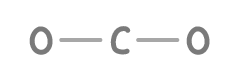
Step 5: Assign non-bonding pairs to oxygen atoms
Each oxygen needs 3 pairs to complete its octet (total 8 pairs used).

Step 6: Ensure full octet for central atom
Carbon has only 4 electrons (2 pairs) from single bonds. To complete its octet, form double bonds by sharing two more pairs from each oxygen.
The final Lewis formula for CO_2_ is:

Worked example 2 - Drawing the Lewis formula of the carbonate ion
Draw the Lewis formula of the carbonate ion, CO32-.
Step 1: Calculate total valence electrons
Carbon has 4 valence electrons, each oxygen has 6 valence electrons, and add 2 electrons for the 2- charge.
Total valence electrons = 4 + 6 + 6 + 6 + 2 = 24
Step 2: Determine electron pairs
Number of electron pairs = $\frac{24}{2}$ = 12 pairs
Step 3: Arrange the atoms
Place the least abundant element (carbon) in the centre and surround with oxygens:

Step 4: Form single bonds
Each bond represents one electron pair (3 pairs used, 9 pairs remaining).
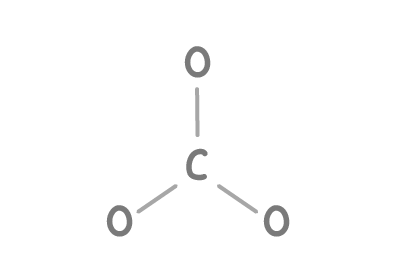
Step 5: Assign non-bonding pairs to oxygen atoms
Each oxygen needs 3 pairs to complete its octet (total 12 pairs used).
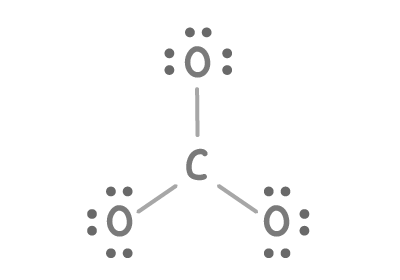
Step 6: Ensure full octet for central atom
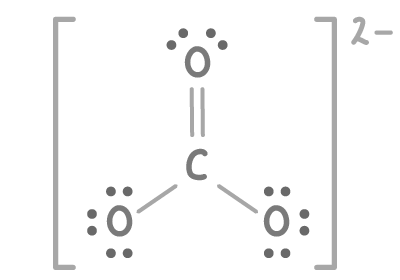
Carbon has only 4 electrons (2 pairs) from single bonds. To complete its octet, form one double bond by sharing two more pairs from one of the oxygen atoms.
The final Lewis formula for CO32- is:
Atoms can share multiple pairs of electrons
- The number of covalent bonds an atom forms depends on how many electrons it needs to fill its outer shell.
- Atoms can share multiple electron pairs to fill their outer shell, forming double or triple bonds.
For example:
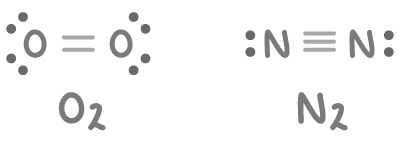
- Oxygen has 6 electrons in its outer shell and needs 2 more to complete it, so it forms a double bond by sharing 2 sets of electrons with another oxygen atom.
- Nitrogen has 5 electrons in its outer shell and needs 3 more to complete it, so it forms a triple bond by sharing 3 sets of electrons with another nitrogen atom.
Covalent bond strength, length, and number of bonds
The strength of a covalent bond depends on the amount of energy needed to break the bond, which is measured using bond enthalpy. Bond enthalpy is the energy required to break one mole of a particular covalent bond in the gaseous state. A higher bond enthalpy indicates a stronger covalent bond.
Bond length, the internuclear distance between two covalently bonded atoms, also provides information about the strength of a covalent bond. Stronger bonds tend to be shorter due to increased electrostatic attraction between the shared electron pair(s) and the nuclei, which pulls the atoms closer together.
The relationship between the number of bonds, bond length, and bond strength is as follows:
As the number of bonds between two atoms increases, the bond length decreases, and the bond strength increases. This is because more shared electron pairs result in a greater electrostatic attraction between the electrons and the nuclei, leading to a shorter and stronger bond.
This relationship is highlighted in the table below:
| Bond | Bond enthalpy (kJ mol^-1^) | Bond length (10^-12^ m) |
|---|---|---|
| C-C | 346 | 154 |
| C=C | 614 | 134 |
| C≡C | 839 | 120 |
The table demonstrates that as the number of bonds between carbon atoms increases from single to double to triple, the bond enthalpy increases (indicating stronger bonds) while the bond length decreases.
Coordination bonding
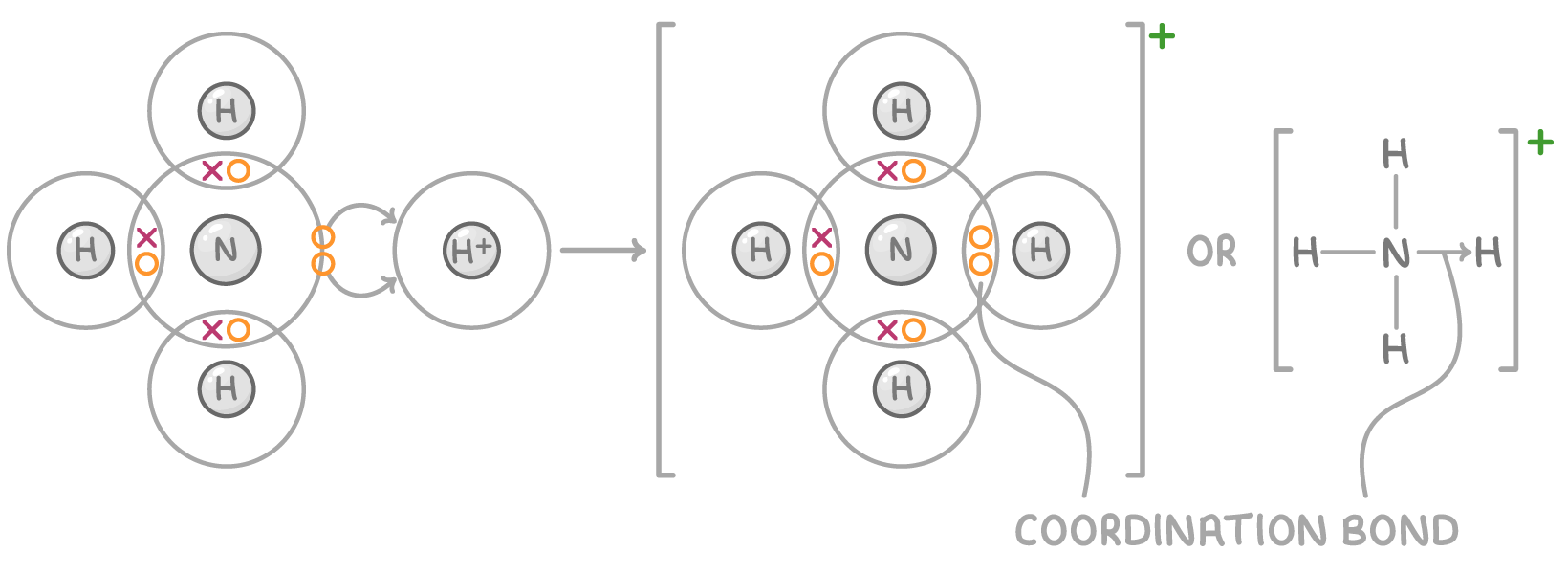
In coordination bonding, also called dative covalent bonding, both shared electrons come from just one of the bonding atoms rather than one electron coming from each atom.
For a coordination bond to form between two atoms, the following requirements must be met:
- One atom must have a lone pair of electrons to donate.
- The other atom must be electron deficient, (i.e., it must have an incomplete electron shell).
This type of bonding is represented by an arrow showing the direction of electron donation from the atom with the lone pair to the electron-deficient atom.
For example, in ammonium NH4+, the nitrogen atom provides both shared electrons to form a coordination bond with the hydrogen ion (H+):
Coordination bonds in transition element complexes
Transition elements can form complex ions containing coordination bonds, which hold together the central metal cation and the surrounding atoms or groups of atoms called ligands. Ligands have a lone pair of electrons that can be used to form the coordination bond with the metal ion.
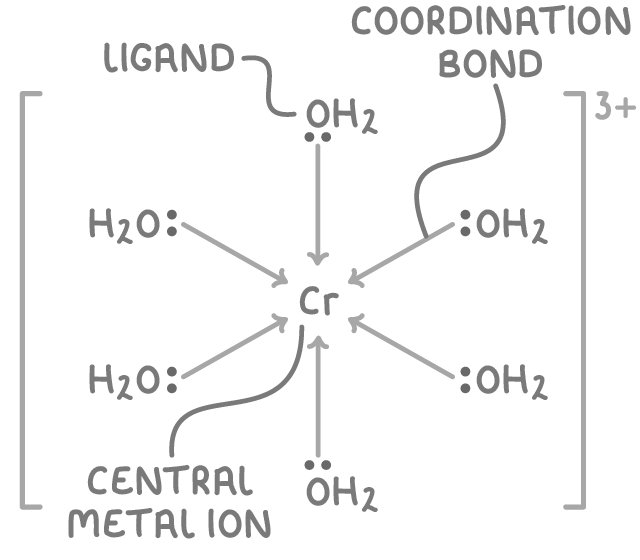
A common example of a transition element complex is [Cr(H2O)6]3+. In this complex, six water molecules (H2O) act as ligands, each forming a coordination bond with the central chromium(III) cation (Cr3+) through their oxygen atoms. The resulting complex ion has an overall charge of 3+.