20.7 - Reduction of Organic Compounds
- 1
The reduction of ketones to secondary alcohols
- 2
The reduction of carboxylic acids to primary alcohols
- 3
The reduction of alkenes and alkynes to alkanes
Reduction of ketones and carboxylic acids
Ketones and carboxylic acids can be reduced to alcohols by the addition of hydrogen. These reduction reactions are the reverse of the corresponding oxidation processes.
Reduction of ketones to secondary alcohols:
- Ketones contain a carbonyl group (C=O), which can be reduced to a hydroxyl group (-OH).
- This forms a secondary alcohol with the general formula R-CH(OH)-R'.
- The reaction requires a reducing agent, represented by [H], which provides the necessary hydrogen atoms.
- In this reaction, hydride ions (H-) act as nucleophiles, transferring a hydrogen atom and two electrons to the carbonyl group, converting it to a hydroxyl group.
The general equation for this reaction is:
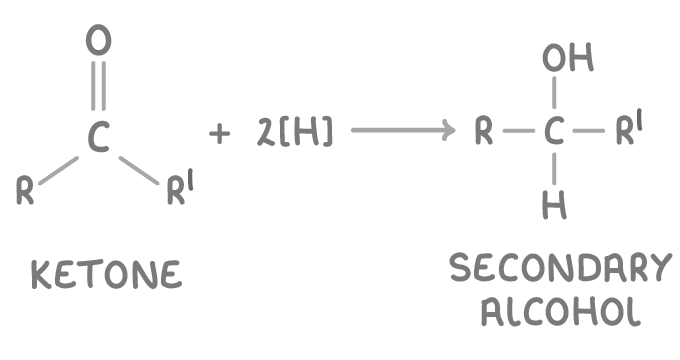
For example, the equation representing the reduction of propanone to propan-2-ol is:
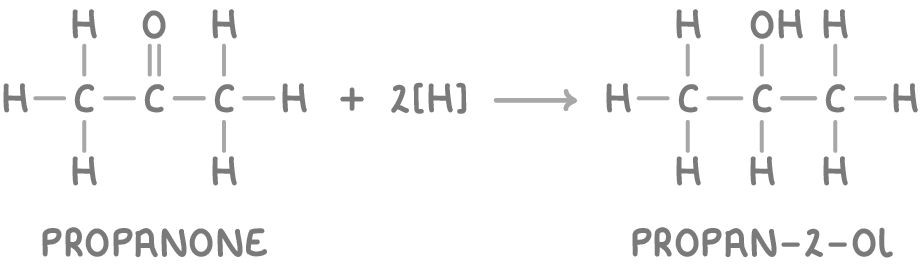
Reduction of carboxylic acids to primary alcohols:
- Carboxylic acids are reduced to primary alcohols through a two-step reaction process.
- In the first step, the carboxyl group (-COOH) is reduced to a carbonyl group (-CHO), forming an aldehyde intermediate.
- In the second step, the aldehyde's carbonyl group is further reduced to a hydroxyl group, resulting in the formation of a primary alcohol.
The general equation for this reaction is:
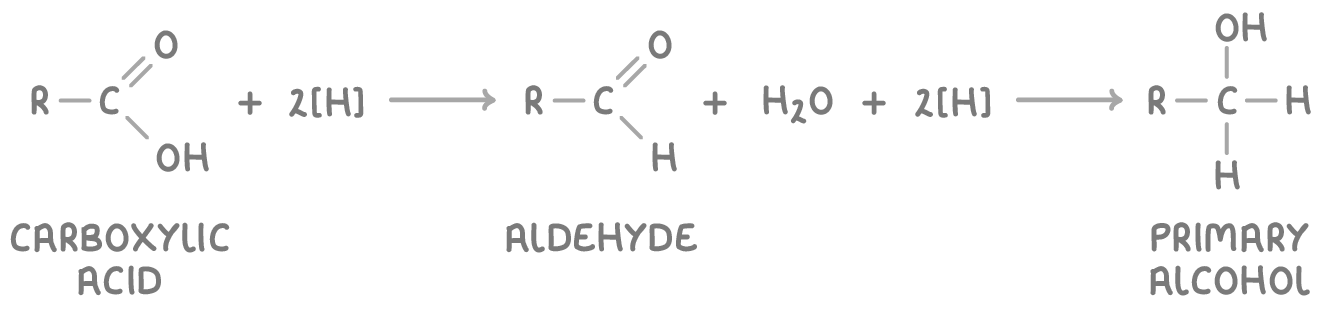
For example, the equation representing the reduction of propanoic acid to propan-1-ol is:
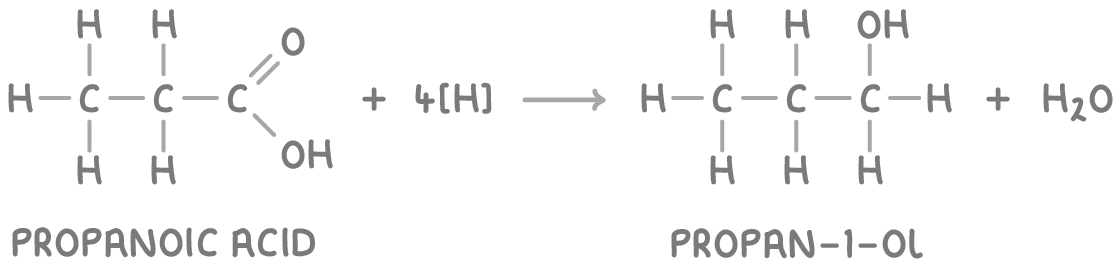
Reduction of alkenes and alkynes
Alkenes (C=C) and alkynes (C≡C) are unsaturated compounds that can be reduced by the addition of hydrogen to their multiple bonds.
Reduction of alkenes to alkanes:
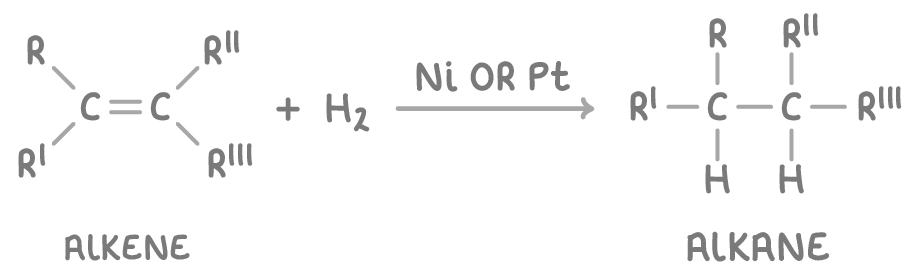
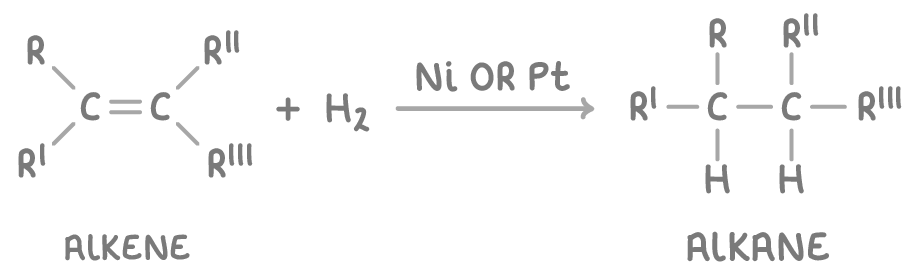
Alkenes can be reduced to alkanes using hydrogen gas (H2) and a transition metal catalyst like nickel or platinum.
The general equation for this reaction is:
For example, the equation representing the reduction of ethene to ethane is:
Reduction of alkynes to alkenes:
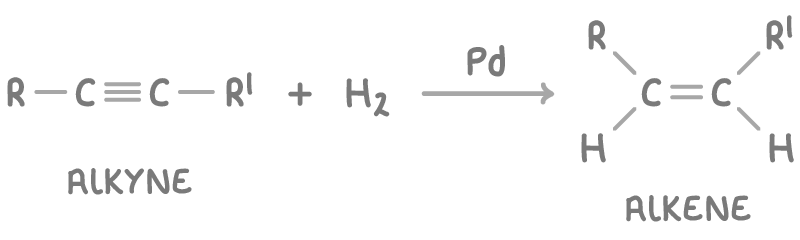
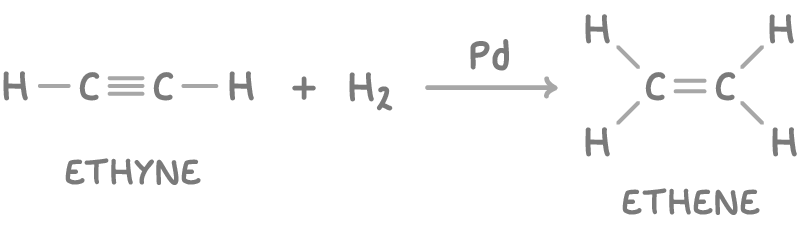
Alkynes can be reduced to alkenes using hydrogen gas (H2) and a deactivated palladium catalyst.
The general equation for this reaction is:
For example, the equation representing the reduction of ethyne to ethene is:
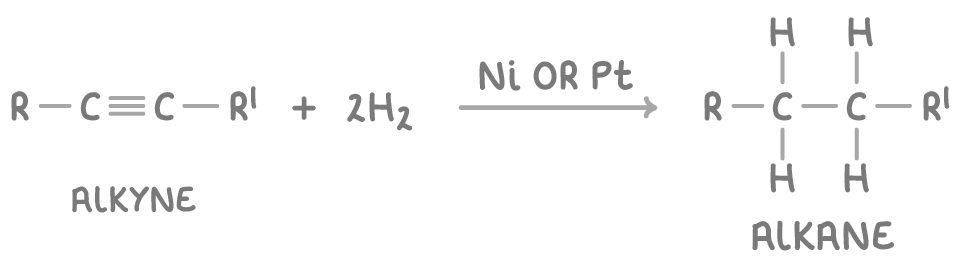
Reduction of alkynes to alkanes:
Alkynes can be directly reduced to alkanes using excess hydrogen gas (H2) and the same nickel or platinum catalysts used for alkene reduction.
The general equation for this reaction is:
For example, the equation representing the reduction of ethyne to ethane is:
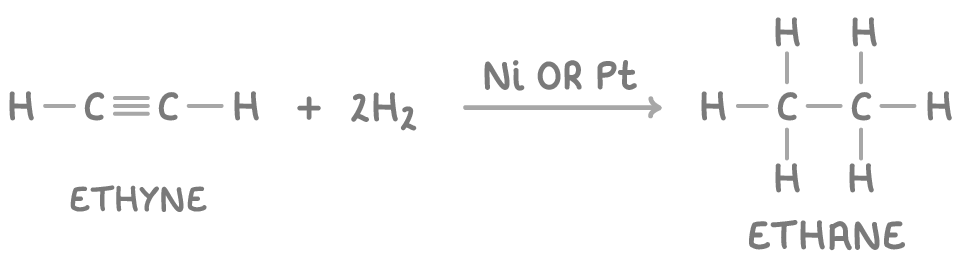
Reducing alkenes and alkynes decreases the degree of unsaturation in these compounds, as the multiple bonds are converted to single bonds through the addition of hydrogen atoms.