14.4 - Fuel Cells
- 1
What fuel cells are
- 2
How hydrogen and direct-methanol fuel cells work
- 3
Comparing the energy density and specific energy of different fuels
Fuel cells
Fuel cells are a type of electrochemical cell that convert the chemical energy of a fuel directly into electrical energy.
In contrast, primary cells, which have a limited lifespan due to the irreversible nature of their reactions, fuel cells can produce electricity continuously as long as fuel is supplied from an external source.
You need to know know about two types of fuel cell:
- Hydrogen fuel cells - These use hydrogen gas as a fuel source.
- Methanol fuel cells - These use liquid methanol as a fuel source.
How hydrogen fuel cells work
Hydrogen fuel cells use hydrogen and oxygen gases as fuel to generate water, electricity, and heat.
The process includes the following steps:
- Hydrogen oxidation at the anode - At the anode, hydrogen (H2) is split into protons (H+) and electrons (e-) with the help of a platinum catalyst.
- Proton migration through the electrolyte - The protons (H+) move through the polymer electrolyte membrane, which only allows protons to pass. This forces the electrons (e-) to travel through an external circuit to get to the cathode.
- Electron flow through the external circuit - The electrons flowing through the external circuit generate an electric current that can power devices.
- Oxygen reduction at the cathode - Oxygen (O2) at the cathode combines with the protons (H+) from the anode and the electrons (e-) from the circuit to produce water (H2O), the only waste product.
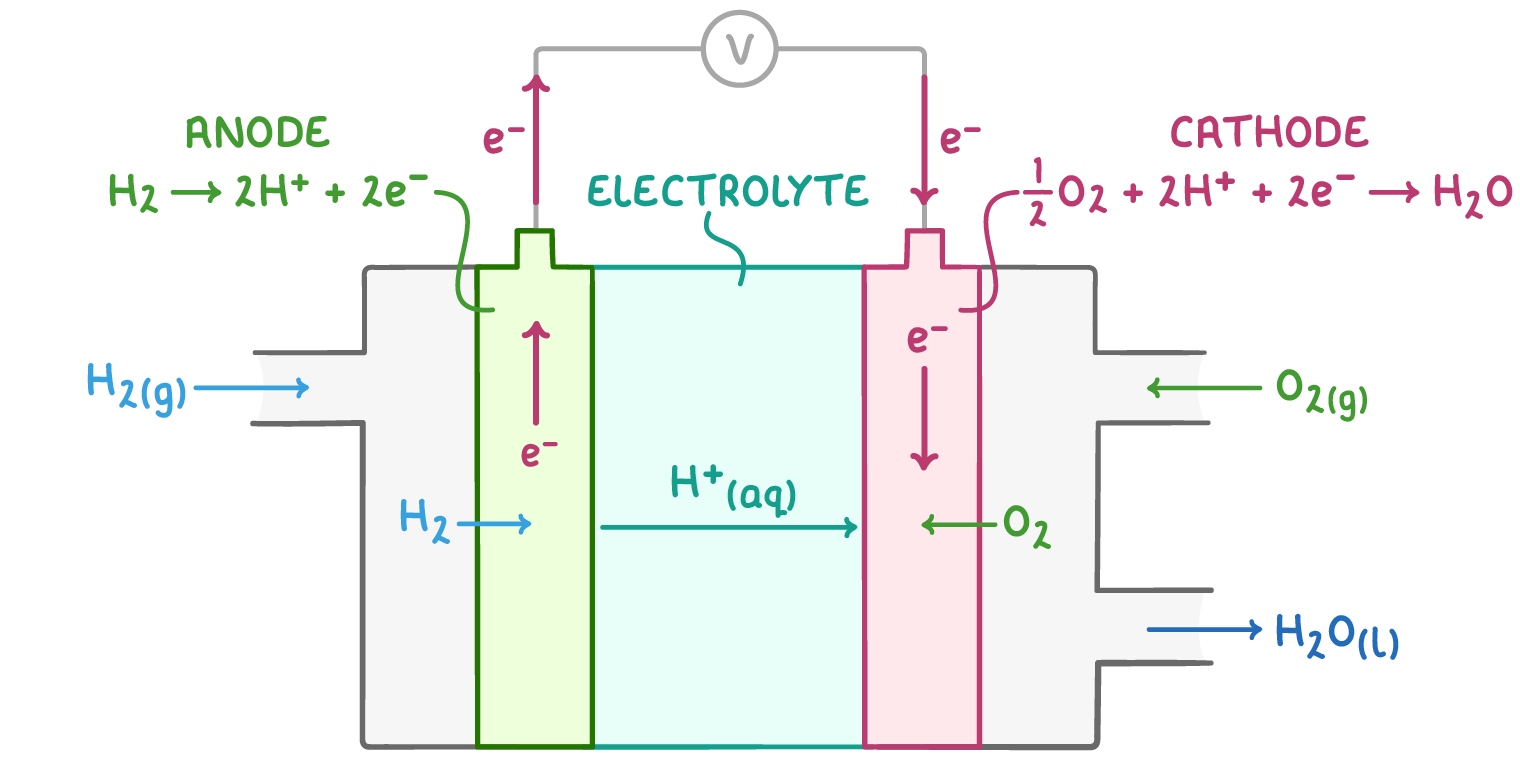
The overall reaction in the fuel cell is the formation of water from hydrogen and oxygen:
2H2(g) + O2(g) ➔ 2H2O(l)
The specific reactions at each electrode are:
- Anode: H2(g) ➔ 2H+(aq) + 2e-
- Cathode: 1⁄2O2(g) + 2H+(aq) + 2e- ➔ H2O(l)
Hydrogen fuel cells are a clean energy source, producing only water as a byproduct. However, hydrogen gas is often produced through environmentally unsustainable methods, such as steam reforming of methane, which releases carbon dioxide.
How direct-methanol fuel cells work
In a direct methanol fuel cell (DMFC), methanol is used as the fuel source instead of hydrogen gas. DMFCs operate on the same basic principles as hydrogen fuel cells, with the key difference being that methanol is oxidised at the anode to produce hydrogen ions (H^+^), electrons, and carbon dioxide.
The overall reaction in the fuel cell is the formation of water from methanol and oxygen:
CH3OH(g) + 3⁄2O2(g) ➔ CO2(g) + 2H2O(l)
The specific reactions at each electrode are:
- Anode: CH_3_OH_(aq)_ + H_2_O_(l)_ ➔ CO_2(g)_ + 6H^+^_(aq)_ + 6e^−^
- Cathode: 3⁄2O_2(g)_ + 6H^+^_(aq) _+ 6e^−^ ➔ 3H_2_O_(l)_
Methanol can also undergo steam reforming at 250°C to supply H_2_ gas for hydrogen fuel cells, producing some CO_2_ and CO.
Comparing fuel sources
When comparing fuels, two key measures are:
- Energy density - Energy released per unit volume (MJ dm^-3^).
- Specific energy - Energy released per unit mass (MJ kg^-1^).
The energy density and specific energy of some common fuels are shown in the table below.
| Fuel source | Energy density (MJ dm^-3^) | Specific energy (MJ kg^-1^) |
|---|---|---|
| Compressed hydrogen | 1.9 | 120 |
| Methanol | 16 | 20 |
| Petrol | 32 | 46 |
- Hydrogen has a very high specific energy (120 MJ kg-1) as 1 mol of H_2_ fuel weighs only 2.02 g, compared to 32.1 g for 1 mol of methanol or ~110 g for 1 mol of petrol.
- However, 1 mol of H_2_ gas occupies about 24 dm^3^ at room temperature and pressure, requiring very large or highly compressed storage tanks. Even compressed, H_2_ takes up more space than liquid fuels. The same 24 dm^3^ tank could hold over 545 mol of methanol.
- While petrol has the highest energy density, it comes with environmental problems.
- Although hydrogen seems promising based on specific energy, its low energy density poses storage challenges for applications like vehicles.