19.1 - Acids & Bases
- 1
The Brønsted-Lowry definitions of acids and bases
- 2
Representing protons in aqueous solution
- 3
The difference between bases and alkalis
- 4
Conjugate acid-base pairs
- 5
Amphiprotic and amphoteric species
Brønsted-Lowry acids and bases
In 1923, Johannes Brønsted and Martin Lowry independently proposed definitions of acids and bases based on the transfer of protons (H+ ions):
- A Brønsted-Lowry acid is a proton donor.
- A Brønsted-Lowry base is a proton acceptor.
For example, in the reaction between gaseous hydrogen chloride and ammonia:
HCl(g) + NH3(g) ➔ NH4Cl(s)
- Hydrogen chloride acts as a Brønsted-Lowry acid by donating a proton: HCl(g) ➔ H+ + Cl−
- Ammonia acts as a Brønsted-Lowry base by accepting a proton: NH3(g) + H+ ➔ NH4+
The resulting ammonium and chloride ions then combine to form a salt, ammonium chloride: NH4+ + Cl− ➔ NH4Cl(s)
Worked example 1 - Deducing Brønsted-Lowry acids and bases
The neutralisation of nitric acid with sodium hydroxide is shown below:
HNO3(aq) + NaOH(aq) ➔ NaNO3(aq) + 2H2O(l)
Deduce the Brønsted-Lowry acid and base in this reaction.
Step 1: Deduce the Brønsted-Lowry acid
Nitric acid (HNO3) donates a proton, so it acts as a Brønsted-Lowry acid: HNO3(aq) ➔ H+(aq) + NO3−(aq)
Step 1: Deduce the Brønsted-Lowry base
Sodium hydroxide (NaOH) dissociates in water to form sodium ions (Na+) and hydroxide ions (OH−):
NaOH(aq) ➔ Na+(aq) + OH−(aq)
The hydroxide ion (OH−) accepts a proton, so it acts as a Brønsted-Lowry base: OH−(aq) + H+(aq) ➔ H2O(l)
Representing protons in aqueous solution
Free protons (H+) cannot exist on their own in aqueous solution as they are immediately attracted to the lone pairs on water molecules. Instead, they react with water molecules to form hydronium ions (H3O+):
H+(aq) + H2O(l) ➔ H3O+(aq)
Therefore, a proton in aqueous solution can be represented as either H+(aq) or H3O+(aq).
For example, the ionisation of hydrochloric acid in water can be written as:
HCl(aq) + H2O(l) ➔ H3O+(aq) + Cl−(aq)
The difference between bases and alkalis
Bases and alkalis are both proton acceptors, but they differ in their solubility:
- Bases are proton acceptors that may or may not be soluble in water.
- Alkalis are bases that are soluble in water, usually referring to the hydroxides of group 1 and group 2 metals.
So while all alkalis are bases, not all bases are alkalis.
For example, copper(II) oxide (CuO) is a base as it can accept protons, but it is insoluble in water so it is not an alkali.
Conjugate acid-base pairs
When Brønsted-Lowry acids and bases react together, they form conjugate acid-base pairs on opposite sides of the reaction equation:
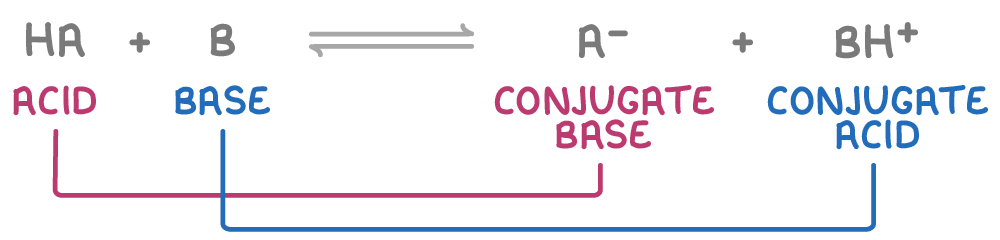
- When a Brønsted-Lowry acid (HA) donates a proton it forms a substance with one less proton, called its conjugate base (A-).
- Similarly, when a Brønsted-Lowry base (B) accepts a proton it forms a substance with one more proton (BH+), called its conjugate acid.
- The acid and base that differ by a single proton are referred to as a conjugate acid-base pair.
For example, when ethanoic acid (CH3COOH) reacts with water:

In this reaction:
- CH3COOH is the acid (proton donor) and CH3COO- is its conjugate base.
- H2O is the base (proton acceptor) and H3O+ is its conjugate acid.
Key points:
- The conjugate base always has one less H+ than its conjugate acid.
- The conjugate acid always has one more H+ than its conjugate base.
Amphiprotic species act as Brønsted-Lowry acids and bases
Some species can act as both Brønsted-Lowry acids and bases. There are two terms used to describe such species:
- Amphiprotic species are those that can both donate and accept protons. Water is an example of an amphiprotic species:
- As an acid (proton donor): H2O(l) ⇌ H+(aq) + OH-(aq)
- As a base (proton acceptor): H2O(l) + H+(aq) ⇌ H3O+(aq)
Other examples of amphiprotic species include the hydrogen carbonate ion (HCO3-) and the hydrogen sulfate ion (HSO4-).
2. Amphoteric species are those that can react with both acids and bases, but do not necessarily donate or accept protons. All amphiprotic species are amphoteric, but not all amphoteric species are amphiprotic.
For example, aluminium oxide (Al2O3) can react with both acids and bases, so it is amphoteric:
- With acid: Al2O3(s) + 6HCl(aq) ➔ 2AlCl3(aq) + 3H2O(l)
- With base: Al2O3(s) + 2NaOH(aq) ➔ 2NaAlO2(aq) + H2O(l)
However, Al2O3 does not contain any ionisable hydrogen atoms, so it cannot donate a proton and therefore is not amphiprotic.