13.2 - Hess' Law
- 1
The concept of Hess' law
- 2
Applying Hess' law using the summation of equations method
- 3
Applying Hess' law using the enthalpy cycle diagram method
- 4
Standard enthalpy changes of combustion and formation
- 5
Applying Hess' law to enthalpy changes of combustion and formation
Hess' law says route doesn't affect ΔH
Hess' law states that no matter which route a chemical reaction takes, the enthalpy change will always be the same, provided the initial and final states of the system are identical.
This law is based on the principle that enthalpy is a state function, meaning the change depends only on the initial and final states, not on the path taken.
For instance, the overall reaction for the oxidation of sulfur, S(s), to sulfur trioxide, SO3(l), can be carried out in two steps:
Step 1: S(s) + O2(g) ➔ SO2(g)
Step 2: SO2(g) + ½O2(g) ➔ SO3(l)
Adding these two steps gives the overall reaction:
S(s) + 3⁄2O2(g) ➔ SO3(l)
Based on Hess' law, the sum of the enthalpy changes for step 1 and step 2 will be equal to the enthalpy change of the overall reaction.
Applying Hess' law - Summation of equations method
One way to apply Hess' law is by the summation of equations method. This involves manipulating known equations and their enthalpy changes to determine the enthalpy change for a target reaction.
The steps are:
- Identify equations containing the reactants and products of the target reaction.
- If needed, reverse equations to make the desired species a product - remember to also reverse the sign of ΔH.
- If needed, multiply equations by coefficients to obtain the correct stoichiometry - remember to multiply ΔH by the same factor.
- Add the modified equations together, cancelling out common species on both sides.
- The ΔH of the final equation is the sum of the modified ΔH values.
Worked example 1 - Calculating ΔH using the summation of equations
Calculate ΔH for the reaction: 2C(s) + 2H2(g) + O2(g) ➔ CH3COOH(l) using the following equations:
| Equation | ΔH (kJ mol^-1^) |
|---|---|
| CH_3_COOH_(l)_ + 2O_2(g)_ ➔ 2CO_2(g)_ + 2H_2_O_(l)_ | -875 |
| C_(s)_ + O_2(g)_ ➔ CO_2(g)_ | -394 |
| H_2(g)_ + ½O_2(g)_ ➔ H_2_O_(l)_ | -286 |
Step 1: Modify equations to match target reaction
- Equation 1 needs to be reversed and ΔH sign changed:
2CO2(g) + 2H2O(l) ➔ CH3COOH(l) + 2O2(g) ΔH = +875 kJ mol-1
- Equation 2 needs to be multiplied by 2 to match the stoichiometry of the target:
2C(s) + 2O2(g) ➔ 2CO2(g) ΔH = $-$788 kJ mol-1
- Equation 3 needs to be multiplied by 2 to match the stoichiometry of the target:
2H2(g) + O2(g) ➔ 2H2O(l) ΔH = $-$572 kJ mol-1
Step 2: Add the modified equations
2C(s) + 3O2(g) + 2H2(g) + 2CO2(g) + 2H2O(l) ➔ 2CO2(g) + 2H2O(l) + CH3COOH(l) + 2O2(g)
Step 3: Cancel out common species
2C(s) + 2H2(g) + O2(g) ➔ CH3COOH(l)
ΔH = 875 + ($-$788) + ($-$ 572) = $-$485 kJ mol-1.
Applying Hess' law - Enthalpy cycle diagram method
The enthalpy cycle diagram method is an alternative way to apply Hess' law. This approach uses a graphical representation of the enthalpy changes between reactants, products, and intermediates.
The steps are:
- Write the target reaction and any intermediate species below it.
- Draw arrows representing the known equations and label with their ΔH values - adjust arrow directions and ΔH signs if equations were reversed.
- Calculate ΔH for the target reaction by summing the ΔH values, following the path from reactants to products via the intermediates - reverse the sign of ΔH if going against an arrow.
Worked example 2 - Calculating ΔH using an enthalpy cycle diagram
Calculate ΔH for the reaction: 2C(s) + 2H2(g) + O2(g) ➔ CH3COOH(l) using the following equations:
| Equation | ΔH (kJ mol^-1^) |
|---|---|
| CH_3_COOH_(l)_ + 2O_2(g)_ ➔ 2CO_2(g)_ + 2H_2_O_(l)_ | -875 |
| C_(s)_ + O_2(g)_ ➔ CO_2(g)_ | -394 |
| H_2(g)_ + ½O_2(g)_ ➔ H_2_O_(l)_ | -286 |
The enthalpy cycle diagram is:
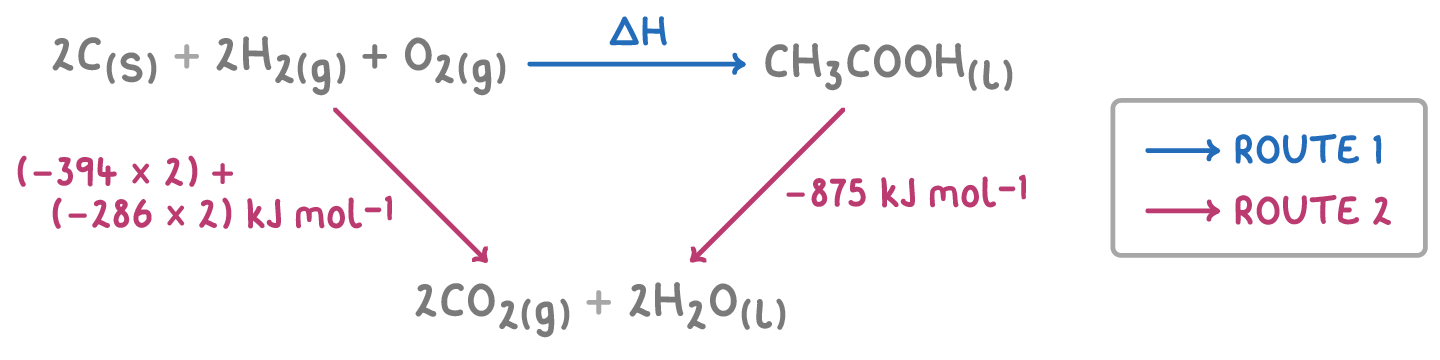
From the diagram, ΔH for the target reaction (route 1) is:
$\Delta{H}=(-394\times2) + (-286\times2) - (-875) = -788 - 572 + 875 = -485\text{ kJ mol}^{-1}$.
This matches the result from the summation of equations method, confirming Hess' law.
Standard enthalpy changes of combustion (ΔH⦵c)
The standard enthalpy of combustion (ΔH⦵c) is defined as the enthalpy change when one mole of a substance in its standard state undergoes complete combustion in oxygen. Standard states refer to conditions of 25°C (298 K) and 100 kPa.
For example, the equation representing the ΔH⦵c of propane (C3H8):
C3H8(g) + 5O2(g) ➔ 3CO2(g) + 4H2O(l) ΔH⦵c = $-$2,220 kJ mol-1
The negative ΔH⦵c value indicates that this is an exothermic reaction, meaning it releases heat to the surroundings.
Standard enthalpy changes of formation (ΔH⦵f)
The standard enthalpy of formation (ΔH⦵f) is defined as the enthalpy change when one mole of a compound forms from its constituent elements in their standard states.
For example, the equation representing the ΔH⦵f of propane is:
3C(s) + 4H2(g) ➔ C3H8(g) ΔH⦵f = $-$104 kJ mol-1
It's important to note that the ΔH⦵f for all elemental substances in their standard states is defined as 0 kJ mol-1.
Applying Hess' law to enthalpy changes of combustion and formation
Hess' law allows us to use ΔH⦵c and ΔH⦵f data to calculate the enthalpy change of any reaction (ΔH⦵r).
Using ΔH⦵c values:
ΔH⦵r = ∑(ΔH⦵c reactants) $-$ ∑(ΔH⦵c products)
Using ΔH⦵f values:
ΔH⦵r = ∑(ΔH⦵f products) $-$ ∑(ΔH⦵f reactants)
These relationships directly result from Hess' law and the conservation of energy principle.
Worked example 3 - Calculating ΔH⦵ using enthalpy of formation data
Calculate ΔH⦵r for the reaction:
SO2(g) + 2H2S(g) ➔ 3S(s) + 2H2O(l)
Given:
ΔH⦵f(SO2(g) = $-$297 kJ mol-1
ΔH⦵f(H2S(g)) = $-$20.2 kJ mol-1
ΔH⦵f(H2O_(l)_) = $-$286 kJ mol^-1^
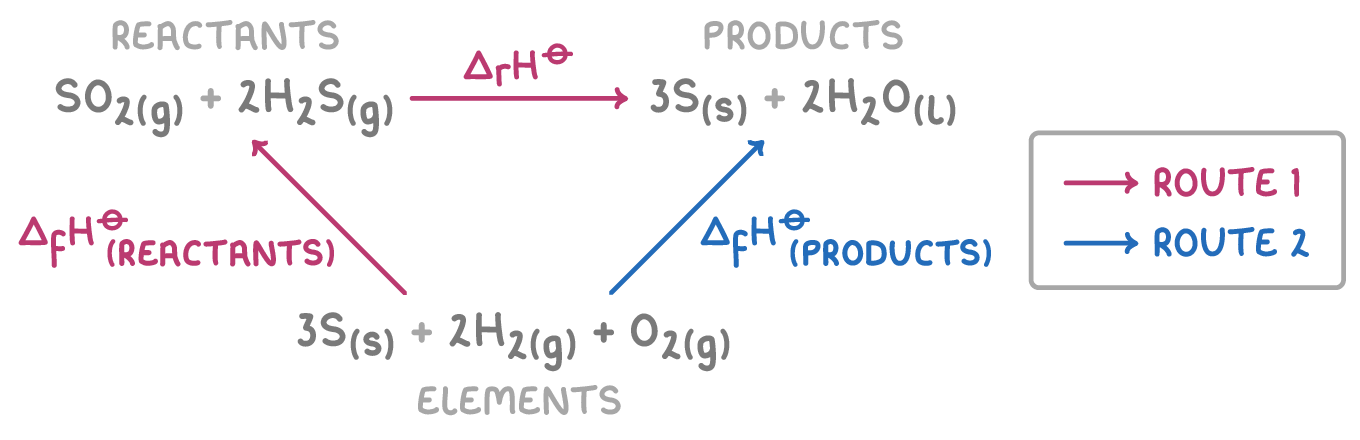
This diagram shows the reaction pathway from reactants to products. We can use Hess' law and known enthalpy values to calculate ΔH⦵ for this reaction.
Step 1: Equation
ΔH⦵r = ΣΔH⦵f(products) $-$ ΣΔH⦵f(reactants)
Step 2: Substitution and correct evaluation
ΔH⦵f(products) = 3(0) + 2($-$286) = $-$572 kJ mol^-1^
ΔH⦵f(reactants) = $-$297 + 2($-$20.2) = $-$337.4 kJ mol^-1^
Step 3: Determine the overall ΔH⦵
ΔH⦵ = $-$572 + 337.4 = $-$234.6 kJ mol^-1^
Therefore, the ΔH⦵ for the reaction is $-$235 kJ mol^-1^
Worked example 4 - Calculating ΔH⦵ using enthalpy of combustion data
Calculate ΔH⦵r for the reaction:
C2H5OH(l) + 3O2(g) ➔ 2CO2(g) + 3H2O(l)
Given:
ΔH⦵c(C_2_H_5_OH) = $-$1,367 kJ mol^−1^
ΔH⦵c(C) = $-$394 kJ mol^−1^
ΔH⦵c(H_2_) = $-$286 kJ mol^−1^
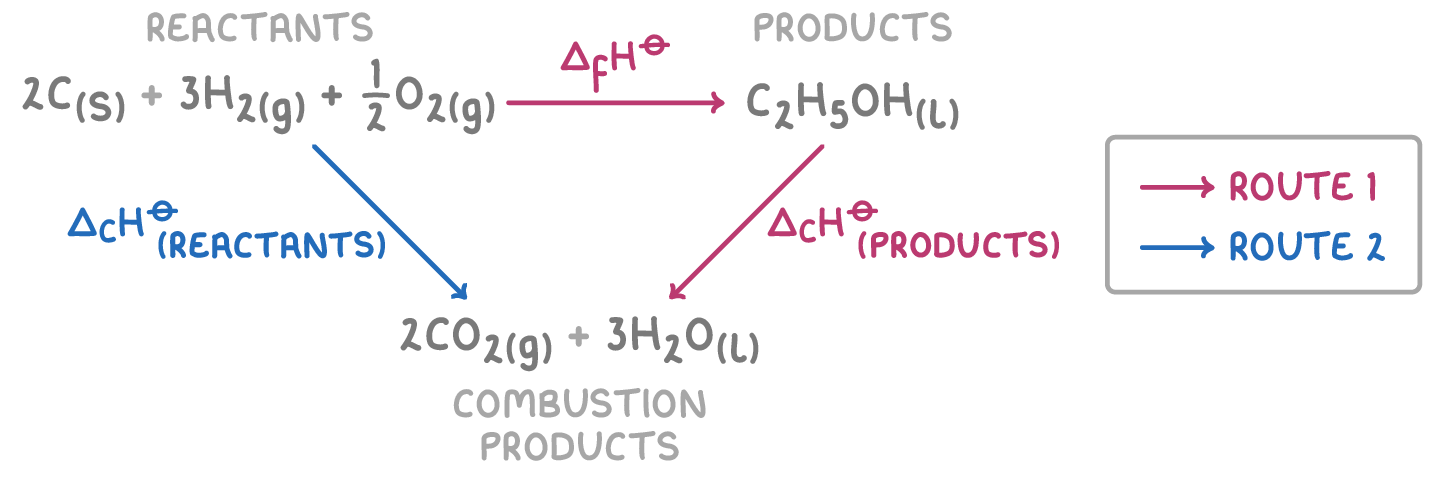
This diagram shows the reaction pathway from reactants to products. We can use Hess' law and known enthalpy values to calculate ΔH⦵ for this reaction.
Step 1: Equation
ΔH⦵r = ΣΔH⦵c(reactants) $-$ ΣΔH⦵c(products)
Step 2: Substitution and correct evaluation
ΔH⦵c(reactants) = 2($-$394) + 3($-$286) = $-$1,646 kJ mol^-1^
ΔH⦵c(products) = $-$1,367 kJ mol^-1^
Step 3: Determine the overall ΔH⦵
ΔH⦵ = $-$1,646 $-$ ($-$1,367) = $-$279 kJ mol^-1^
Therefore, the ΔH⦵ for the formation of ethanol is $-$279 kJ mol^-1^.