6.1 - Ionic Bonding
- 1
How ions form through electron transfer
- 2
Polyatomic ions
- 3
Naming and determining formulae of ionic compounds
Ions form to achieve full outer electron shells
Atoms can gain or lose electrons to form ions with full outer shells:
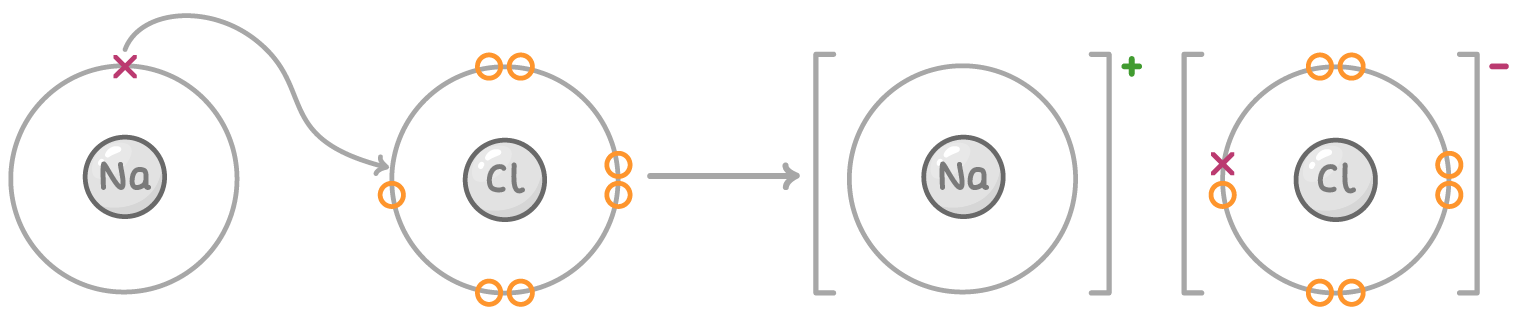
Metal atoms lose electrons to become positive ions called cations. For example, sodium loses one electron to form a sodium ion (Na+).
- Sodium atom: 1s2, 2s2, 2p6, 3s1
- Sodium ion (Na+): 1s2, 2s2, 2p6
Non-metal atoms gain electrons to become negative ions called anions. For example, chlorine gains one electron to form a chloride ion (Cl-).
- Chlorine atom: 1s2, 2s2, 2p6, 3s2, 3p5,
- Chloride ion (Cl-): 1s2, 2s2, 2p6, 3s2, 3p6,
In ionic bonding, electrons lost by the metal atom are transferred to the non-metal atom. This transfer allows both atoms to achieve full outer electron shells, resulting in the formation of stable ions.
Dot and cross diagrams show how electrons are transferred to form ions:
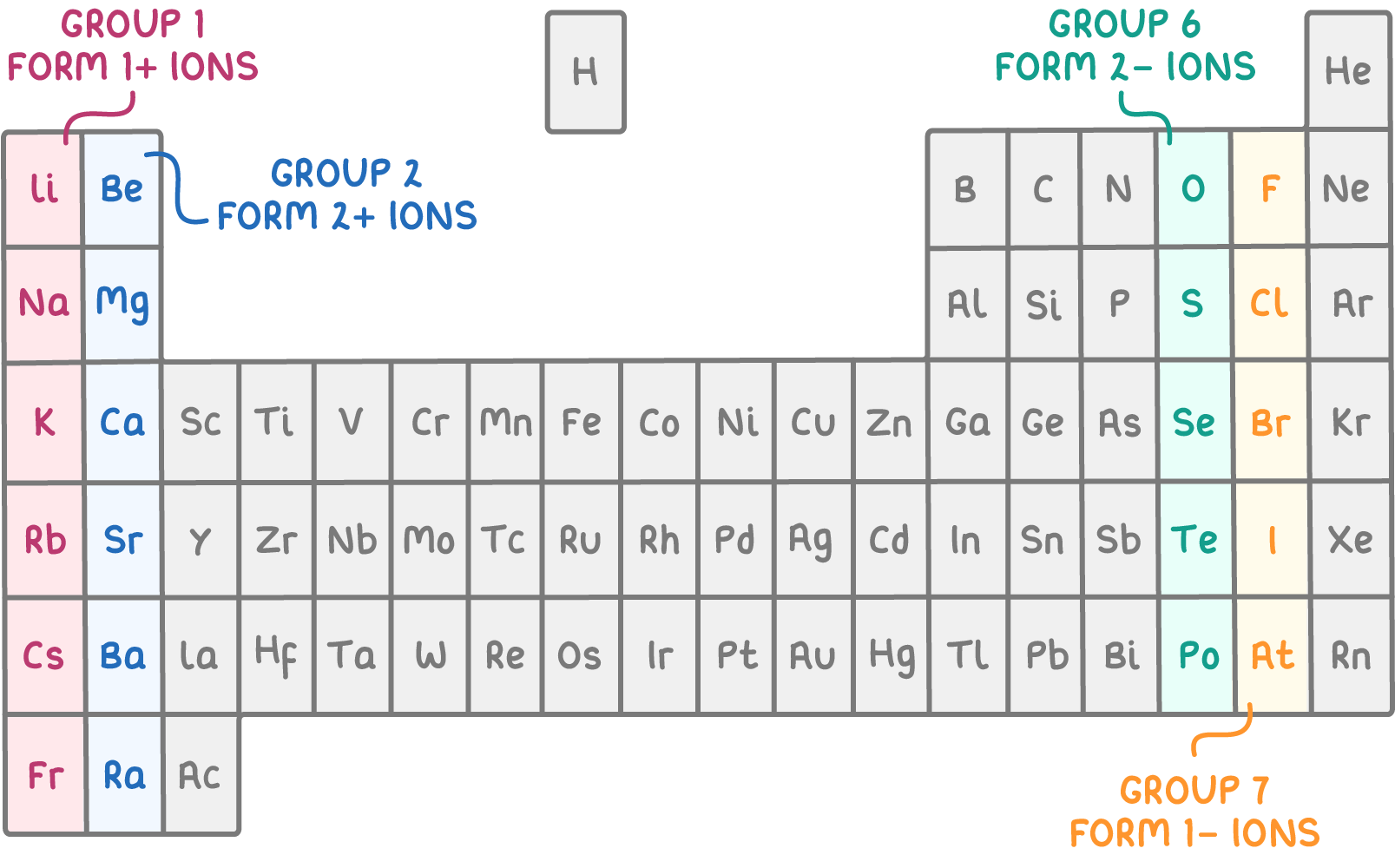
Elements in the same group of the periodic table form ions with the same charge as they have the same number of outer shell electrons:
- Elements in group 1 form 1+ ions
- Elements in group 2 form 2+ ions
- Elements in group 6 form 2- ions
- Elements in group 7 form 1- ions
Unlike main group elements, transition elements have partially filled d sub-shells, enabling them to form multiple ions with different charges. For example, iron can form both Fe2+ and Fe3+ ions:
- Fe2+: [Ar] 3d6
- Fe3+: [Ar] 3d5
When transition elements undergo ionisation, the 4s electrons are lost before the 3d electrons. The similar energies of the 3d and 4s sub-shells allow for successive ionisations in many transition elements, resulting in the formation of ions with varying charges.
Polyatomic ions
Polyatomic ions consist of atoms from two or more elements chemically bonded together, resulting in an overall charge.
The important polyatomic ions to know are:
- Nitrate ion (NO3-)
- Carbonate ion (CO32-)
- Hydrogencarbonate ion (HCO3-)
- Sulfate ion (SO42-)
- Phosphate ion (PO43-)
- Hydroxide ion (OH-)
- Ammonium ion (NH4+)
Naming ionic compounds
When naming ionic compounds, follow these rules:
- The cation (positive ion) is named first, followed by the anion (negative ion).
- Cations keep the name of the parent atom. For transition elements, the charge of the cation is indicated in Roman numerals (in brackets) after the name.
- Monatomic anions take the stem of the parent atom's name and add the suffix "-ide".
- Polyatomic anions have specific names (e.g., nitrate NO3-, carbonate CO32-, sulfate SO42-).
The name does not indicate the number of ions in the formula.
Examples of ionic compound names and formula are:
- Potassium bromide - KBr
- Calcium sulfate - CaSO4
- Copper(I) oxide - Cu2O
- Iron(III) chloride - FeCl3
Determining formulae of ionic compounds
Ionic compound formulas indicate the ions present and their ratios. For example:
- NaCl contains Na+ ions and Cl- ions in a 1:1 ratio
- MgCl2 contains Mg2+ ions and Cl- ions in a 1:2 ratio
The total positive and negative charges must balance in an ionic compound.
To determine the formula of an ionic compound from its name:
- Identify the cation and anion based on the name.
- Determine the charges of the cation and anion.
- Balance the charges to make the compound electrically neutral by adjusting the ratios of the ions.
Worked example 1 - Determining the formula of an ionic compound
Deduce the formula of aluminium oxide.
Step 1: Identify ions present
- Aluminium ion
- Oxide ion
Step 2: Determine charges of each ion
- Al3+
- O2-
Step 3: Balance positive and negative charges
The smallest number 3+ and 2- charges can balance at is 6, so:
- Two aluminium ions (2 x Al3+) have a total charge of +6
- Three oxide ions (3 x O2-) have a total charge of -6
Therefore, the formula of aluminium oxide is Al2O3.