7.5 - Intermolecular Forces
- 1
The types of intermolecular force
- 2
London (dispersion) forces
- 3
Dipole-induced dipole forces
- 4
Dipole-dipole forces
- 5
Hydrogen bonding
- 6
How intermolecular forces affect the properties of substances
Intermolecular forces are weak attractions between molecules
Intermolecular forces are weak attractions between molecules. These forces are much weaker than the covalent bonds that hold atoms together within molecules. The nature of the intermolecular force that exists between molecules is determined by the size and polarity of the molecules.
There are four types of intermolecular force, listed in order of increasing strength:
- London (dispersion) forces.
- Dipole-induced dipole forces.
- Dipole-dipole forces.
- Hydrogen bonding.
The term "van der Waals' forces" is an inclusive term that encompasses London (dispersion) forces, dipole-induced dipole forces, and dipole-dipole forces.
The key characteristics of these four types of intermolecular force are summarised in the table below:
| Name of intermolecular force | Strength | Where does it occur? |
|---|---|---|
| London (dispersion) forces | Weak | Between all molecules and noble gases |
| Dipole-induced dipole forces | Weak | Between polar and non-polar molecules |
| Dipole-dipole forces | Moderate | Between polar molecules |
| Hydrogen bonding | Strong | Between polar molecules with H-F, H-O or H-N bonds |
London (dispersion) forces occur between all molecules
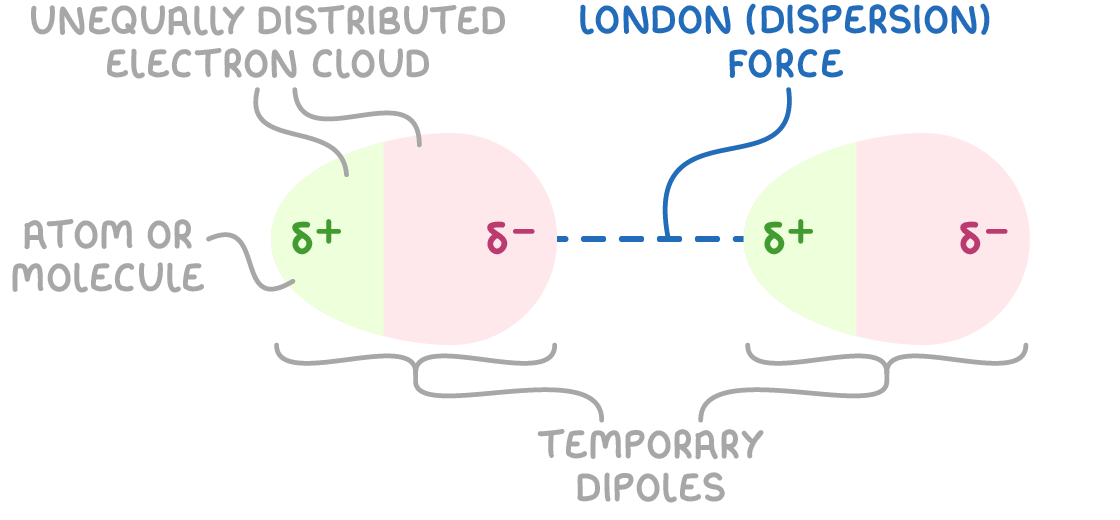
London (dispersion) forces, also known as induced dipole-induced dipole forces, are present between all atoms and molecules, even non-polar ones. They arise due to temporary fluctuations in the electron distribution around atoms:
How London (dispersion) forces arise
- Electrons in atoms are constantly moving. At any instant, there may be more electrons on one side of the atom than the other, creating a temporary dipole.
- This temporary dipole can induce an opposite dipole in a neighbouring atom, causing a weak electrostatic attraction between the atoms.
- This induced dipole can then induce further dipoles in other nearby particles.
- Although these dipoles are constantly forming and disappearing as the electrons move, the overall effect is a net attraction between the atoms or molecules.
Factors affecting the strength of London (dispersion) forces
The strength of induced dipole-dipole forces increases with the size and surface area of the atoms or molecules:
- Size - Larger atoms and molecules have more electrons and a greater volume of electron density that can become polarised, creating stronger temporary dipoles.
- Polarisability - Atoms or molecules with more easily distorted electron clouds (higher polarisability) experience stronger induced dipole-dipole forces. Polarisability generally increases with the size and number of electrons in an atom or molecule.
Consequently, substances with stronger London (dispersion) forces tend to have higher boiling points.
For example, the boiling points of the group 4 hydrides increase down the group:
| Hydride | Molecular formula | Boiling point (K) |
|---|---|---|
| Methane | CH_4_ | 111 |
| Silane | SiH_4_ | 161 |
| Germane | GeH_4_ | 185 |
| Stannane | SnH_4_ | 221 |
The trend occurs because as you move down the group:
- Molecular size and number of electrons increase.
- This leads to higher polarisability, allowing electron clouds to be more easily distorted to form temporary dipoles.
- Consequently, the London (dispersion) forces become stronger, requiring more energy to overcome, resulting in higher boiling points.
London (dispersion) forces in molecular lattices and noble gases
London (dispersion) forces can also be strong enough to hold molecules together in a lattice structure. For example:
- In solid iodine, I_2_ molecules are held together by strong covalent bonds.
- These I_2_ molecules are then attracted to each other by weak London (dispersion) forces, forming a molecular lattice.
London (dispersion) forces also explain the existence of noble gas liquids and solids - even though noble gas atoms have complete outer shells and do not form covalent, ionic or metallic bonds, the weak London (dispersion) forces allow them to condense into the liquid and solid states at very low temperatures.
Dipole-induced dipole forces occur between polar and non-polar molecules
Dipole-induced dipole forces are a type of intermolecular force that occurs between a polar molecule and a nearby non-polar molecule.
How dipole-induced dipole forces arise
- The permanent dipole of the polar molecule distorts the electron distribution in the non-polar molecule, inducing a temporary dipole.
- This induced dipole is then attracted to the permanent dipole, resulting in a weak electrostatic attraction between the molecules.
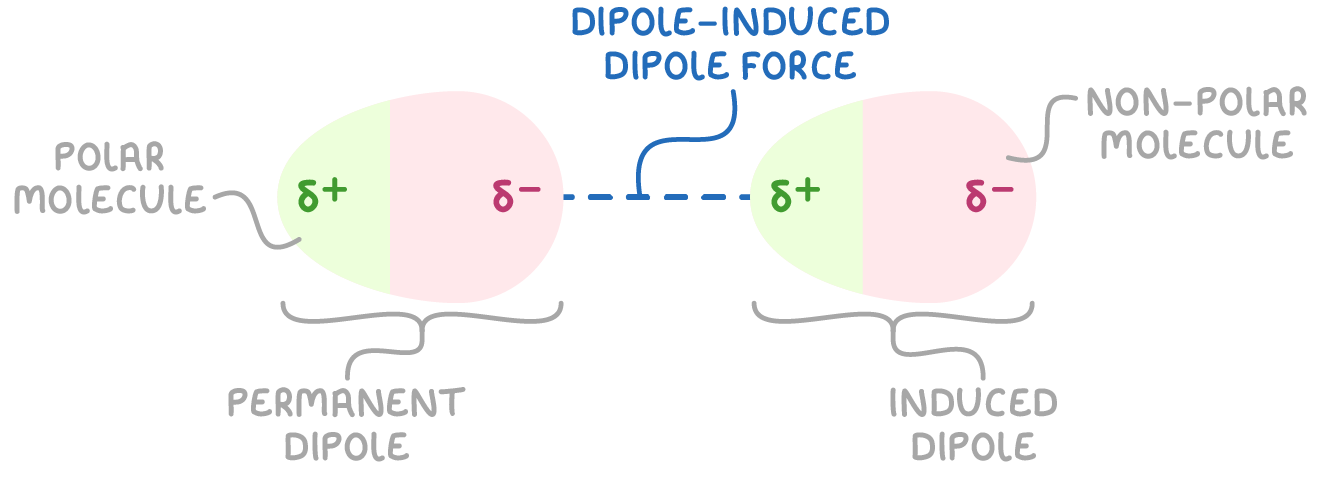
For example, dipole-induced dipole forces attract non-polar oxygen molecules (O2) to polar water molecules (H2O). The relatively weak nature of these forces explains the low aqueous solubility of oxygen.
Polar molecules experience dipole-dipole forces
Polar molecules have permanent dipoles arising from unequal sharing of electrons in covalent bonds. The partial positive (δ+) and partial negative (δ-) charges on polar molecules enable them to experience (permanent) dipole-dipole forces.
How dipole-dipole forces arise
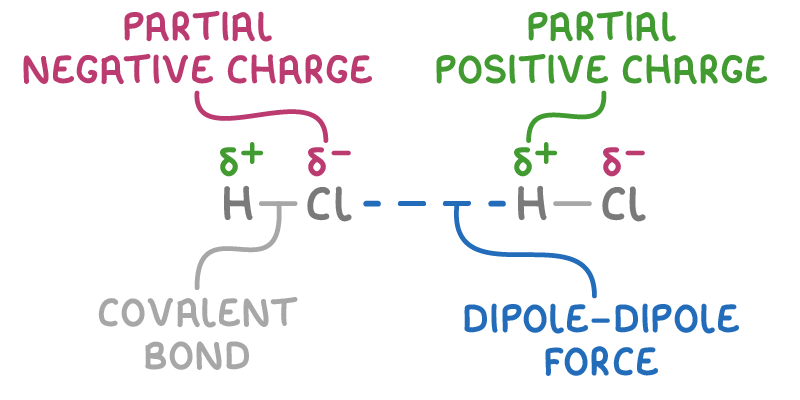
Dipole-dipole forces are electrostatic attractions between the partial positive end of one polar molecule and the partial negative end of another.
For example, in gaseous hydrogen chloride (HCl):
- The H-Cl bond is polar due to the greater electronegativity of chlorine compared to hydrogen.
- The hydrogen atom bears a partial positive charge (δ+) and the chlorine a partial negative charge (δ-).
- HCl molecules align so the δ+ hydrogen of one molecule is attracted to the δ- chlorine of a neighbouring molecule.
Polar molecules contain dipole-dipole and London (dispersion) forces
These dipole-dipole forces are in addition to the London (dispersion) forces that exist between all molecules. So polar molecules have stronger overall intermolecular forces than non-polar molecules of similar size.
For example, methanal (CH2O) has a higher boiling point than ethane (C2H6):
| Molecule | Molecular formula | Polarity | Boiling point (K) |
|---|---|---|---|
| Methanal | CH_2_O | Polar | 254 |
| Ethane | C_2_H_6_ | Non-polar | 184 |
The difference in boiling points can be explained by the types of intermolecular forces present in each substance:
- Methanal is a polar molecule due to the carbonyl group (C=O), so it experiences both dipole-dipole forces and London (dispersion) forces. The dipole-dipole forces are stronger than the London (dispersion) forces alone.
- Ethane is a non-polar molecule, so it only experiences London (dispersion) forces.
As a result, more energy is required to overcome the stronger intermolecular forces in methanal, leading to a higher boiling point, even though the molecules are of similar size and have the same molecular mass (M_r_ = 30).
Hydrogen bonding is the strongest type of intermolecular force
Hydrogen bonding is a special type of (permanent) dipole-dipole force that occurs when hydrogen is bonded to the highly electronegative elements fluorine, oxygen or nitrogen.
Requirements for hydrogen bonding
For hydrogen bonding to occur, two criteria must be met:
- The molecule must contain a hydrogen atom covalently bonded to either fluorine (F), oxygen (O), or nitrogen (N).
- There must be a lone pair of electrons on the F, O, or N atom of an adjacent molecule available to interact with the hydrogen.
How hydrogen bonds form
- The H-F, H-O, and H-N bonds are highly polar due to the large electronegativity differences between hydrogen and these elements. This leads to a significant partial positive charge (δ+) on the hydrogen atom and a partial negative charge (δ-) on the F, O, or N atom.
- The small size of the hydrogen atom allows it to get close to the lone pair of electrons on an adjacent F, O, or N atom.
- The lone pairs on F, O, and N atoms are regions of high electron density and therefore high partial negative charge.
- The positively charged hydrogen is strongly attracted to the negatively charged lone pair, forming a hydrogen bond between the molecules.
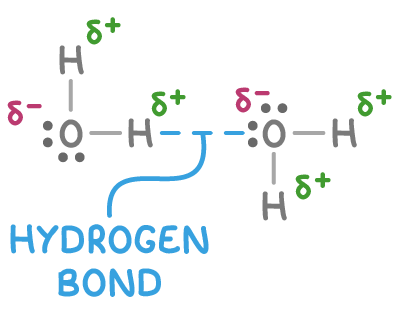
Hydrogen bonding occurs in molecules containing N-H, O-H and H-F bonds, such as water (H2O), ammonia (NH3) and hydrogen fluoride (HF).
Impact of hydrogen bonding on properties
Hydrogen bonding has significant effects on the properties of substances:
- Greater solubility in water - Substances that can form hydrogen bonds with water (e.g., ethanol) tend to be soluble, while those that cannot (e.g., ethane) are typically insoluble.
- Higher melting and boiling points compared to similar-sized molecules that cannot hydrogen bond - Extra energy is needed to overcome the strong hydrogen bonding forces.
For example, consider the boiling points of the group 6 hydrides:
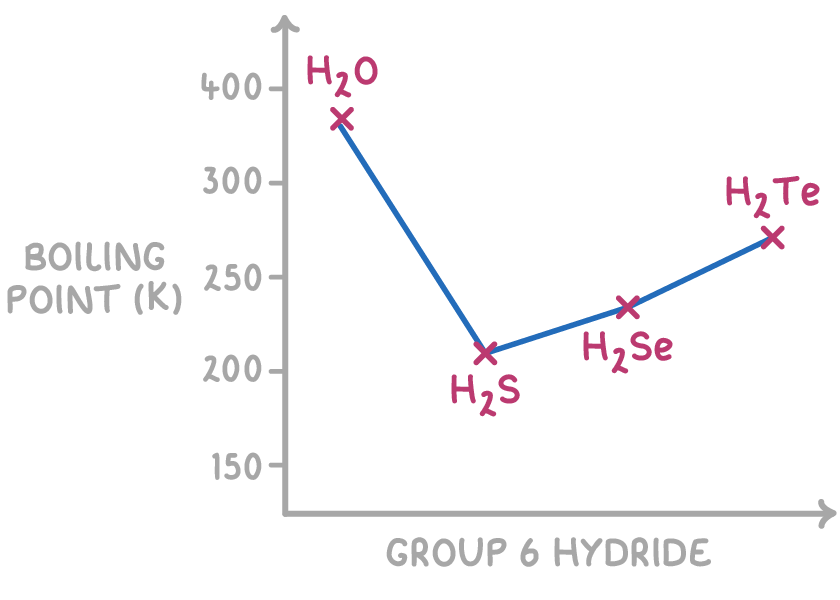
- Water (H2O) has a significantly higher boiling point than the other group 6 hydrides due to its ability to form hydrogen bonds. The strong intermolecular forces created by hydrogen bonding require more energy to overcome, resulting in a higher boiling point.
- The trend of increasing boiling points from H2S to H2Te can be attributed to the increasing molecular mass and size of the molecules. As the molecules become larger, the strength of the London (dispersion) forces increases, leading to higher boiling points.
Hydrogen bonding explains the anomalous properties of water and ice
Hydrogen bonding significantly impacts the structure and properties of water and ice:
- Ice is less dense than water - In solid ice, water molecules are arranged in a 3D lattice held together by hydrogen bonds. Upon melting, some of these hydrogen bonds break. Since hydrogen bonds are relatively long compared to covalent bonds, this causes ice to be less dense than liquid water.
- Water and ice have high melting and boiling points - Water has relatively high melting and boiling points compared to other molecules of similar size. This is due to the strong hydrogen bonds between H2O molecules, which require more energy to break.
Intermolecular forces explain properties of simple molecular substances
The type and strength of intermolecular forces present in a simple molecular substance influence its physical properties.
- Volatility - Molecular substances are generally volatile because the intermolecular forces holding the molecules together are relatively weak and require little energy to overcome. However, the volatility of molecular substances varies depending on their size and the strength of the intermolecular forces. Larger molecules have stronger London dispersion forces, resulting in lower volatility and higher melting and boiling points.
- Solubility in water - Polar molecules, especially those capable of hydrogen bonding (e.g., ethanoic acid), can interact favorably with water molecules and are soluble. Non-polar molecules that only have induced dipole-dipole forces (e.g., hexane) are hydrophobic and insoluble in water.
- Electrical conductivity - Covalent compounds do not conduct electricity, regardless of polarity. Even though polar molecules have permanent dipoles, they are electrically neutral overall and do not carry charge.