15.3 - Gibbs Energy & Equilibrium
- 1
The relationship between reaction quotient (Q) and equilibrium constant (K)
- 2
How Gibbs energy changes during a reversible reaction
- 3
The relationship between ΔG, Q, K, and temperature
- 4
How K and ΔG⦵ indicate whether products or reactants are favoured at equilibrium
Comparing reaction quotient and equilibrium constant
The reaction quotient (Q) is the ratio of the concentration of products to the concentration of reactants at any point during a reaction:
Q = $\frac{\text{[products]}}{\text{[reactants]}}$
In contrast, the equilibrium constant (K) is the ratio of the concentration of products to the concentration of reactants specifically at equilibrium.
Equilibrium is achieved when the rates of the forward and reverse reactions are equal in a reversible reaction. The equilibrium arrow (⇌) indicates a reversible reaction, such as in the Haber process for synthesising ammonia:
N_2(g)_ + 3H_2(g)_ ⇌ 2NH_3(g)_
You can predict the progress and direction of a reversible reaction by comparing Q and K.
| Relationship | Description | Direction of reaction |
|---|---|---|
| Q > K | Product concentration is higher than at equilibrium | Reverse reaction favoured |
| Q < K | Reactant concentration is higher than at equilibrium | Forward reaction favoured |
| Q = K | Concentrations are at equilibrium values | Forward and reverse rates equal |
Gibbs energy changes during a reversible reaction
The Gibbs energy changes as a reversible reaction progresses, influenced by the shifting ratio of reactants to products, as shown in the graph below.
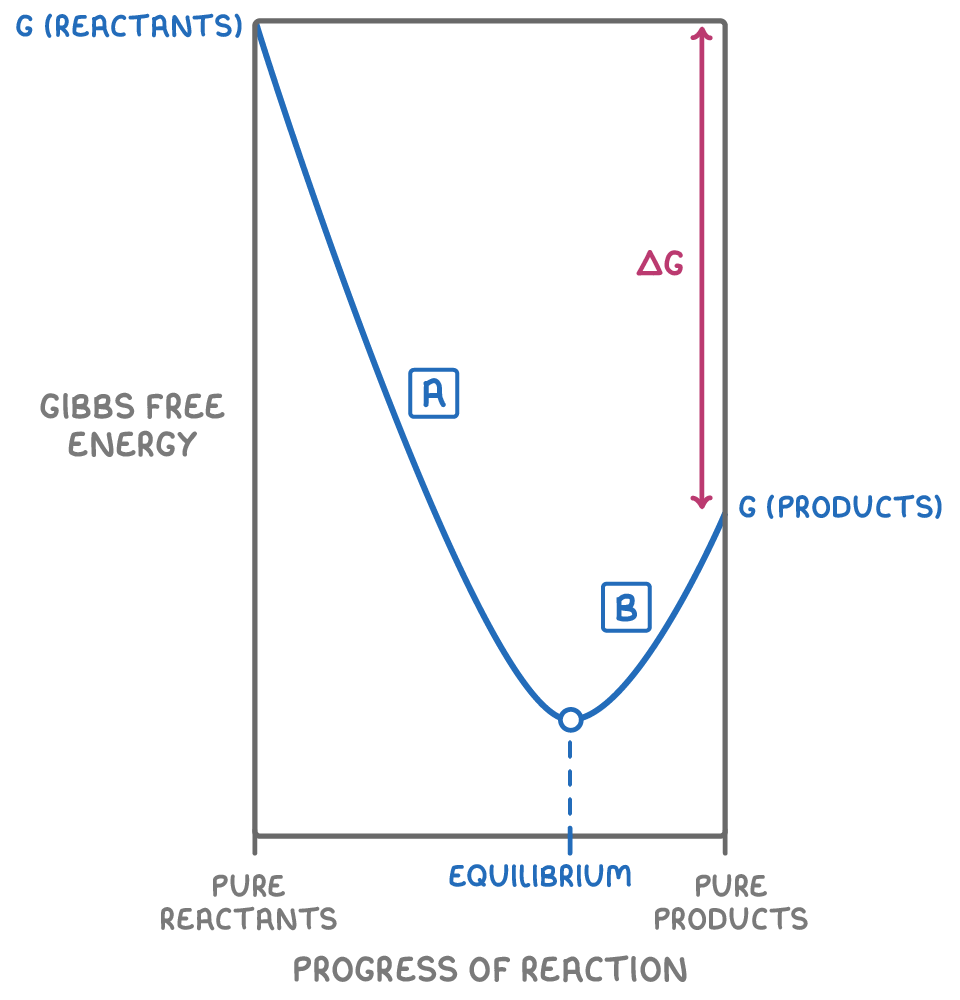
- At the start of the reaction, the Gibbs energy is high. As the reaction proceeds forward spontaneously, the Gibbs energy decreases (ΔG < 0 for the forward reaction).
- In region A, the forward reaction is favoured as reactants are converted to products, lowering the Gibbs energy of the system.
- The minimum Gibbs energy is reached at equilibrium (Q = K, ΔG = 0). At this point, the forward and reverse reaction rates are equal, and concentrations remain constant.
- After passing equilibrium (region B), the Gibbs energy increases again. Now ΔG > 0 for the forward reaction, so it is non-spontaneous. The reverse reaction (products to reactants) is favoured instead.
- The reaction will proceed spontaneously in the reverse direction until the Gibbs energy minimum at equilibrium is re-established.
Equations linking ΔG, Q, K, and temperature
The Gibbs energy change (ΔG) at any point in a reaction can be calculated from the standard Gibbs energy change (ΔG⦵), temperature (T), and reaction quotient (Q) using:
ΔG = ΔG⦵ + RTlnQ
Where:
ΔG = Gibbs energy change at any point during a reaction (kJ mol-1)
ΔG⦵ = standard Gibbs energy change (kJ mol-1)
R = gas constant (8.31 J K-1 mol-1).
T = temperature (K)
Q = reaction quotient
At equilibrium, ΔG = 0 and Q = K. Substituting this into the equation gives the relationship between ΔG⦵, T, and K:
ΔG⦵ = ${-RTlnK}$
Where:
ΔG⦵ = standard Gibbs energy change (kJ mol-1)
R = gas constant (8.31 J K-1 mol-1).
T = temperature (K)
K = equilibrium constant
Rearranging for K yields:
$K=e^{\frac{-\Delta G^{\ominus}}{R T}}$
Using K and ΔG⦵ to predict reaction favourability
The magnitude of the equilibrium constant (K) indicates whether reactants or products are favoured at equilibrium. This can also be determined from the sign and magnitude of the standard Gibbs energy change (ΔG⦵).
| K value | Equilibrium position | ΔG^⦵^ value |
|---|---|---|
| K = 1 | Neither reactants nor products favoured | ΔG^⦵^ = 0 |
| K > 1 | Products favoured | ΔG^⦵^ < 0 |
| K < 1 | Reactants favoured | ΔG^⦵^ > 0 |
By calculating K from ΔG⦵ (or vice versa), you can predict the spontaneity and favourability of a reversible reaction at a given temperature.
Worked example 1 - Calculating Gibbs energy change
Consider the following reversible reaction at 350 K:
2SO_2(g)_ + O_2(g)_ ⇌ 2SO_3(g)_ ΔG⦵ = $-$133 kJ mol-1
Given that the reaction quotient (Q) is 2.00 x 10⁻³ at a certain point during the reaction, calculate the Gibbs energy change (ΔG), in kJ mol-1, at this point and comment on the spontaneity of the forward reaction.
The gas constant, R = 8.31 J K-1 mol-1
Step 1: Conversion of kJ mol-1 into J mol-1
To convert kJ mol-1 into J mol-1, multiply by 1,000
$-$133 kJ mol-1 = $-$133,000 J mol-1
Step 2: Equation
ΔG = ΔG⦵ + RT ln Q
Step 3: Substitution and correct evaluation
ΔG = $-$133,000 + (8.31 × 350 x ln(2.00 x 10⁻³))
ΔG = $-$133,000 + (8.31 × 350 × ${-6.21}$)
ΔG = $-$133,000 ${- 18,100 = -151,000}$ J mol-1
Step 4: Conversion of mol-1 into kJ mol-1
To convert from J mol-1 into kJ mol-1, divide by 1,000
$-$151,000 J mol-1 = $-$151 kJ mol-1
Step 5: Interpretation of ΔG
Since ΔG < 0, the forward reaction is spontaneous at this point.
Worked example 2 - Determining the equilibrium constant
The following reversible reaction has a standard Gibbs energy change (ΔG⦵) of 6.40 kJ mol-1.
H_2(g)_ + I_2(g)_ ⇌ 2HI_(g)_
Determine the value of the equilibrium constant (K) for this reaction at a temperature of 400 K, and use your result to comment on the favourability of the forward reaction at this temperature.
The gas constant, R = 8.31 J K-1 mol-1
Step 1: Conversion of kJ mol-1 into J mol-1
To convert kJ mol-1 into J mol-1, multiply by 1,000
6.40 kJ mol-1 = 6,400 J mol-1
Step 2: Equation
ΔG⦵ = $-$RT ln K
Step 3: Rearrange equation
ln K = $\frac{-\Delta{G}^{\ominus}}{RT}$
$K=e^{\frac{-\Delta G^{\ominus}}{R T}}$
Step 4: Substitution and correct evaluation
ln K = $\frac{-6,400}{(8.31 × 400)} = -1.93$
K = e^-1.93^ = 0.146
Step 5: Interpretation of K
The small K value indicates the forward reaction (formation of HI) is not favourable at 400 K.