7.8 - Formal Charge
- 1
What formal charge is and how it is calculated
- 2
How to use formal charge to select between possible Lewis structures
- 3
Examples of calculating formal charge for molecules and ions
Defining formal charge
Formal charge is a way of assigning charges to individual atoms in a molecule or ion based on the arrangement of electrons in the Lewis structure.
It represents the charge an atom would have if:
- All bonding electron pairs were shared equally between the bonded atoms.
- All non-bonding electrons belonged exclusively to the atom they are assigned to.
Essentially, formal charge looks at how the number of electrons associated with an atom changes when it forms bonds compared to when it was unbonded.
Calculating formal charge
The formal charge on an atom can be calculated using the formula:
$\text{Formal charge }=\text{ number of valence electrons }-\text{ (number of non-bonding electrons }+\frac{1}{2}\times\text{ number of bonding electrons})$
This can be expressed mathematically as:
$\text{FC }=\text{ VE}-\text{ (NBE }+\frac{1}{2}\text{BE})$
Where:
- FC = formal charge
- VE = number of valence electrons of the unbonded atom
- NBE = number of non-bonding electrons on the atom in the molecule/ion
- BE = total number of bonding electrons the atom shares in the molecule/ion
The sum of formal charges in a molecule or ion should always equal the overall charge of the molecule or ion.
Worked example 1 - Calculating the formal charge of phosphorus trichloride
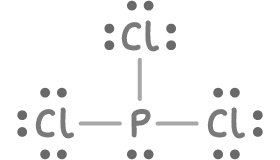
Calculate the formal charge on each atom in PCl3. The Lewis formula of PCl3 is shown below.
Step 1: Equation
$\text{FC }=\text{ VE}-\text{ (NBE }+\frac{1}{2}\text{BE})$
Step 2: Formal charge on phosphorus (P)
- VE (valence electrons) = 5
- NBE (non-bonding electrons) = 2 (1 lone pair)
- BE (bonding electrons) = 6 (3 single bonds)
$\text{FC }=5-(2+\frac{6}{2})=0$
Step 3: Formal charge on each chlorine (Cl)
- VE = 7
- NBE = 6 (3 lone pair)
- BE = 2 (1 single bond)
$\text{FC }=7-(6+\frac{2}{2})=0$
Assessing possible Lewis structures
When there are multiple valid Lewis structures for a molecule or ion, we can use formal charges to help select the most appropriate one.
In general, the most stable and likely Lewis structure will have:
- Formal charges on atoms as close to zero as possible.
- The smallest possible spread of formal charges.
- Any negative formal charges on the most electronegative atoms.
By calculating the formal charges for the atoms in each possible Lewis structure, we can assess which one best meets these criteria.
Worked example 2 - Determining the preferred Lewis formula of the phosphate ion
Consider the following two proposed Lewis formulas for the phosphate ion, PO43-.
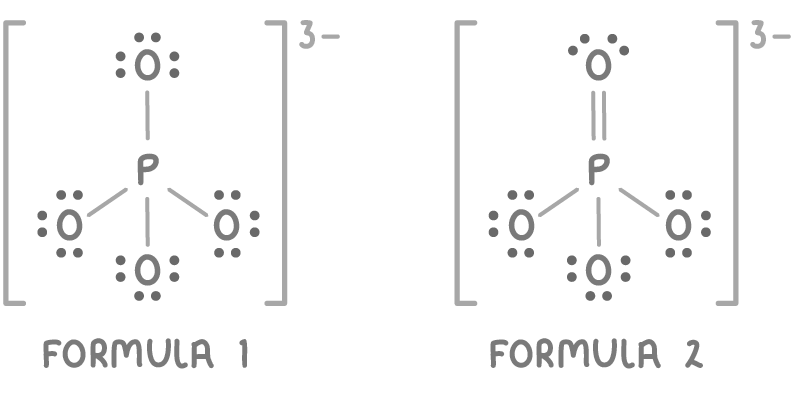
Calculate the formal charge on each atom in both structures to determine which Lewis formula is preferred.
Step 1: Equation
$\text{FC }=\text{ VE}-\text{ (NBE }+\frac{1}{2}\text{BE})$
Step 2: Calculate formal charges for Formula 1
Formal charge on phosphorus (P):
- VE = 5
- NBE = 0 (no lone pairs)
- BE = 8 (4 single bonds)
$\text{FC }=5-(0+\frac{8}{2})=+1$
Formal charge on each oxygen (O):
- VE = 6
- NBE = 6 (3 lone pairs)
- BE = 2 (1 single bond)
$\text{FC }=6-(6+\frac{2}{2})=-1$
Step 3: Calculate formal charges for Formula 2
Formal charge on phosphorus (P):
- VE = 5
- NBE = 0
- BE = 10 (2 single bonds + 2 double bonds)
$\text{FC }=5-(0+\frac{10}{2})=0$
Formal charge on each single bonded oxygen (O):
- VE = 6
- NBE = 6
- BE = 2
- FC(O single bonded) = 6 − (6 + ½ × 2) = 6 − (6 + 1) = 6 − 7 = −1
Formal charge on double bonded oxygen (O):
- VE = 6
- NBE = 4 (2 lone pairs)
- BE = 4 (1 double bond)
$\text{FC }=6-(4+\frac{4}{2})=0$
Step 4: Assess the formulas
- In both formulas, the sum of formal charges equals $-$3, matching the overall charge on PO43-.
- Formula 2 is preferred because the formal charges are closer to zero and there is a better distribution of charges compared to Formula 1.