20.6 - Oxidation of Organic Compounds
- 1
Oxidation of primary alcohols to aldehydes and carboxylic acids
- 2
Oxidation of secondary alcohols to ketones
- 3
Controlling the oxidation of primary alcohols
Oxidation of alcohols
Certain functional groups in organic compounds can be oxidised under specific conditions. The hydroxyl group (-OH) in alcohols is an example of a functional group that can undergo oxidation.
The oxidation of alcohols requires:
- An oxidising agent (represented by the symbol [O]) - This provides the oxygen atoms needed for the oxidation process.
- A concentrated acid - The acid acts as a catalyst, facilitating the oxidation reaction.
- Heat energy - Usually applied through reflux or distillation to provide the necessary activation energy.
The products of alcohol oxidation depend on whether the starting alcohol is primary, secondary or tertiary:
| Alcohol | General structure | Oxidation product |
|---|---|---|
| Primary | R-CH_2_-OH | Aldehyde (R-CHO) or carboxylic acid (R-COOH) |
| Secondary | R-CHOH-R' | Ketone (R-CO-R') |
| Tertiary | R-COH(R')(R") | No oxidation |
Tertiary alcohols cannot be oxidised in the same way as primary and secondary alcohols because they lack a hydrogen atom on the carbon bonded to the -OH group, which is necessary for the oxidation process to occur.
Oxidation of secondary alcohols
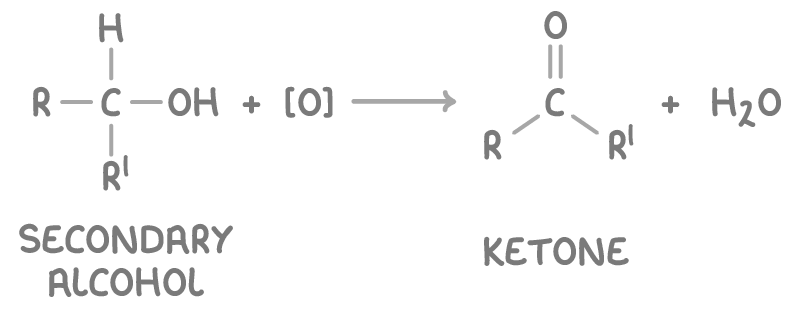
Secondary alcohols (R-CHOH-R') can be oxidised to ketones (R-CO-R'). This involves the loss of two hydrogen atoms from the alcohol and the formation of a carbon-oxygen double bond (C=O), known as a carbonyl group.
The general equation for this reaction is:
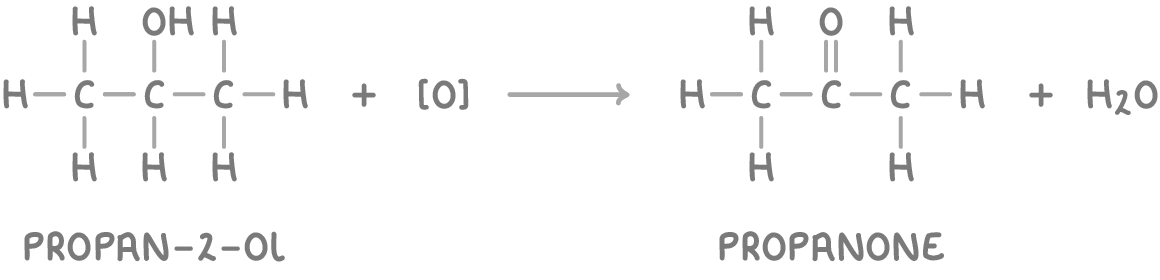
For example, the equation representing the oxidation of propan-2-ol to propanone is:
To ensure complete oxidation of a secondary alcohol, the reaction is carried out under reflux conditions, with the oxidising agent in excess.
Oxidation of primary alcohols
Primary alcohols (R-CH2-OH) can be oxidised to either aldehydes (R-CHO) or carboxylic acids (R-COOH), depending on the reaction conditions.
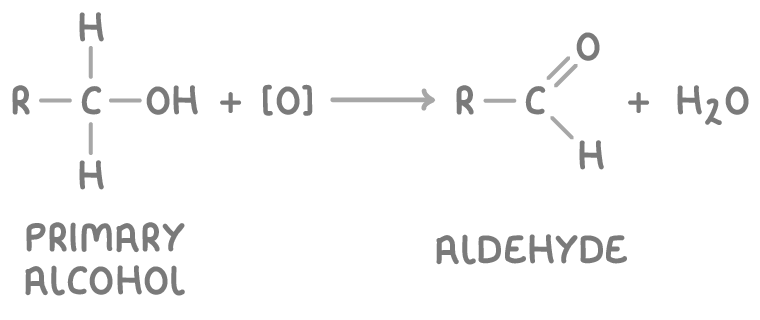
Oxidation to an aldehyde involves the loss of two hydrogen atoms and the formation of a carbonyl group.
The general equation for this reaction is:
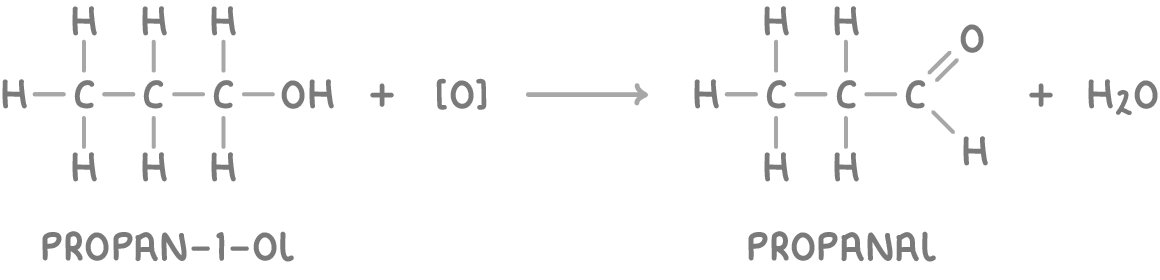
For example, the equation representing the oxidation of propan-1-ol to propanal is:
To obtain an aldehyde product, the alcohol must be in excess, and the reaction carried out under distillation conditions. Distillation allows the aldehyde to be separated from the reaction mixture before it can be further oxidised.
Oxidation to a carboxylic acid is a two-step process. The aldehyde formed in the first step is oxidised further, gaining an oxygen atom to form a carboxyl group (-COOH).
The general equation for this reaction is:
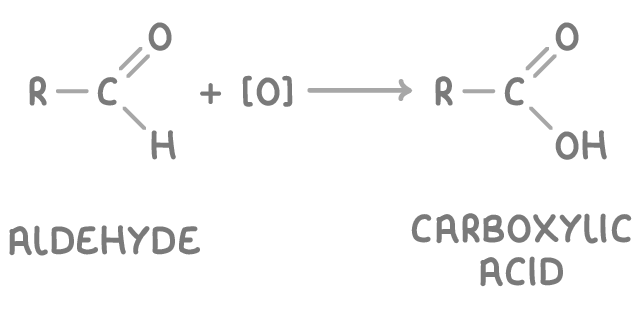
For example, the equation representing the oxidation of propan-1-ol to propanoic acid is:
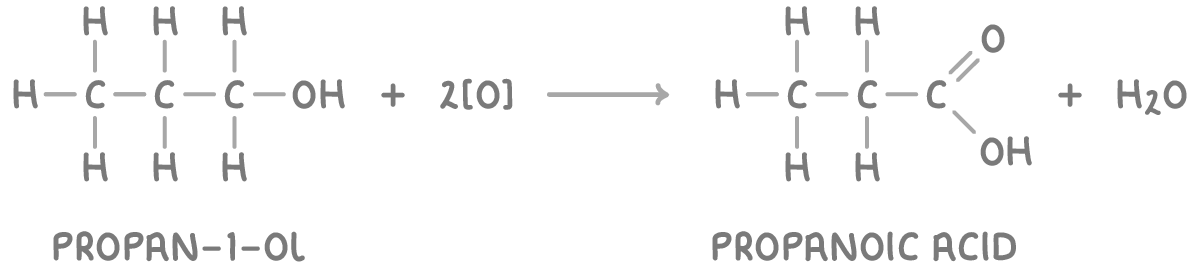
To obtain a carboxylic acid product, the oxidising agent must be in excess, and the reaction carried out under reflux conditions. Reflux allows the aldehyde intermediate to be continually oxidised until the final carboxylic acid product is formed.
Controlling the oxidation of primary alcohols
Reflux and distillation are two key experimental procedures used in the oxidation of alcohols. These techniques help control the reaction conditions and the final oxidation product obtained.
Reflux is used when the desired product is a carboxylic acid.
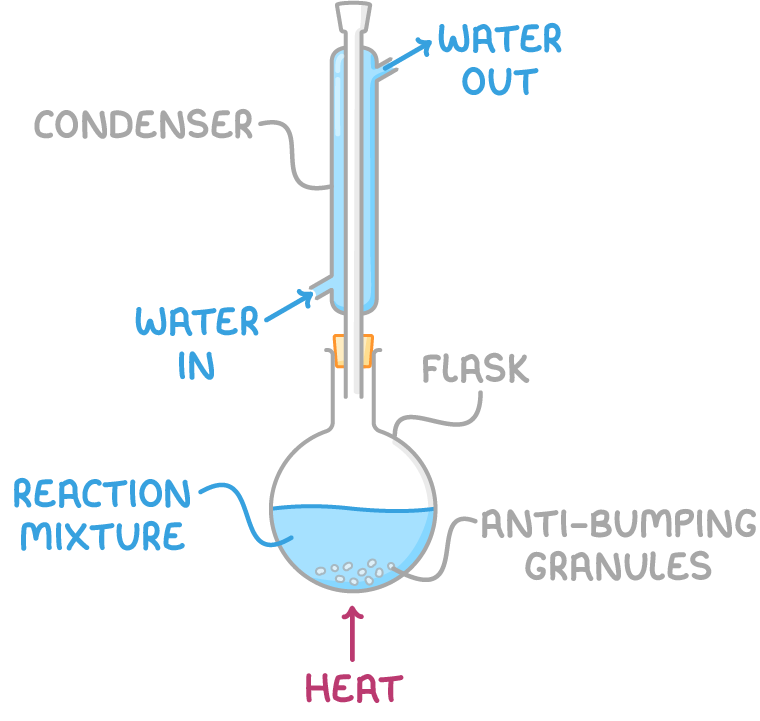
In this procedure:
- The reaction mixture is heated at its boiling point.
- Vapours produced are cooled by a condenser and returned to the reaction flask.
- The prolonged heating and recycling of vapours allows the reaction to continue until the carboxylic acid product is formed.
On the other hand, distillation is used when the desired product is an aldehyde.
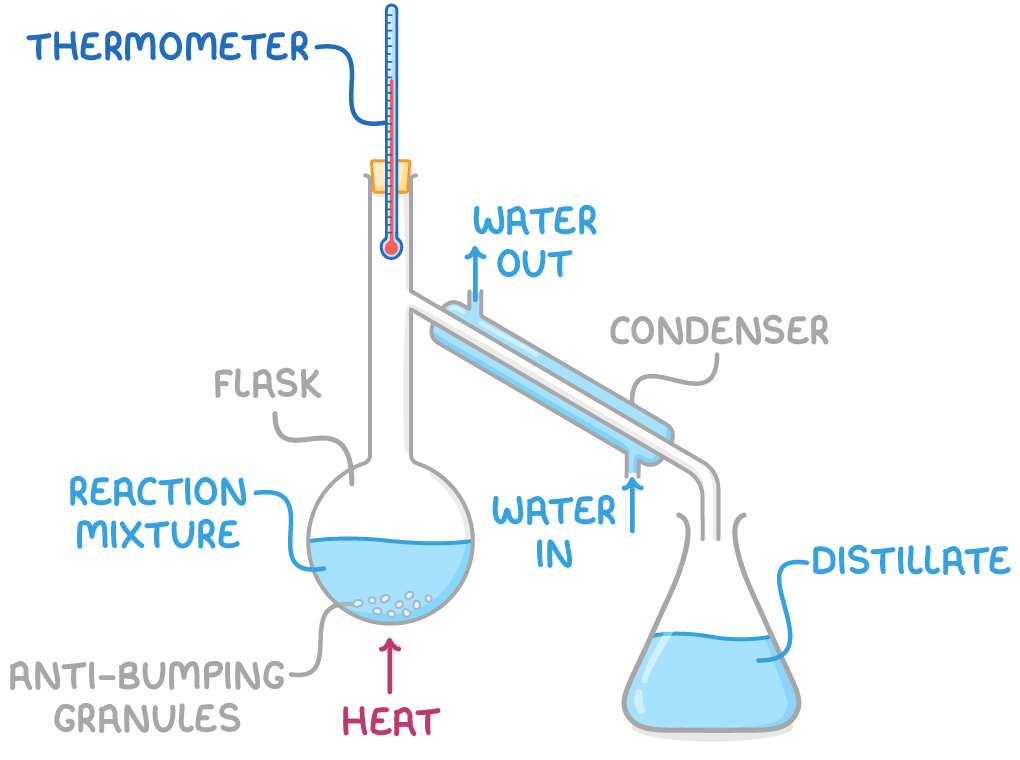
In this procedure:
- The reaction mixture is heated, and vapours are collected.
- The vapours are cooled and condense in a separate flask, isolating the aldehyde product.
- By removing the aldehyde from the reaction mixture, distillation ensures that the oxidation stops at the aldehyde stage.