3.1 - Emission Spectra
- 1
How emission spectra are produced
- 2
The relationship between colour, wavelength, frequency, and energy
- 3
The difference between continuous and line spectra
- 4
The emission spectrum of hydrogen
Production of emission spectra
Emission spectra are produced when electrons in excited states of atoms return to lower energy levels, emitting photons in the process.
- When an atom absorbs energy, electrons can be promoted to higher energy levels (excited states).
- When these excited electrons fall back to lower energy levels, they emit photons of specific frequencies.
- The emitted photons have energies equal to the difference between the energy levels.
Each element has a unique emission spectrum that can be used to identify it.
Properties of electromagnetic radiation
Electromagnetic (EM) radiation is a form of energy that propagates through space as oscillating electric and magnetic fields. It includes a wide range of radiation types, such as radio waves, microwaves, infrared, visible light, ultraviolet, X-rays, and gamma rays.
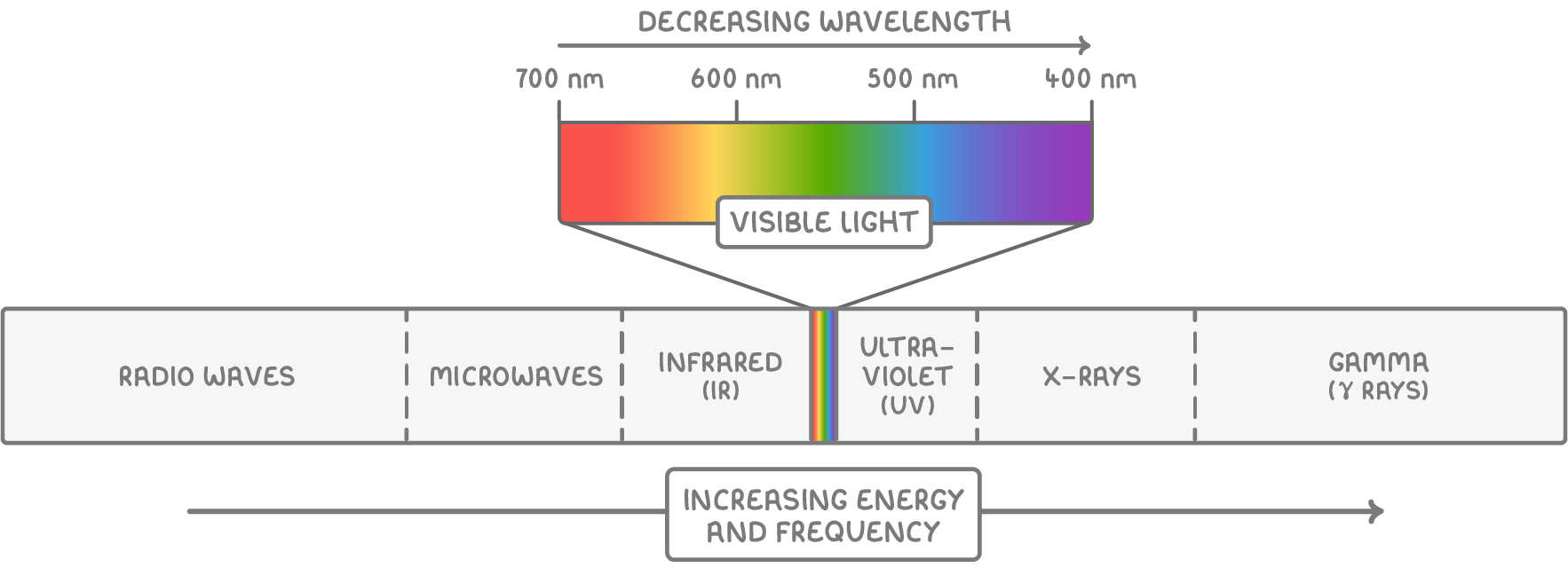
These types of EM radiation differ in their wavelength, frequency, and energy.
- Wavelength (λ) - The distance between corresponding points on adjacent waves, expressed in m.
- Frequency (f) - The number of wave cycles that pass a fixed point per unit time, expressed in Hz or s-1.
- Energy (E) - The energy carried by a photon of the radiation, expressed in J.
Relationship between wavelength, frequency, and energy
- The wavelength and frequency of EM radiation are inversely proportional to each other, as expressed by the equation:
c = λ × f
where c is the speed of light (3.00 × 10⁸ m s-1). This means that as the wavelength increases, the frequency decreases, and vice versa.
- The energy of a photon is directly proportional to its frequency and inversely proportional to its wavelength, as described by the Planck-Einstein equation:
E = h × f = $\frac{\text{hc}}{\lambda}$
where h is Planck's constant (6.63 × 10⁻³⁴ J s). As the frequency increases or the wavelength decreases, the photon energy increases.
Visible light spectrum
Visible light is a small portion of the electromagnetic spectrum, with wavelengths ranging from about 400 nm to 700 nm. Within the visible spectrum:
- Violet light has the shortest wavelength, highest frequency, and highest energy.
- Red light has the longest wavelength, lowest frequency, and lowest energy.
Continuous vs. line spectra
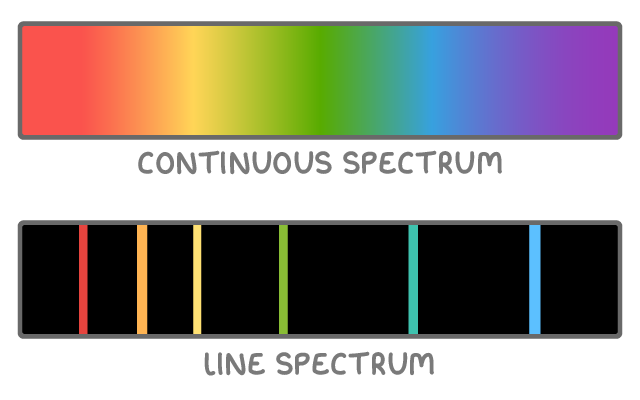
- A continuous emission spectrum contains all wavelengths of light with no gaps, e.g., a rainbow. This type of spectrum is produced by hot, dense objects such as the filament of an incandescent light bulb or the core of a star.
- A line emission spectrum consists of discrete lines at specific wavelengths, characteristic of the atom. Each spectral line corresponds to a particular electron transition between energy levels in the atom, with the unique energy difference determining the wavelength of light emitted.
The hydrogen emission spectrum
The emission spectrum of hydrogen consists of several series of lines in the ultraviolet (UV), visible, and infrared (IR) regions. These lines result from electrons transitioning between different energy levels.
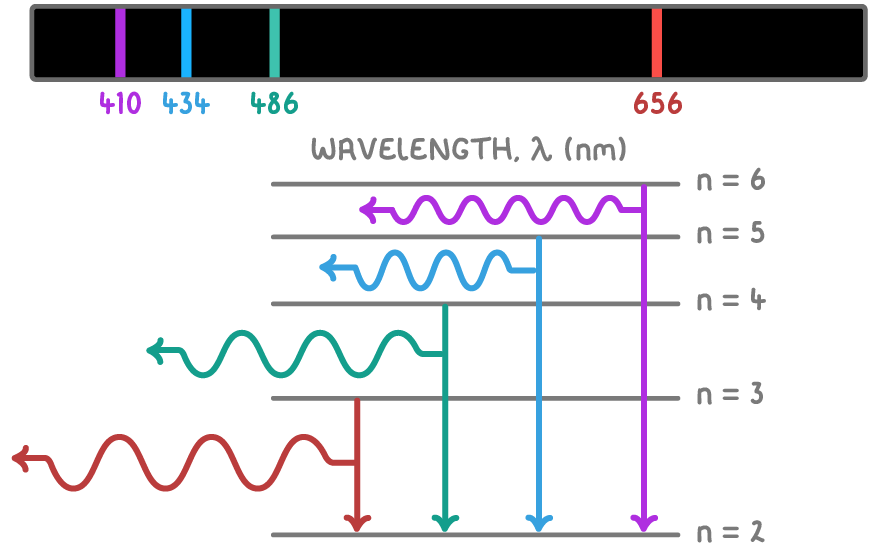
The four visible lines in the hydrogen spectrum (above) are produced by electrons falling to the n=2 energy level from higher levels.
In addition to the visible lines, the hydrogen emission spectrum also includes:
- UV lines - Produced by electrons falling to the n=1 energy level from higher levels.
- IR lines - Produced by electrons falling to the n=3 energy level from higher levels.
The presence of discrete lines in the hydrogen emission spectrum, rather than a continuous range of colours, provides strong evidence for the existence of quantised electron energy levels in atoms.