20.1 - Oxidation & Reduction
- 1
Defining oxidation and reduction
- 2
Identifying oxidising and reducing agents
- 3
Disproportionation reactions
- 4
Balancing redox reactions
Defining oxidation and reduction
Oxidation and reduction can be defined in several ways:
1. Oxygen transfer:
- Oxidation involves a substance gaining oxygen.
- Reduction involves a substance losing oxygen.
For example, in the reaction:
2CuO(s) + C(s) ➔ 2Cu(s) + CO2(g),
C is oxidised to CO2 by gaining oxygen while CuO is reduced to Cu by losing it.
2. Hydrogen transfer:
- Oxidation involves a substance losing hydrogen.
- Reduction involves a substance gaining hydrogen.
For example, in the reaction:
N2H4(l) + O2(g) ➔ N2(g) + 2H2O(g),
N2H4 is oxidised to N2 by losing hydrogen while O2 is reduced to H2O by gaining it.
3. Electron transfer:
- Oxidation involves a substance losing electrons.
- Reduction involves a substance gaining electrons.
A useful mnemonic to remember this is OIL RIG:
Oxidation
Is
Loss (of electrons),
Reduction
Is
Gain (of electrons)
For example, in the reaction:
Na(s) + 1⁄2Cl2(l) ➔ NaCl(s)
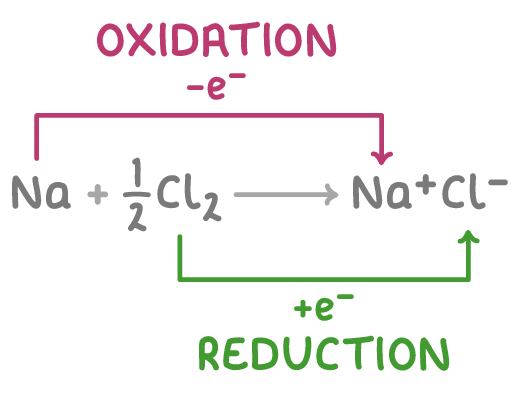
- Na is oxidised to Na+ by losing electrons: Na ➔ Na+ + e-
- Cl2 is reduced to Cl- by gaining electrons: 1⁄2Cl2 + e- ➔ Cl-
4. Oxidation state change:
- Oxidation involves an increase in oxidation state.
- Reduction involves a decrease in oxidation state.
For example, in the reaction:
Mg(s) + 2HCl(aq) ➔ MgCl2(aq) + H2(g)
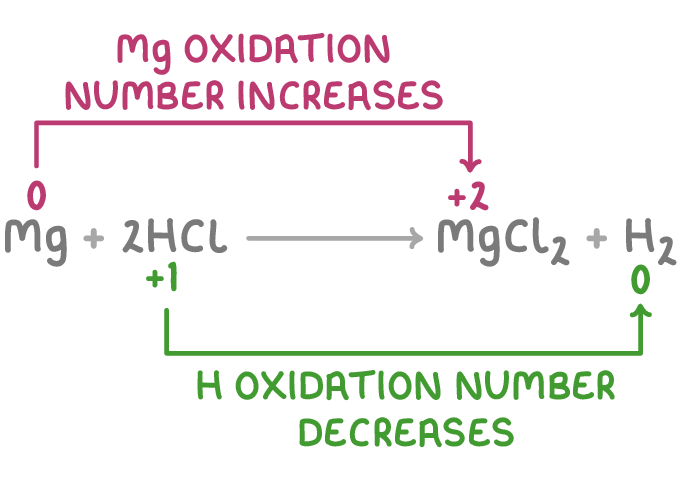
- Mg is oxidised because its oxidation number increases from 0 (in Mg) to +2 (in MgCl2).
- H is reduced because its oxidation number decreases from +1 (in HCl) to 0 (in H2).
In all redox reactions, one species is oxidised while another is simultaneously reduced.
Identifying oxidising and reducing agents
In a redox reaction:
- Oxidising agents are electron acceptors - they oxidise other substances and are themselves reduced.
- Reducing agents are electron donors - they reduce other substances and are themselves oxidised.
For example, in the reaction:
Na(s) + 1⁄2Cl2(g) ➔ NaCl(s)
- Na is the reducing agent because it is oxidised: Na ➔ Na+ + e-
- Cl is the oxidising agent because it is reduced: 1⁄2Cl2 + e- ➔ Cl-
Disproportionation is simultaneous oxidation and reduction
Disproportionation is a unique type of redox reaction where a single substance is both oxidised and reduced.
For example, in the reaction:
Cl2 + 2OH− ➔ ClO− + Cl− + H2O
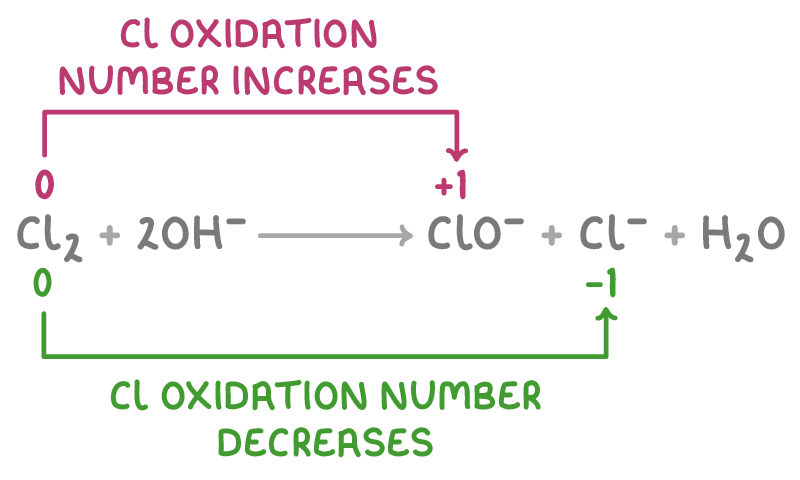
The oxidation state of Cl:
- Increases from 0 (in Cl2) to +1 (in ClO-) so Cl is oxidised.
- Decreases from 0 (in Cl2) to -1 (in Cl-) so Cl is reduced.
Balancing redox equations in aqueous solution
The steps for writing balanced redox equations in aqueous solutions are:
- Assign oxidation numbers and identify what is oxidised and reduced.
- Split the reaction into 2 separate oxidation and reduction half-equations.
- Balance any atoms being oxidised or reduced.
- Add electrons to the more positive side of each half-equation. For oxidation, electrons appear as products whilst for reduction, electrons appear as reactants. The number of electrons equals the change in oxidation state.
- Multiply the half-equations to equalise the electrons.
- Combine the half-equations.
- Check the final equation is fully balanced in terms of atoms and charge.
For reactions in acidic solution, balance oxygen atoms by adding H2O and hydrogen atoms by adding H+.
Worked example 1 - Balancing a redox reaction
Write the balanced redox equation that occurs when Cu(s) and NO3–(aq) react in acid to form Cu2+(aq) and NO2(g).
Step 1: Assign oxidation numbers and identify species oxidised and reduced
Cu is oxidised: 0 in Cu ➔ +2 in Cu2+
N is reduced: +5 in NO3– ➔ +4 in NO2
Step 2: Write separate oxidation and reduction equations
Oxidation: Cu ➔ Cu2+
Reduction: NO3– ➔ NO2
Step 3: Balance O and H atoms
Only the reduction half-equation requires O and H balancing:
NO3– + 2H+ ➔ NO2 + H2O
Step 4: Add electrons
Cu ➔ Cu2+ + 2e–
NO3– + 2H+ + e– ➔ NO2 + H2O
Step 5: Equalise electrons
Multiply the reduction half-equation (NO3– + 2H+ + e– ➔ NO2 + H2O) by 2 so both half-equations contain 2e-:
2NO3– + 4H+ + 2e– ➔ 2NO2 + 2H2O
Step 6: Combine half-equations
2NO3– + 4H+ + 2e– + Cu ➔ 2NO2 + 2H2O + Cu2+ + 2e–
Cancelling the electrons gives the final balanced equation:
2NO3– + 4H+ + Cu ➔ 2NO2 + 2H2O + Cu2+
Worked example 2 - Balancing a redox reaction
Write the balanced redox equation that occurs when MnO4–(aq) and C2O42–(aq) react in acid to form Mn2+(aq) and CO2(g).
Step 1: Assign oxidation numbers and identify what is oxidised and reduced
C is oxidised: +3 in C2O42– ➔ +4 in CO2
Mn is reduced: +7 in MnO4– ➔ +2 in Mn2+
Step 2: Write separate oxidation and reduction equations
Oxidation: C2O42– ➔ CO2
Reduction: MnO4– ➔ Mn2+
Step 3: Balance O and H atoms
C2O42– ➔ 2CO2
MnO4– + 8H+ ➔ Mn2+ + 4H2O
Step 4: Add electrons
C2O42– ➔ 2CO2 + 2e–
MnO4– + 8H+ + 5e– ➔ Mn2+ + 4H2O
Step 5: Equalise electrons
Multiply the oxidation half-equation (C2O42– ➔ 2CO2 + 2e–) by 5 and the reduction half-equation (MnO4– + 8H+ + 5e– ➔ Mn2+ + 4H2O) by 2 so both half-equations contain 10e-:
5C2O42– ➔ 10CO2 + 10e–
2MnO4– + 16H+ + 10e– ➔ 2Mn2+ + 8H2O
Step 6: Combine half-equations
5C2O42– 2MnO4– + 16H+ + 10e– ➔ 10CO2 + 10e– + 2Mn2+ + 8H2O
Cancelling the electrons gives the final balanced equation;
5C2O42– 2MnO4– + 16H+ ➔ 10CO2 + 2Mn2+ + 8H2O
Worked example 3 - Balancing a redox reaction
Write the balanced redox equation that occurs when I–(aq) and IO3–(aq) react in acid to form I2(s).
Step 1: Assign oxidation numbers and identify species oxidised and reduced
I is oxidised: -1 (in I–) ➔ 0 in I2
I is reduced: +5 in IO3– ➔ 0 in I2
Step 2: Write separate oxidation and reduction equations
Oxidation: I– ➔ I2
Reduction: IO3– ➔ I2
Step 3: Balance I atoms
I– ➔ 1⁄2I2
IO3– ➔ 1⁄2I2
Step 4: Balance O and H atoms
Only the reduction half-equation requires O and H balancing:
IO3– + 6H+ ➔ 1⁄2I2 + 3H2O
Step 5: Add electrons
I– ➔ 1⁄2I2 + e-
IO3– + 6H+ + 5e- ➔ 1⁄2I2 + 3H2O
Step 6: Equalise electrons
Multiply the oxidation half-equation (I– ➔ 1⁄2I2 + e–) by 5 so both half-equations contain 5e-:
5I– ➔ 5⁄2I2 + 5e–
Step 7: Combine half-equations
5I– + IO3– + 6H+ + 5e- ➔ 5⁄2I2 + 5e– + 1⁄2I2 + 3H2O
Cancelling the electrons and combining I2 gives the final balanced equation:
5I– + IO3– + 6H+ ➔ 3I2 + 3H2O