21.1 - Radical Substitution Reactions
- 1
What radicals are and how they are formed
- 2
The steps involved in radical substitution reactions
- 3
Halogenation of alkanes through radical substitution
Radicals are species with unpaired electrons
A radical is a chemical species that contains an unpaired electron.
Key features of radicals include:
- They are represented using a dot (•) next to the atom bearing the unpaired electron. For example, Cl• represents a chlorine radical and •CH3 a methyl radical.
- Unlike ions, radicals can exist independently without a counter-ion.
- They are usually highly reactive intermediates rather than final products.
Radicals participate in two types of reactions:
- Propagation - A radical reacts with a non-radical to generate a new radical species. This allows the reaction to continue in a chain process.
- Termination - Two radicals react to form a covalent bond, producing a stable molecule.
Radicals form via homolytic bond fission
Radicals are generated when a covalent bond undergoes homolytic fission - the two bonding electrons are split evenly between the atoms, producing two radicals that each have one unpaired electron.
Single-barbed "fish hook" curly arrows show the movement of single electrons during homolytic fission.
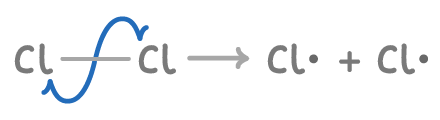
When drawing mechanisms:
- The arrow base starts where the electron originates.
- The arrowhead finishes at the electron's destination.
- Arrows go from electron-rich to electron-poor regions.
Halogens (X2) can undergo homolytic fission when exposed to UV light or heat:
X_2_ ➔ X• + X•
Homolytic fission of halogens to generate halogen radicals is the first step (the initiation step) in radical-initiated chain reactions.
Radical substitution of alkanes
Alkanes are relatively unreactive due to their strong, non-polar C-C and C-H bonds. To make alkanes more reactive, some of these bonds can be replaced with polar ones through halogenation using radical substitution.
For example, methane reacts with chlorine under UV light or heat to form chloromethane and HCl:
CH4 + Cl2 ➔ CH3Cl + HCl
Radical substitution proceeds through three stages: initiation, propagation, and termination.
Stage 1 - Initiation
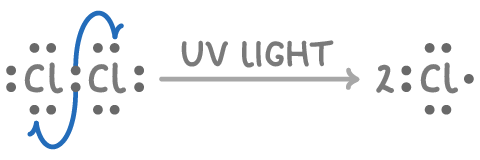
UV light causes homolytic fission of chlorine, producing two chlorine radicals:
Cl2 ➔ 2Cl•
Stage 2 - Propagation
The propagation stage consists of two steps that repeat in a cycle:
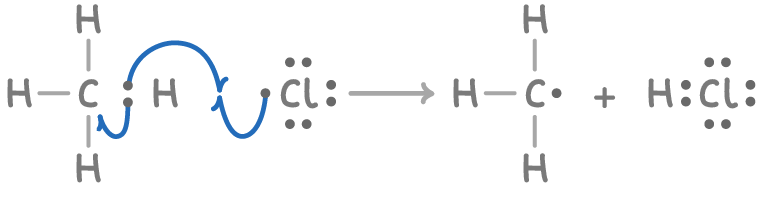
First, a chlorine radical abstracts a hydrogen from methane, forming HCl and a methyl radical:
Cl• + CH4 ➔ •CH3 + HCl
Then, the methyl radical reacts with Cl2, forming the product chloromethane and regenerating Cl•:
CH3 + Cl2 ➔ CH3Cl + Cl•
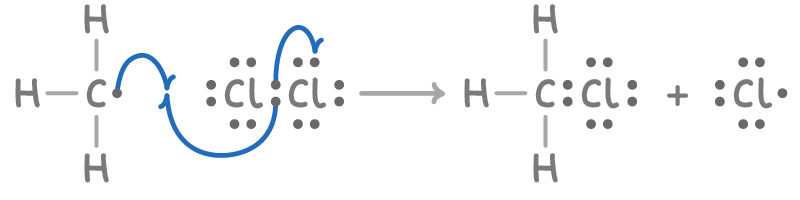
This regenerated Cl• continues the chain reaction by reacting with another CH4. The propagation steps continue until termination occurs.
Stage 3 - Termination
Two radicals can combine to form stable, non-radical products. In this case, three possible termination reactions can occur:
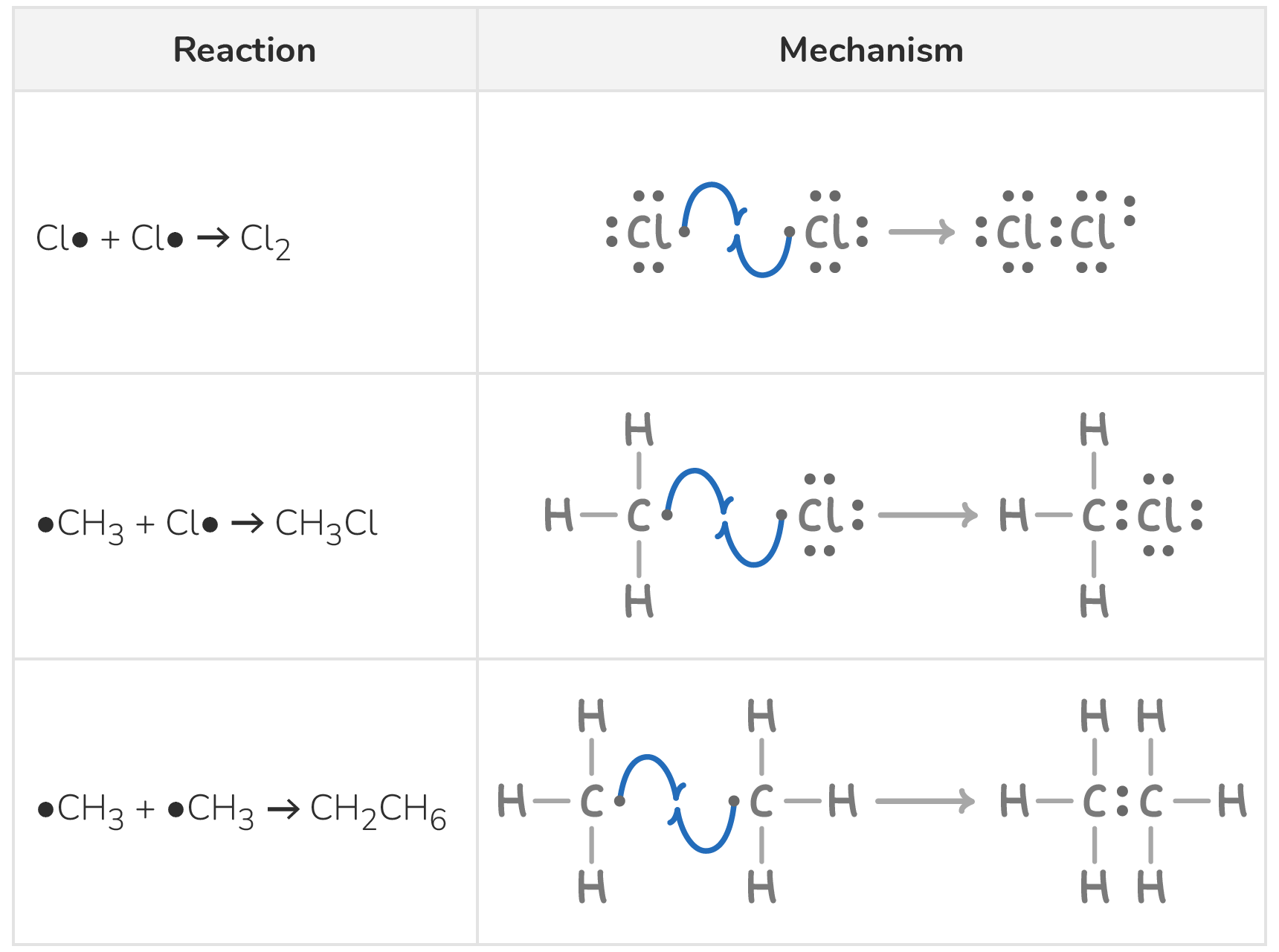
Termination depletes radical concentration, eventually halting the reaction and resulting in a mixture of the desired halogenoalkane (CH3Cl), recycled Cl2, and the byproduct ethane (C2H6).
The polar C-Cl bond in chloromethane makes it more reactive than the parent alkane for use in further reactions.
Other alkanes can be halogenated via a similar radical mechanism using Cl_2_ or Br_2_ with UV light or heat. However:
- Fluorine is so reactive it often breaks C-C bonds, yielding complex mixtures.
- Iodine is too unreactive to engage in radical substitutions on alkanes.