13.3 - Born-Haber Cycles
- 1
Types of enthalpy change
- 2
Lattice enthalpy and factors affecting it
- 3
How Born-Haber cycles can be used to determine lattice enthalpies
- 4
Calculating other values using Born-Haber cycles
Types of enthalpy change
There are many types of enthalpy change, each referring to a specific chemical or physical process:
- Enthalpy change of formation (ΔH⦵f) - The enthalpy change when 1 mole of a compound is formed from its elements in their standard states under standard conditions. For example:
2C(s) + 3H2(g) + 1⁄2O2(g) ➔ C2H5OH(l)
ΔH⦵f values are usually exothermic as energy is released when bonds form between the elements to make the compound.
- Enthalpy change of atomisation (ΔH⦵at) - The enthalpy change when 1 mole of gaseous atoms is formed from the element in its standard state under standard conditions. For example:
1⁄2Cl2(g) ➔ Cl(g)
ΔH⦵at values are always endothermic as energy must be supplied to break the bonds holding the atoms in the element together.
- First ionisation energy (ΔH⦵IE1) - The enthalpy change when 1 mole of gaseous 1+ ions is formed from 1 mole of gaseous atoms. For example:
Mg(g) ➔ Mg+(g) + e-
ΔH⦵IE1 values are always endothermic as energy is needed to overcome the electrostatic attraction between the nucleus and the electron being removed.
- Second ionisation energy (ΔH⦵IE2) - The enthalpy change when 1 mole of gaseous 2+ ions is formed from 1 mole of gaseous 1+ ions. For example:
Mg+(g) ➔ Mg2+(g) + e-
ΔH⦵IE2 values are always endothermic as even more energy is required to remove an electron from a positively charged ion.
- First electron affinity (ΔH⦵ea1) - The enthalpy change when 1 mole of gaseous 1- ions is formed from 1 mole of gaseous atoms. For example:
O(g) + e- ➔ O-(g)
ΔH⦵ea1 values are usually exothermic as the attraction between the nucleus and the incoming electron releases energy.
- Second electron affinity (ΔH⦵ea2) - The enthalpy change when 1 mole of gaseous 2- ions is formed from 1 mole of gaseous 1- ions. For example:
O-(g) + e- ➔ O2-(g)
ΔH⦵ea2 values are always endothermic as energy must be supplied to overcome the repulsion between the negative ion and the second incoming electron.
Lattice enthalpy measures ionic bond strength
Lattice enthalpy (ΔH⦵latt) is a measure of the strength of the electrostatic forces holding ions together in an ionic lattice. It is defined as the enthalpy change when one mole of a solid ionic compound is formed from its gaseous ions under standard conditions (298 K, 100 kPa).
For example: Na+(g) + Cl-(g) ➔ NaCl(s) ΔH⦵latt = $-$787 kJ mol-1
Lattice enthalpy values are always negative (exothermic) because energy is released when the oppositely charged ions come together to form the solid lattice.
The more negative the lattice enthalpy, the stronger the ionic bonding in the compound. For instance, MgO has a more negative lattice enthalpy ($-$3,791 kJ mol-1) than NaCl ($-$787 kJ mol-1), indicating that MgO has stronger ionic bonds.
Factors affecting lattice enthalpy
The lattice enthalpy of an ionic compound depends on two key factors.
1. Ionic charge
- Ions with higher charges experience stronger electrostatic attractions than ions with lower charges.
- This leads to more energy being released when the lattice forms, resulting in a more negative lattice enthalpy.
- For example, MgCl2 has a much more negative lattice enthalpy ($-$2,526 kJ mol-1) than NaCl ($-$787 kJ mol-1) because the Mg2+ ion has a higher charge than the Na+ ion, resulting in stronger electrostatic attractions in the lattice.
2. Ionic radius
- Smaller ions have a higher charge density and can pack more closely together in the lattice.
- This increases the strength of the electrostatic attractions between ions.
- Consequently, compounds with smaller ions tend to have more negative lattice enthalpies.
- For example, LiCl has a more negative lattice enthalpy ($-$853 kJ mol-1) than NaCl ($-$787 kJ mol-1) because the Li+ ion is smaller than the Na+ ion, allowing closer packing in the lattice.
So in general, compounds with small, highly charged ions have the most negative lattice enthalpies.
Calculating lattice enthalpies with Born-Haber cycles
Hess' law states that the overall enthalpy change for a reaction is independent of the route taken.
As lattice enthalpies cannot be measured directly, Born-Haber cycles are used to determine the enthalpy change for an alternative, indirect pathway.
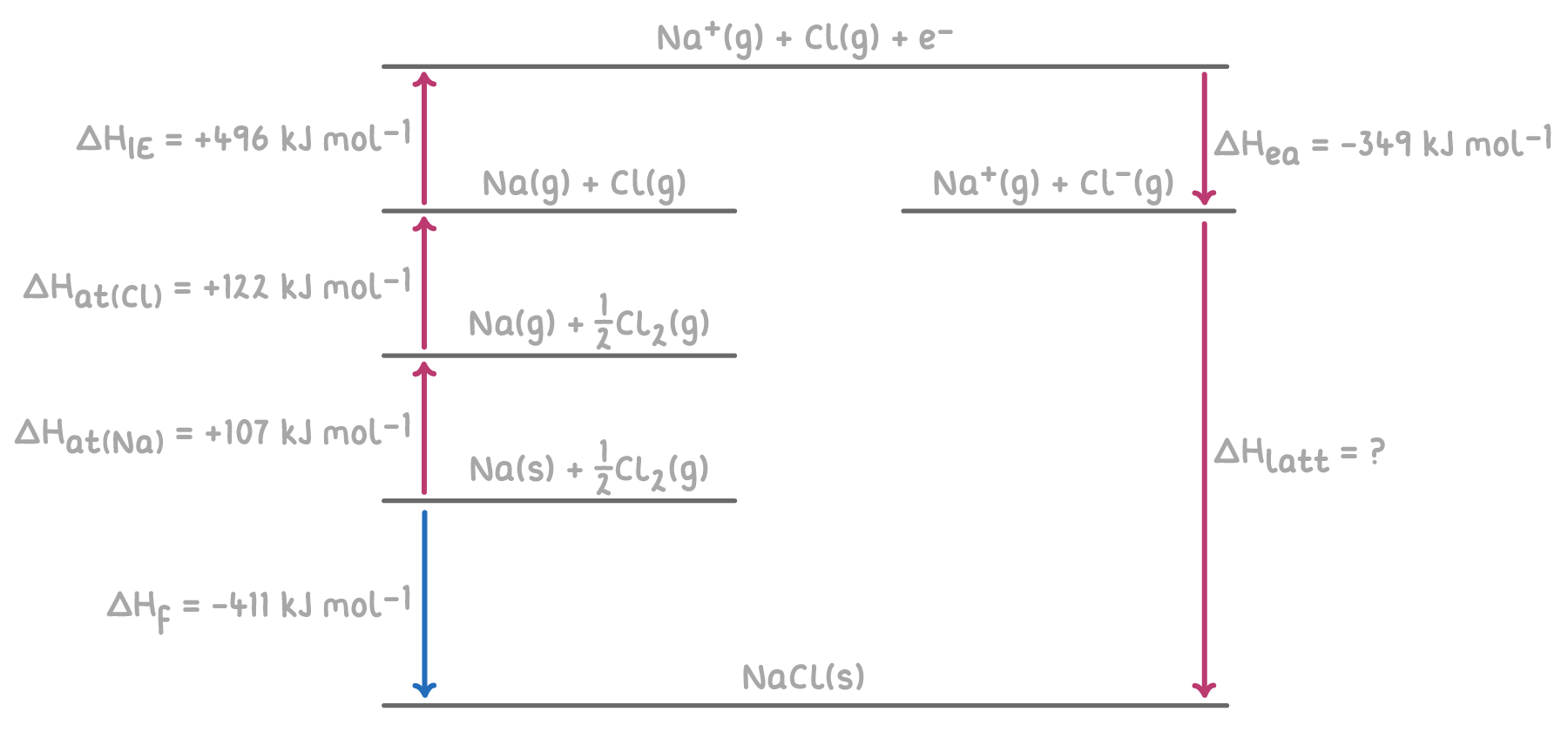
Here's an example of a Born-Haber cycle for calculating the lattice enthalpy of sodium chloride (NaCl).
Worked example 1 - Calculating lattice enthalpy of sodium chloride
Given the following enthalpy changes, calculate the lattice enthalpy of sodium chloride (NaCl) using a hypothetical Born-Haber cycle:
| Enthalpy change | Value (kJ mol^-1^) |
|---|---|
| Enthalpy of formation of NaCl, ∆H_f_ | -411 |
| Enthalpy of atomisation of sodium, ∆H_at_(Na) | +107 |
| Enthalpy of atomisation of chlorine, ∆H_at_(Cl) | +122 |
| First ionisation energy of sodium, ∆H_IE1_(Na) | +496 |
| Electron affinity of chlorine, ∆H_ea_(Cl) | -349 |
Step 1: Apply Hess's Law for the Born-Haber cycle
The overall enthalpy change for the formation of NaCl can be calculated by summing the enthalpy changes for each step of the Born-Haber cycle.
Step 2: Substitution and correct evaluation
ΔHlatt(NaCl) = $-$ΔHea(Cl) $-$ ΔHIE1(Na) $-$ ΔHat(Cl) $-$ ΔHat(Na) + ΔHf
= $-$($-$349) $-$ 496 $-$ 122 $-$ 107 + ($-$411)
= 349 $-$ 496 $-$ 122 $-$ 107 $-$ 411
ΔHlatt(NaCl) = $-$787 kJ mol-1
Therefore, the lattice enthalpy of sodium chloride is $-$787 kJ mol-1.
Adapting Born-Haber cycles for different compounds
The Born-Haber cycle can be modified for various compounds.
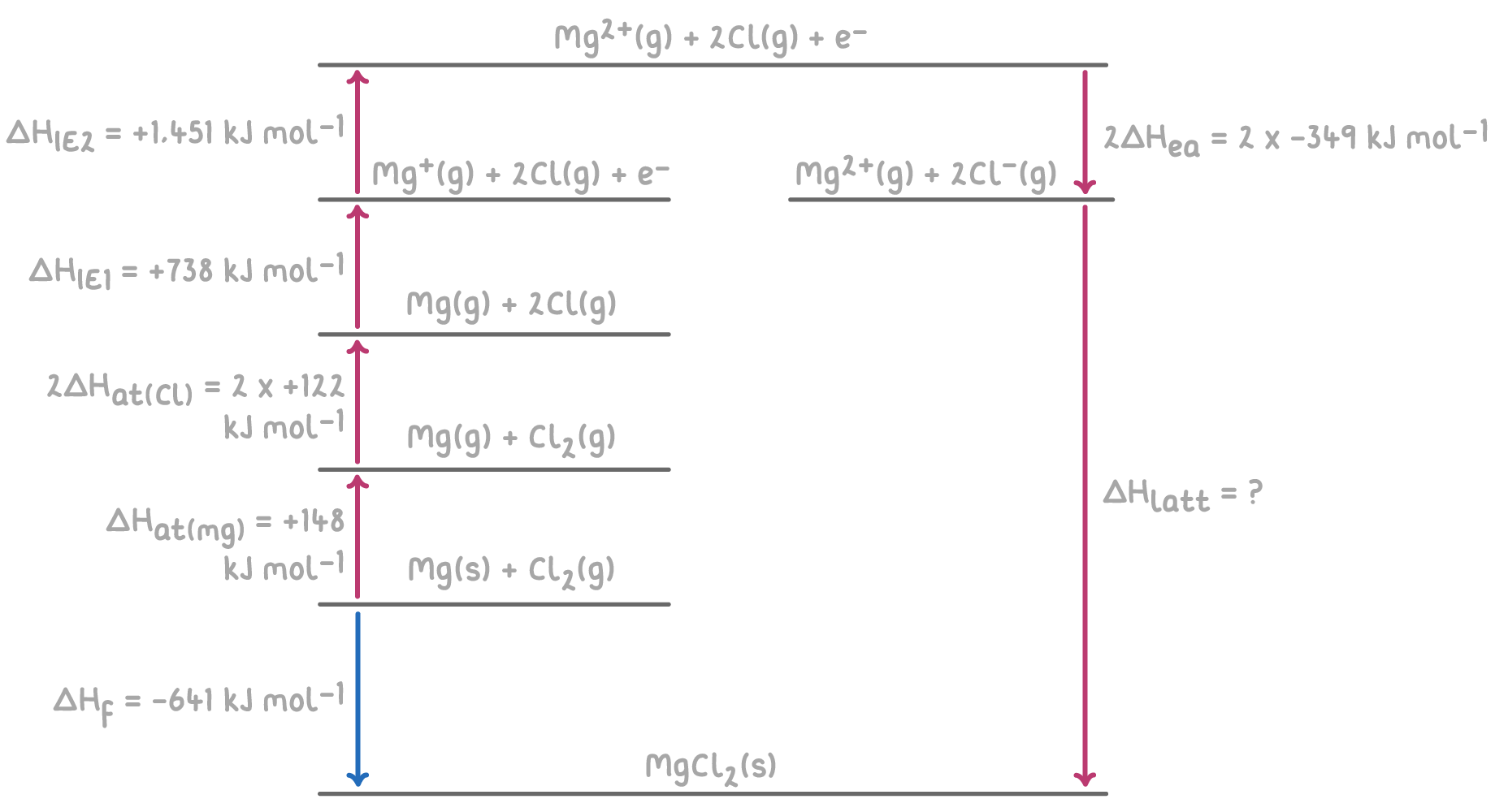
For example, when calculating the lattice enthalpy of a group 2 compound like magnesium chloride (MgCl2), extra steps are needed:
- Magnesium forms a 2+ ion, so the second ionisation energy of magnesium is included.
- There are 2 moles of chlorine per mole of MgCl2, so the atomisation enthalpy of chlorine is doubled.
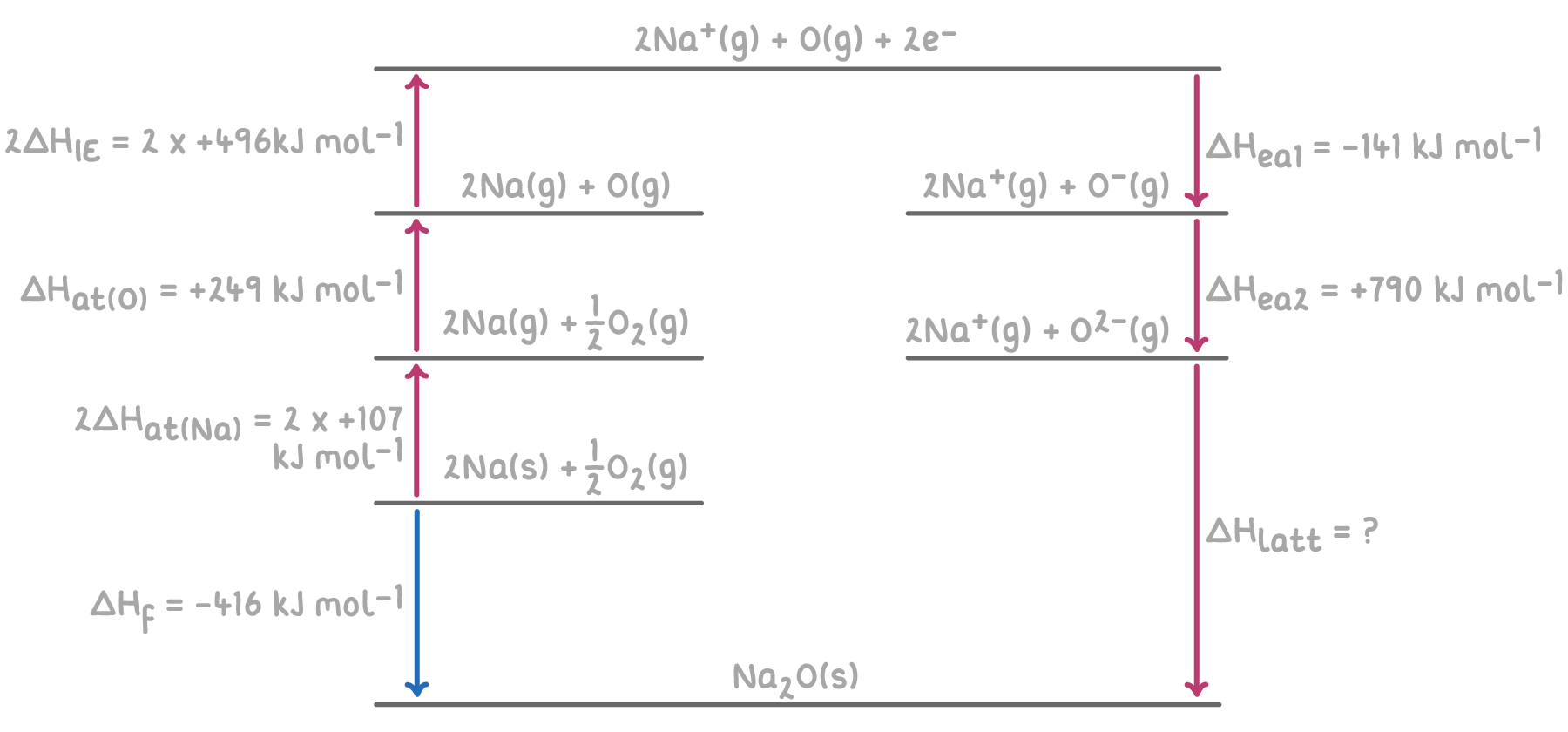
Similarly, when constructing a Born-Haber cycle for sodium oxide (Na2O), additional steps are required:
- There are 2 moles of sodium per mole of Na2O, so the atomisation enthalpy and first ionisation energy of sodium are doubled.
- Oxygen forms a 2- ion, so the second electron affinity of oxygen is included.
For compounds with ions that have charges greater than 1, additional ionisation energies and electron affinities are incorporated into the Born-Haber cycle, as demonstrated in the following examples.
Worked example 2 - Calculating lattice enthalpy of magnesium chloride
Given the following enthalpy changes, calculate the lattice enthalpy of magnesium chloride (MgCl2) using a hypothetical Born-Haber cycle:
| Enthalpy change | Value (kJ mol^-1^) |
|---|---|
| Enthalpy of formation of MgCl_2_, ∆H_f_ | -641 |
| Atomisation enthalpy of magnesium, ∆H_at_(Mg) | +148 |
| Atomisation enthalpy of chlorine, ∆H_at_(Cl) | +122 |
| First ionisation energy of magnesium, ∆H_IE1_(Mg) | +738 |
| Second ionisation energy of magnesium, ∆H_IE2_(Mg) | +1,451 |
| Electron affinity of chlorine, ∆H_ea_(Cl) | -349 |
Step 1: Apply Hess's law for the Born-Haber cycle
The overall enthalpy change for the formation of MgCl2 can be calculated by summing the enthalpy changes for each step of the Born-Haber cycle.
Step 2: Substitution and correct evaluation
$\Delta\text{H}_{\text{latt}}(\text{MgCl}_{2})=-2\Delta\text{H}_{\text{ea}}(\text{Cl})-\Delta\text{H}_{\text{IE1}}(\text{Mg})-\Delta\text{H}_{\text{IE2}}(\text{Mg})-2\Delta\text{H}_{\text{at}}(\text{Cl})-\Delta\text{H}_{\text{at}}(\text{Mg})+\Delta\text{H}_{\text{f}}$
$=-(-698)-738-1,451-244-148+(-641)$
$=698-738-1,451-244-148-641$
$\Delta\text{H}_{\text{latt}}(\text{MgCl}_2)=-2,524\text{ kJ mol}^{-1}$
Therefore, the lattice enthalpy of magnesium chloride is $-$2,524 kJ mol-1.
Worked example 3 - Calculating lattice enthalpy of sodium oxide
Given the following enthalpy changes, calculate the lattice enthalpy of sodium oxide (Na2O) using a hypothetical Born-Haber cycle:
| Enthalpy change | Value (kJ mol^-1^) |
|---|---|
| Enthalpy of formation of Na_2_O, ∆H_f_ | -416 |
| Atomisation enthalpy of sodium, ∆H_at_(Na) | +107 |
| Atomisation enthalpy of oxygen, ∆H_at_(O) | +249 |
| First ionisation energy of sodium, ∆H_IE1_(Na) | +496 |
| First electron affinity of oxygen, ∆H_ea1_(O) | -141 |
| Second electron affinity of oxygen, ∆H_ea2_(O) | +790 |
Step 1: Apply Hess's law for the Born-Haber cycle
The overall enthalpy change for the formation of Na2O can be calculated by summing the enthalpy changes for each step of the Born-Haber cycle.
Step 2: Substitution and correct evaluation
$\Delta\text{H}_{\text{latt}}(\text{Na}_2\text{O})=-\Delta\text{H}_{\text{ea1}}(\text{O})-\Delta\text{H}_{\text{ea2}}(\text{O})-2\Delta\text{H}_{\text{IE1}}(\text{Na})-2\Delta\text{H}_{\text{at}}(\text{Na})-\Delta\text{H}_{\text{at}}(\text{O})+\Delta\text{H}_{\text{f}}$
= $-(-$141) $- 790 - 992 - 214 - 249 + (-416)$
= $141 - 790 - 992 - 214 - 249 - 416$
ΔHlatt(Na2O) = $-$2,520 kJ mol-1
Therefore, the lattice enthalpy of sodium oxide is $-$2,520 kJ mol-1.
Born-Haber cycles can calculate various enthalpy and energy values
Born-Haber cycles are versatile and can be used to determine any unknown enthalpy or energy value within the cycle. The process is similar to calculating lattice enthalpy.
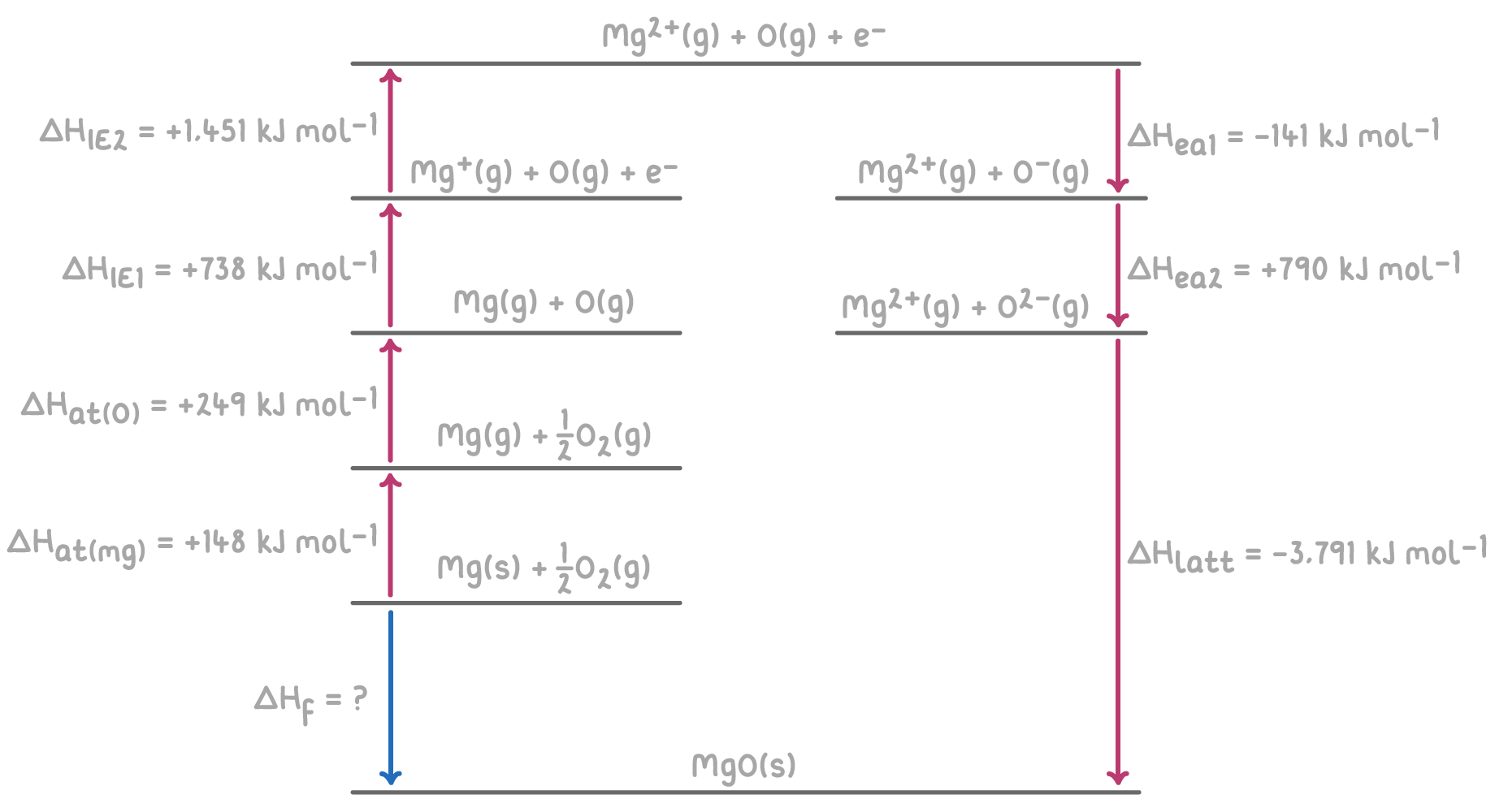
For instance, here's an example of a Born-Haber cycle for calculating the enthalpy of formation of magnesium oxide (MgO).
Worked example 4 - Calculating the enthalpy of formation of magnesium oxide
Given the following enthalpy changes, calculate the enthalpy of formation (ΔHf) of magnesium oxide (MgO) using a hypothetical Born-Haber cycle:
| Enthalpy change | Value (kJ mol^-1^) |
|---|---|
| Lattice enthalpy of MgO, ∆H_latt_ | -3,791 |
| Atomisation enthalpy of magnesium, ∆H_at_(Mg) | +148 |
| Atomisation enthalpy of oxygen, ∆H_at_(O) | +249 |
| First ionisation energy of magnesium, ∆H_IE1_(Mg) | +738 |
| Second ionisation energy of magnesium, ∆H_IE2_(Mg) | +1,451 |
| First electron affinity of oxygen, ∆H_ea1_(O) | -141 |
| Second electron affinity of oxygen, ∆H_ea2_(O) | +790 |
Step 1: Applying Hess's law for the Born-Haber cycle
The overall enthalpy change for the formation of MgO can be calculated by summing the enthalpy changes for each step of the Born-Haber cycle.
Step 2: Substitution and correct evaluation
$\Delta\text{H}_{\text{f}}= \Delta\text{H}_{\text{at}}(\text{Mg}) + \Delta\text{H}_{\text{at}}(\text{O}) +\Delta\text{H}_{\text{IE1}}(\text{Mg}) +\Delta\text{H}_{\text{IE2}}(\text{Mg}) + \Delta\text{H}_{\text{ea1}}(\text{O}) + \Delta\text{H}_{\text{ea2}}(\text{O}) + \Delta\text{H}_{\text{latt}}$
= 148 + 249 + 738 + 1,451 + ($-141) + 790 + (-$3,791)
= 148 + 249 + 738 + 1,451 $- 141 + 790 - 3,791$
ΔHf = $-$556 kJ mol-1
Therefore, the enthalpy of formation of magnesium oxide is $-$556 kJ mol-1.