20.8 - Standard Cell Potentials
- 1
Defining standard electrode potentials
- 2
Calculating standard cell potentials
- 3
Determining the spontaneity of redox reactions
- 4
Relating standard cell potentials to Gibbs energy
Standard electrode potentials
A standard electrode potential (E⦵) is a measure of how easily a species undergoes reduction in an electrochemical cell under standard conditions (298 K, 100 kPa, 1 mol dm-3 concentration for aqueous species).
Standard electrode potentials are defined relative to the standard hydrogen electrode (SHE). This reference electrode consists of:
- A platinum electrode.
- 1 mol dm-3 H+(aq).
- H2 gas at 100 kPa and 298 K.
The half-equation for the SHE is:
H+(aq) + e- ➔ 1⁄2H2(g) E⦵ = 0.00 V
The SHE acts as a universal reference for measuring electrode potentials, with its standard electrode potential defined as 0.00 V by convention.
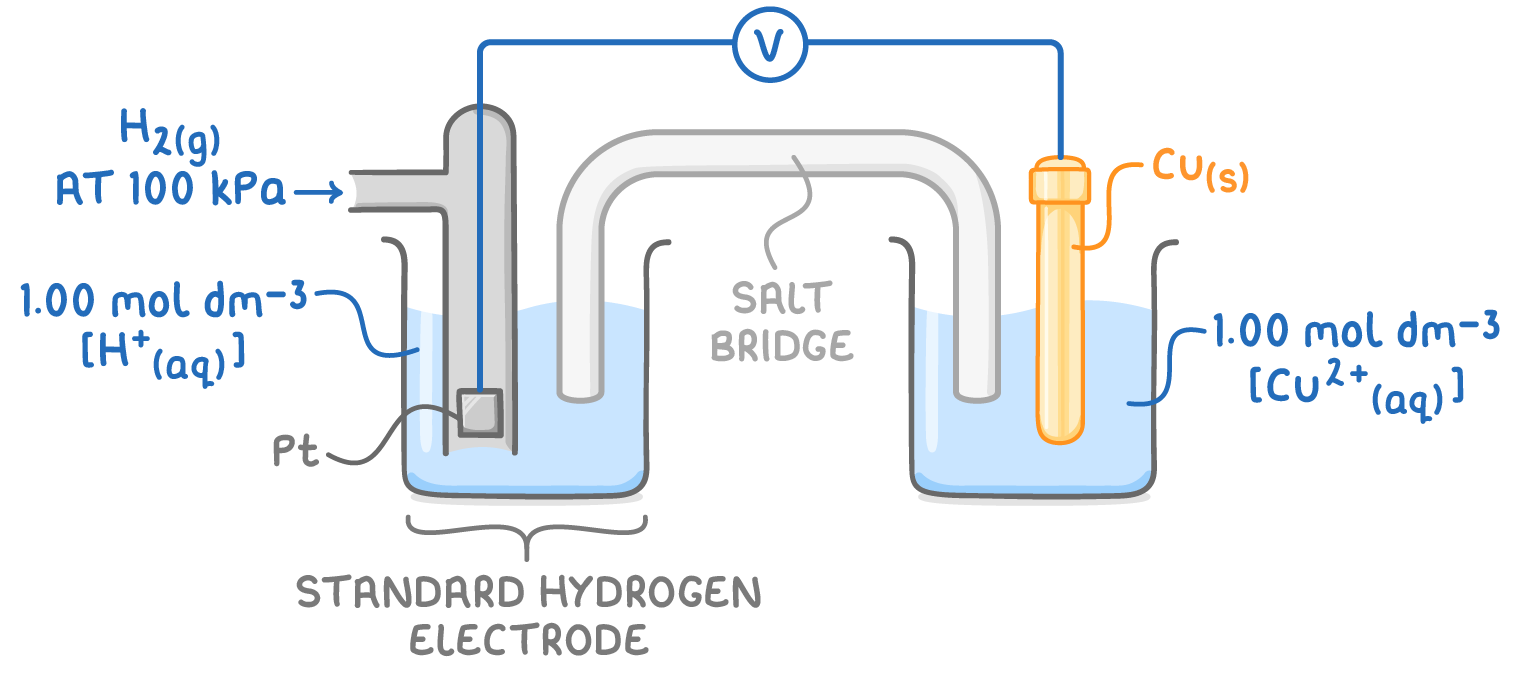
In this diagram, the SHE is shown connected to a copper half-cell. By measuring the potential difference between the SHE and the copper half-cell under standard conditions, the standard electrode potential of Cu2+/Cu can be determined.
Species are ranked based on their standard electrode potentials:
- Species with more positive E⦵ values are more easily reduced and are stronger oxidising agents; they appear lower in the reactivity series.
- Species with more negative E⦵ values are more easily oxidised and are stronger reducing agents; they appear higher in the reactivity series.
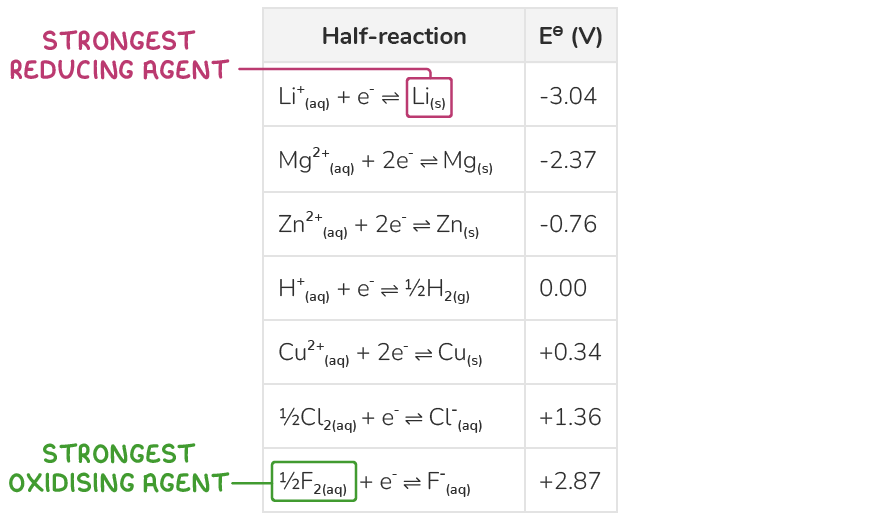
For example, the half-equation for fluorine gas gaining electrons has a very positive E⦵ value (+2.87 V):
F2(g) + 2e- ➔ 2F-(aq) E⦵ = +2.87 V
This tells us that fluorine has a great tendency to be reduced, so is a powerful oxidising agent.
By contrast, the half-equation for lithium metal losing an electron has a very negative E⦵ value ($-$3.04 V):
Li+(aq) + e- ➔ Li(s) E⦵ = $-$3.04 V
This negative E⦵ value indicates that the forward reaction is not favoured. Rather, lithium metal very readily undergoes oxidation to form lithium ions, so is a strong reducing agent.
Standard cell potentials
The voltage produced by an electrochemical cell under standard conditions is called the standard cell potential (E⦵cell). Its value depends on the two half-cells used to construct the cell. In general, the greater the difference in the positions of the two species in the reactivity series, the higher the cell's voltage will be.
E⦵cell can be calculated from the standard electrode potentials (E⦵) of the two half-cells:
E⦵cell = E⦵(reduced species) $-$ E⦵(oxidised species)
For the cell reaction to occur spontaneously (be feasible), E⦵cell must have a positive value.
In a spontaneous cell reaction:
- Reduction occurs at the cathode - This is the half-cell with the more positive E⦵.
- Oxidation occurs at the anode - This is the half-cell with the more negative E⦵.
So for a spontaneous cell reaction, E⦵cell can be expressed as:
E⦵cell = E⦵(cathode) $-$ E⦵(anode)
This following worked examples demonstrate how E⦵ data can be used to predict the spontaneous direction of a reversible redox reaction taking place in an electrochemical cell.
Worked example 1 - Determining spontaneity and cell potential
Consider an electrochemical cell constructed with Fe2+/Fe and Cu2+/Cu half-cells. The relevant half-equations and E⦵ values are shown in the table below.
| Half reaction | E⦵ (V) |
|---|---|
| Fe2+(aq) + 2e- ⇌ Fe(s) | -0.45 |
| Cu2+(aq) + 2e- ⇌ Cu(s) | +0.34 |
Calculate the standard cell potential (E⦵cell) and write the spontaneous reaction that occurs in the electrochemical cell.
Step 1: Identify the cathode and anode
Cathode: Cu2+/Cu (more positive E⦵, so reduction occurs here).
Anode: Fe2+/Fe (more negative E⦵, so oxidation occurs here).
Step 2: Write the half-equations
Cathode (reduction): Cu2+(aq) + 2e- ➔ Cu(s)
Anode (oxidation): Fe(s) ➔ Fe2+(aq) + 2e-
Step 3: Calculate E⦵cell
E⦵cell = E⦵(cathode) $-$ E⦵(anode) = 0.34 $-$ ($-$0.45) = +0.79 V
Step 4: Write the overall cell equation
Fe(s) + Cu2+(aq) ➔ Fe2+(aq) + Cu(s)
The calculated E⦵cell value is positive, indicating that the reaction is spontaneous in the forward direction as written.
Worked example 2 - Determining spontaneity and cell potential
Consider an electrochemical cell constructed with Ag+/Ag and Cu2+/Cu half-cells. The relevant half-equations and E⦵ values are shown in the table below.
| Half reaction | E⦵ (V) |
|---|---|
| Ag+(aq) + e- ⇌ Ag(s) | +0.80 |
| Cu2+(aq) + 2e- ⇌ Cu(s) | +0.34 |
Calculate the standard cell potential (E⦵cell) and write the spontaneous reaction that occurs in the electrochemical cell.
Step 1: Identify the cathode and anode
Cathode: Ag+/Ag (more positive E⦵, so reduction occurs here).
Anode: Cu2+/Cu (less positive E⦵, so oxidation occurs here).
Step 2: Write the half-equations
Cathode (reduction): Ag+(aq) + e- ➔ Ag(s)
Anode (oxidation): Cu(s) ➔ Cu2+(aq) + 2e-
Step 3: Calculate E⦵cell
E⦵cell = E⦵(cathode) $-$ E⦵(anode) = 0.80 $-$ 0.34 = +0.46 V
Step 4: Write the overall cell equation
Cu(s) + 2Ag+(aq) ➔ Cu2+(aq) + 2Ag(s)
The calculated E⦵cell value is positive, indicating that the reaction is spontaneous in the forward direction as written.
Relationship between standard cell potential and Gibbs free energy change
The standard cell potential (E⦵cell) is directly related to the standard Gibbs free energy change (ΔG⦵) for a redox reaction by the equation:
$\Delta G^{\ominus} = -nFE^{\ominus}_\text{cell}$
Where:
- ΔG⦵ = standard Gibbs free energy change (J mol-1).
- n = number of moles of electrons transferred in the balanced redox equation.
- F = Faraday constant (96,500 C mol-1).
- E⦵cell = standard cell potential (V).
The sign of ΔG⦵ indicates the feasibility of the reaction under standard conditions:
- If ΔG⦵ < 0 (E⦵cell > 0), the reaction is spontaneous.
- If ΔG⦵ > 0 (E⦵cell < 0), the reaction is not spontaneous.
This relationship allows chemists to predict the feasibility of redox reactions using standard cell potentials, which can be calculated from standard reduction potentials.
Worked example 3 - Calculating ΔG⦵
Calculate the standard Gibbs free energy change (ΔG⦵) in kJ mol-1 for the reaction:
2Al(s) + 3Cu2+(aq) ➔ 2Al3+(aq) + 3Cu(s) E⦵cell = +2.00 V
The Faraday constant, F = 96,500 C mol-1. Give your answer to 3 significant figures.
Step 1: Determine number of moles of electrons transferred (n)
In this reaction, 6 moles of electrons are transferred as each aluminium atom donates 3 electrons and there are 2 aluminium atoms involved.
Step 2: Gibbs free energy equation
$\Delta G^{\ominus} = -nFE^{\ominus}_\text{cell}$
Step 3: Substitution and correct evaluation
$\Delta G^{\ominus} =-6\times96,500\times2.00=-1,160,000\text{ J mol}^{-1}$
Step 4: Conversion of J mol-1 into kJ mol-1
To convert from J mol-1 into kJ mol-1, divide by 1,000
$-1,160,000\text{ J mol}^{-1 }=-1,160\text{ kJ mol}^{-1}$
The negative value of ΔG⦵, which is consistent with the positive standard cell potential, indicates that the reaction is spontaneous under standard conditions.