20.4 - Secondary Cells
- 1
The difference between primary and secondary cells
- 2
How lead-acid batteries work
- 3
How lithium-ion batteries work
- 4
How fuel cells generate electricity
- 5
The advantages and disadvantages of primary cells, secondary cells, and fuel cells
Primary vs secondary cells
A battery consists of two or more electrochemical cells connected together, usually in a single container.
There are two main types of electrochemical cell:
- Primary cells - In these non-rechargeable cells, the chemical reaction that generates electricity cannot be reversed once the reactants are used up. The anode, electrolyte or both need replacing, or the battery is discarded. Primary cells are suitable for low current devices.
- Secondary cells - Also known as rechargeable cells, the electricity-producing reactions in these cells can be reversed by applying an electric current. This allows the cells to be recharged and reused. Secondary cells can provide higher currents than primary cells but self-discharge faster.
The lead-acid battery
The lead-acid battery is a common type of rechargeable battery used in vehicles. It contains:
- A lead (Pb) anode.
- A lead(IV) oxide (PbO2) cathode.
- Sulfuric acid (H2SO4) electrolyte, which dissociates into H+ and HSO4- ions.
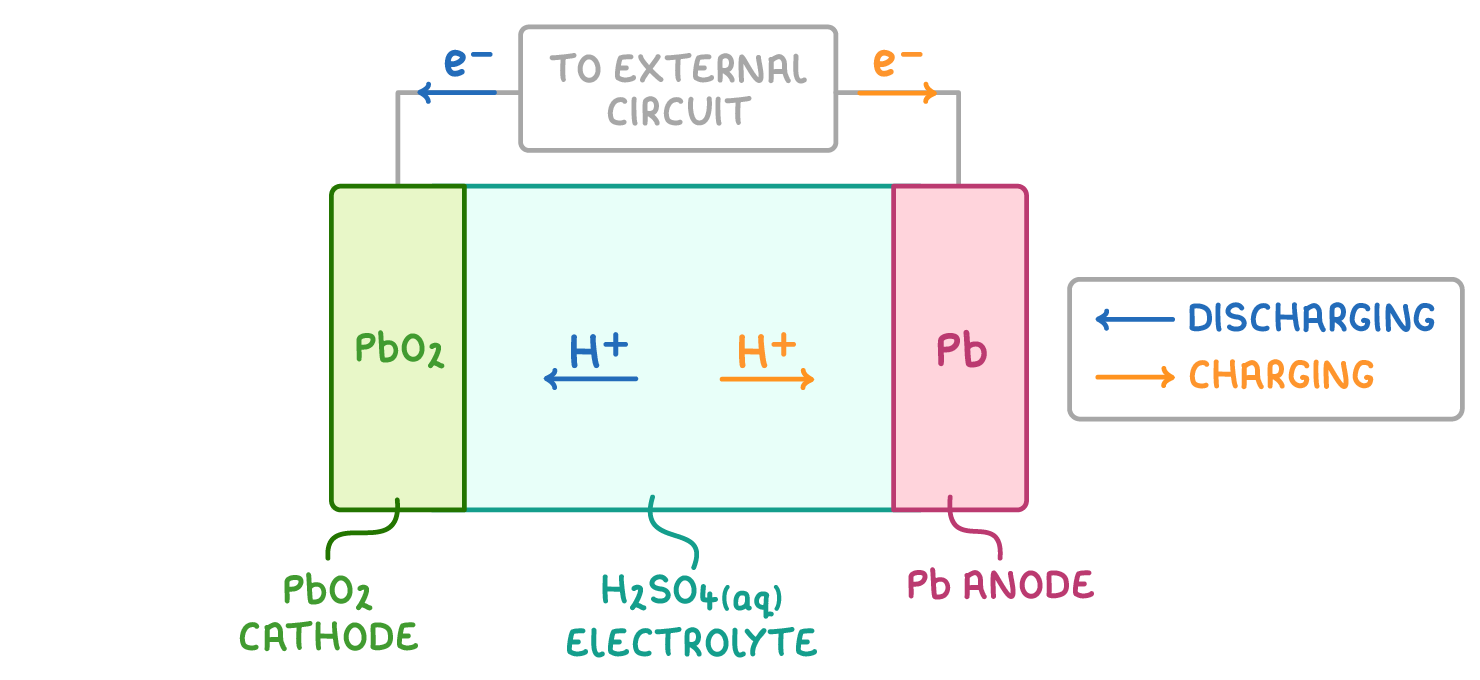
During discharge:
When the battery discharges to power the car's systems:
- HSO4- ions oxidise the Pb anode, forming lead(II) sulfate (PbSO4) and releasing electrons.
- H+ ions reduce the PbO2 cathode, also forming PbSO4.
The half-equations for this process are:
| Electrode | Discharging reaction |
|---|---|
| Anode | Pb(s) + HSO4-(aq) ➔ PbSO4(s) + H+(aq) + 2e- |
| Cathode | PbO2(s) + 3H+(aq) + HSO4-(aq) + 2e- ➔ PbSO4(s) + 2H2O(l) |
Combining these gives the overall discharging reaction:
Pb(s) + PbO2(s) + 2H2SO4(aq) ➔ 2PbSO4(s) + 2H2O(l)
During recharge:
When the car's engine is running, some of its energy is used to recharge the battery by driving these reactions in reverse:
| Electrode | Charging reaction |
|---|---|
| Anode | PbSO4(s) + 2H+(aq) + 2e- ➔ Pb(s) + HSO4-(aq) |
| Cathode | PbSO4(s) + 2H2O(l) ➔ PbO2(s) + 3H+(aq) + HSO4-(aq) + 2e- |
Combining these gives the overall cell charging reaction:
2PbSO4(s) + 2H2O(l) ➔ Pb(s) + PbO2(s) + 2H2SO4(aq)
The lithium-ion battery
Lithium-ion batteries are lightweight, high-energy density rechargeable cells commonly used in portable electronics. They contain:
- A graphite anode with embedded lithium.
- A lithium cobalt oxide cathode (LiCoO2).
- A non-aqueous polymer gel electrolyte that allows lithium ions (Li+) to move between the electrodes.
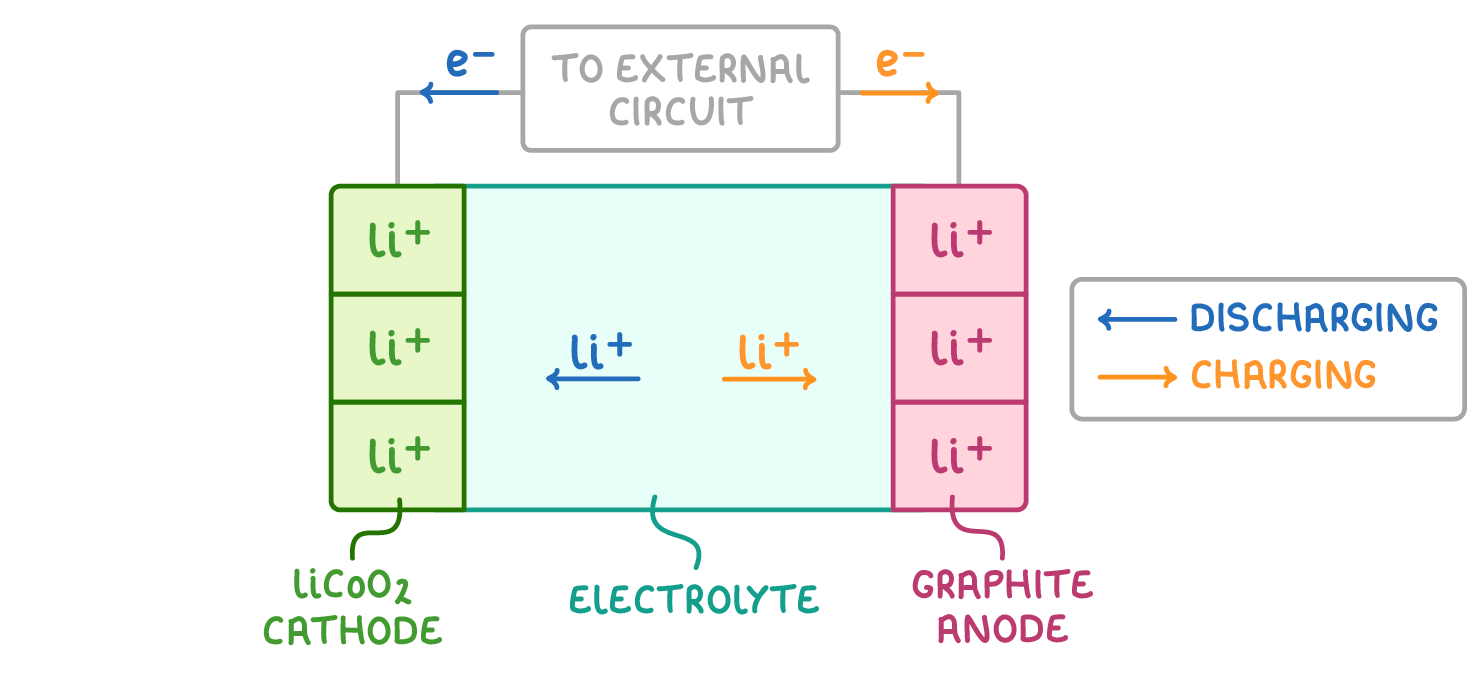
During discharge:
- Lithium atoms in the anode are oxidised to Li+ ions, releasing electrons.
- These electrons flow through the external circuit to the cathode.
- At the cathode, the Li+ ions from the electrolyte are incorporated into the LiCoO2 complex, reducing the cobalt.
The half-equations for this process are:
| Electrode | Discharging reaction |
|---|---|
| Anode | Li(s) ➔ Li+ + e- |
| Cathode | Li+ + e- + CoO2(s) ➔ LiCoO2(s) |
Combining these gives the overall cell discharging reaction:
Li(s) + CoO2(s) ➔ LiCoO2(s)
During recharge:
To recharge the battery, an external voltage is applied, driving these reactions in reverse:
| Electrode | Charging reaction |
|---|---|
| Anode | Li+ + e- ➔ Li(s) |
| Cathode | LiCoO2(s) ➔ Li+ + e- + CoO2(s) |
Combining these gives the overall cell charging reaction:
LiCoO2(s) ➔ Li(s) + CoO2(s)
Fuel cells
Fuel cells convert chemical energy from fuels directly into electrical energy. Like primary cells, fuel cells are not rechargeable, but they can operate continuously if supplied with a steady stream of fuel and oxygen.
Two common types of fuel cells are hydrogen fuel cells and direct methanol fuel cells (DMFCs).
Hydrogen fuel cells:
Hydrogen fuel cells use hydrogen gas (H2) as the fuel and oxygen gas (O2) as the oxidant. The process involves the following steps:
- At the anode, H2 is oxidised: H2(g) ➔ 2H+(aq) + 2e-
- The H+ ions move through the electrolyte to the cathode.
- At the cathode, O2 is reduced: O2(g) + 4H+(aq) + 4e- ➔ 2H2O(l)
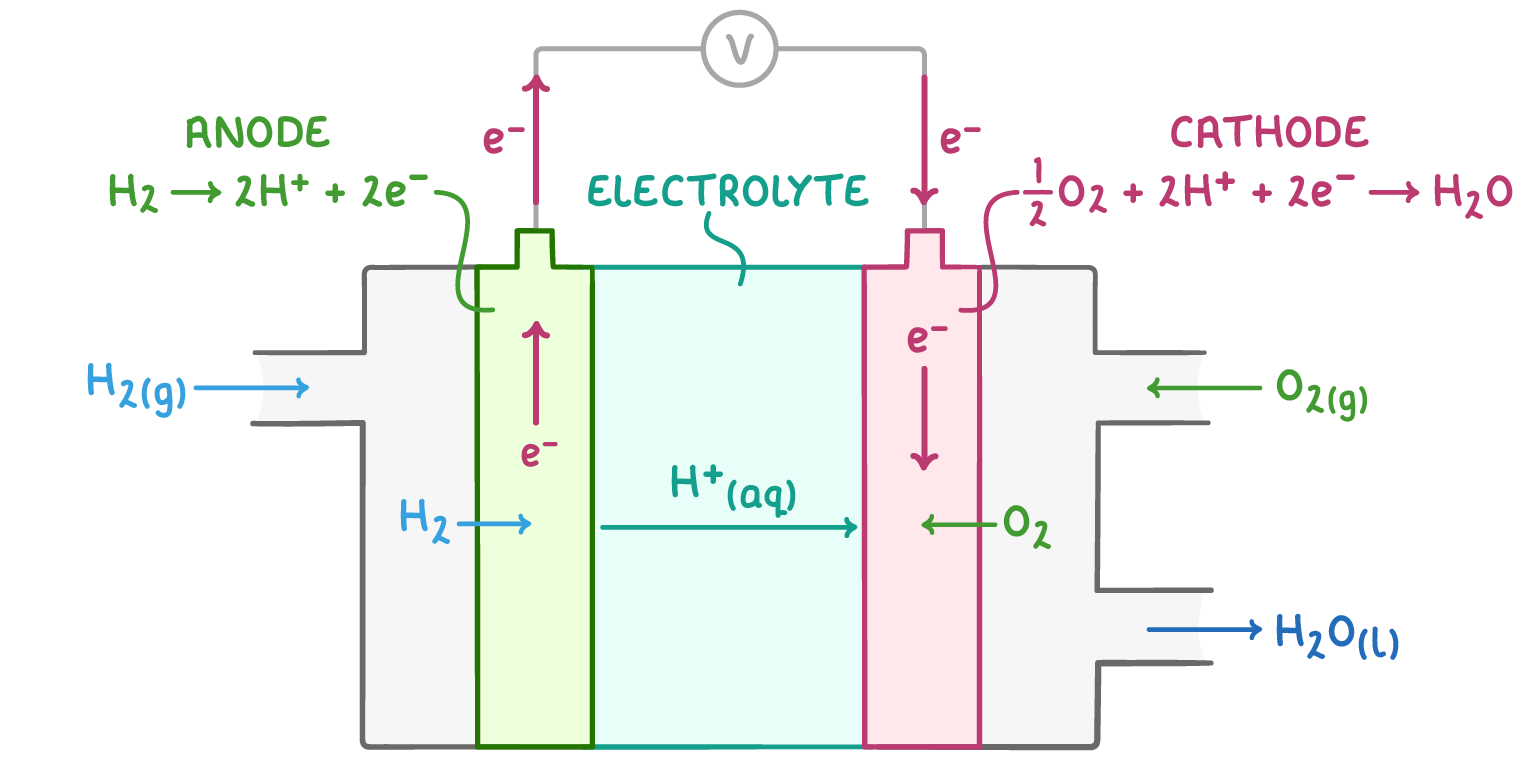
The overall reaction is:
2H2(g) + O2(g) ➔ 2H2O(l)
Hydrogen fuel cells produce no greenhouse gases, as the only product is water. However, they require pure hydrogen gas, which can be obtained through water electrolysis (powered by solar or wind energy) or steam reforming of hydrocarbons like methane: CH4(g) + H2O(g) ➔ 3H2(g) + CO(g)
Direct methanol fuel cells:
On the other hand, direct methanol fuel cells use liquid methanol (CH_3_OH) as the fuel and oxygen gas as the oxidant. The process involves the following steps:
- At the anode, CH3OH is oxidised: CH3OH_(l)_ + H_2_O_(l)_ ➔ CO_2(g)_ + 6H^+^(aq) + 6e-
- The H^+^ ions move through the electrolyte to the cathode.
- At the cathode, O_2_ is reduced: 3⁄2O_2(g)_ + 6H^+^(aq) + 6e^-^ ➔ 3H_2_O_(l)_
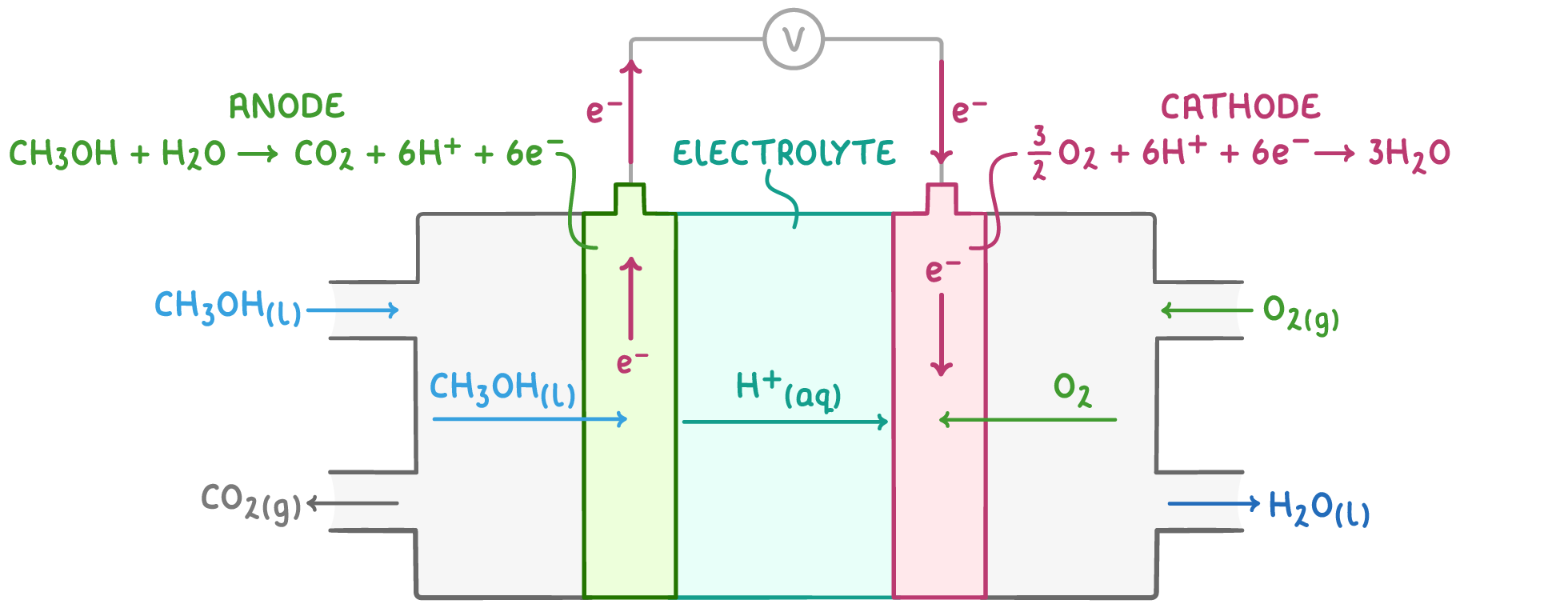
The overall reaction is:
CH3OH_(l)_ + 3⁄2O_2(g)_ ➔ CO_2(g)_ + 2H_2_O_(l)_
Direct methanol fuel cells do not require hydrogen gas extraction, as methanol is directly used. However, they produce carbon dioxide, a greenhouse gas, as a byproduct.
Comparing primary cells, secondary cells, and fuel cells
The advantages and disadvantages of primary cells, secondary cells and fuel cells are summarised in the tables below:
Primary cells:
| Advantages | Disadvantages |
|---|---|
| Convenient and portable | Not rechargeable |
| Inexpensive | Limited capacity |
| Long shelf life | Disposal can be environmentally harmful |
Secondary cells:
| Advantages | Disadvantages |
|---|---|
| Rechargeable, reducing waste and cost over time | Higher initial cost than primary cells |
| High current output | Shorter lifespan than primary cells |
| Suitable for high-power applications | Higher self-discharge rate |
Fuel cells:
| Advantages | Disadvantages |
|---|---|
| High energy efficiency | Expensive due to costly metal catalysts (e.g., platinum) |
| Continuous operation as long as fuel and oxidant are supplied | Require a constant supply of fuel and oxidant |
| Low emissions (hydrogen fuel cells produce only water) | Some fuels (e.g., methanol) produce greenhouse gases |
| Useful heat energy is generated |