1.1 - The Composition of Matter
- 1
Elements, compounds, and mixtures
- 2
Methods for separating mixtures
- 3
Homogeneous vs. heterogeneous mixtures
Elements, compounds, and mixtures
Matter can be classified into three main categories: elements, compounds, and mixtures.
Elements are the simplest form of matter and cannot be broken down into simpler substances by chemical means. Each element is composed of only one type of atom.
Examples include carbon (C), oxygen (O), and iron (Fe).
Compounds are formed when atoms of different elements chemically bond together in a fixed ratio. The properties of a compound differ from those of its constituent elements due to the chemical bonds between atoms.
Examples include water (H_2_O) and sodium chloride (NaCl).
Mixtures contain two or more elements or compounds combined in variable proportions without chemical bonding. The components of a mixture retain their individual properties and can be separated using physical methods.
Examples include air (a mixture of gases) and salt water (a mixture of salt and water).
Properties of elements, compounds, and mixtures
Elements, compounds, and mixtures can be distinguished by their properties:
| Property | Elements | Compounds | Mixtures |
|---|---|---|---|
| Composition | One type of atom | Fixed ratio of different atoms | Variable proportions of elements or compounds |
| Chemical bonds | No bonds (individual atoms) | Atoms chemically bonded | No chemical bonds between components |
| Separation | Cannot be separated by physical means | Cannot be separated by physical means | Can be separated by physical means |
Separating mixtures
The components of a mixture can be separated using differences in their physical properties. The choice of separation technique depends on the specific properties of the mixture components - such as solubility, boiling point, and particle size.
Some common separation techniques are:
1. Solvation (dissolution):
- Used to separate a soluble solid from an insoluble solid using a solvent.
- The solvent is added to the mixture, dissolving the soluble solid while leaving the insoluble solid undissolved.
- Example: Separating salt (soluble solid) from sand (insoluble solid) using water as the solvent.
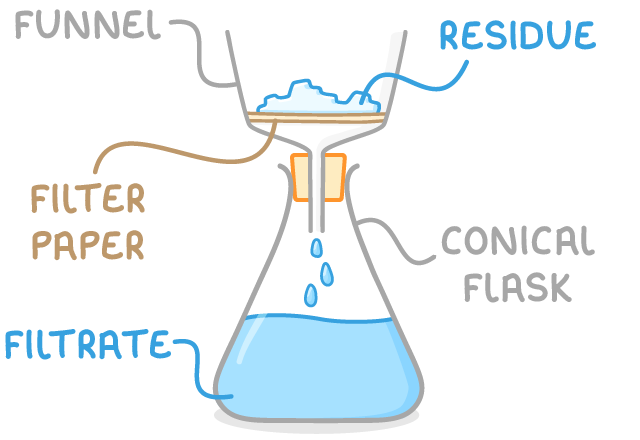
2. Filtration:
- Used to separate an insoluble solid from a liquid.
- The mixture is poured through filter paper.
- The residue (insoluble solid) collects on the filter paper while the filtrate (liquid) passes through.
3. Recrystallisation:
- Used to purify a soluble solid from a liquid or solution.
- The impure solid is dissolved in a minimum amount of hot solvent.
- Upon cooling, the pure solid crystallises from the solution, leaving impurities in the solution.

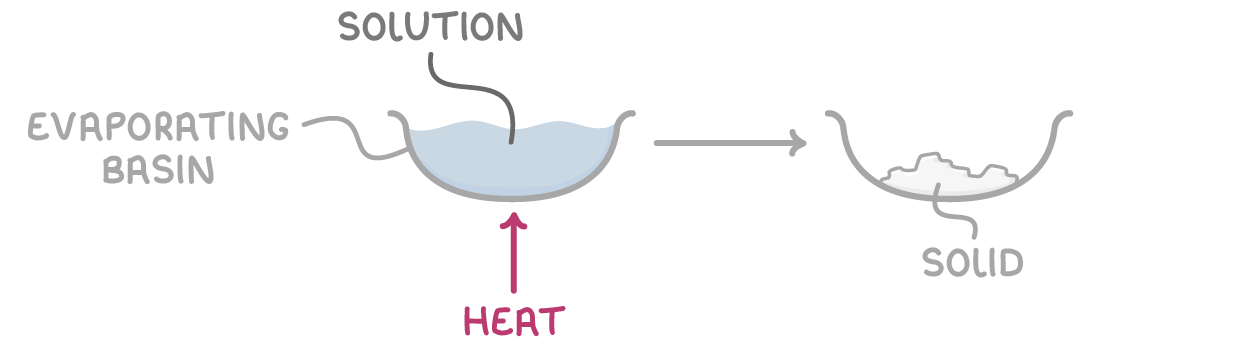
4. Evaporation:
- Used to separate a soluble solid from a liquid.
- The mixture is heated to evaporate the liquid, leaving the solid behind.
- Example: Obtaining salt from a salt solution by heating until the water evaporates completely.
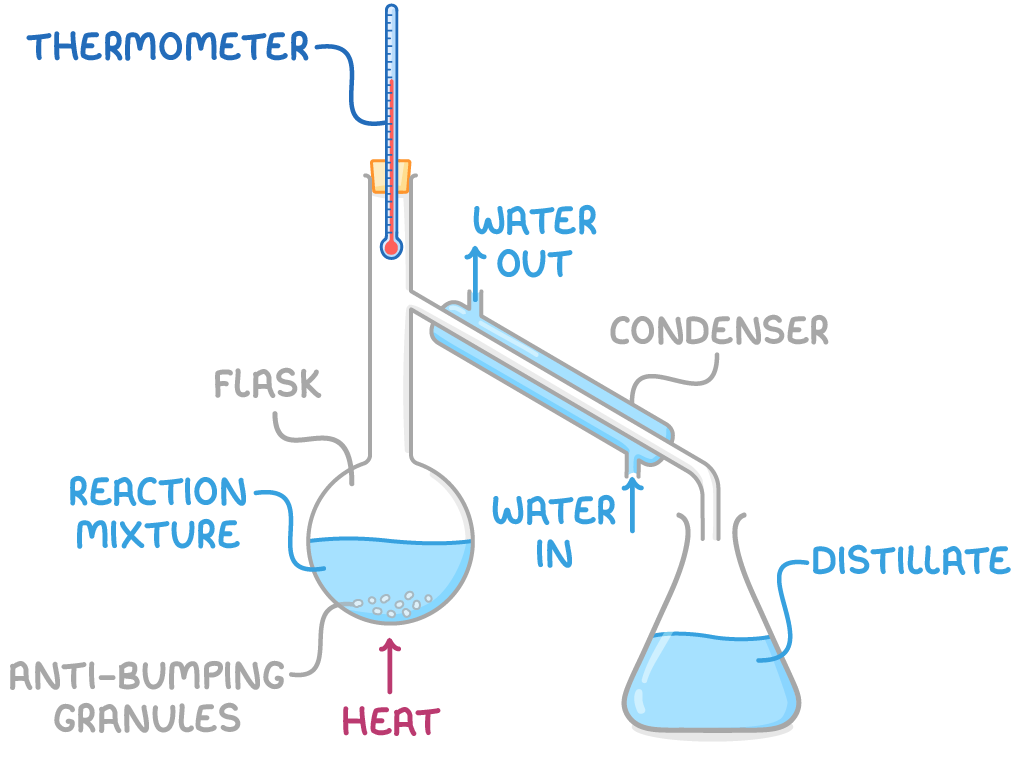
5. Distillation:
- Used to separate miscible liquids with different boiling points.
- The mixture is heated until the comoponent with the lowest boiling point vaporises.
- The vapours are cooled and condensed back into a liquid, known as the distillate, while the liquid(s) with higher boiling points remain in the original flask.
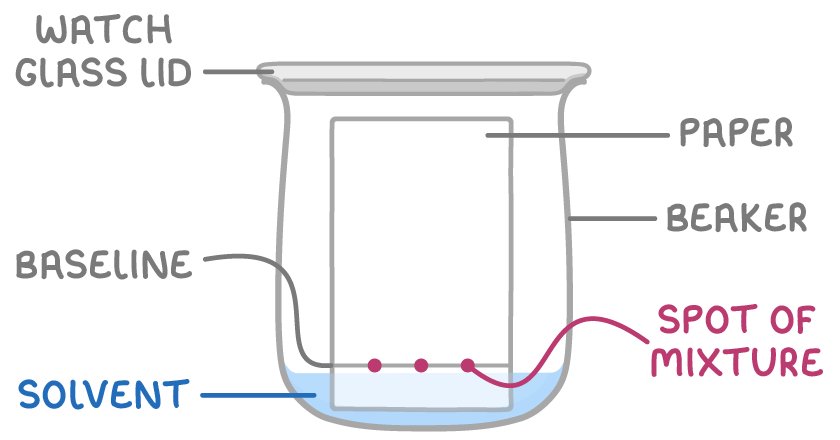
6. Paper chromatography:
- Used to separate dissolved substances based on their interaction with the paper (stationary phase) and the solvent (mobile phase).
- The mixture is spotted on the paper's baseline, and the paper is placed in the solvent.
- Each component travels a unique distance up the paper, determined by its solubility in the solvent and its adsorption to the paper.
The principles of these separation techniques are summarised in the table below.
| Technique | Separates | Basis of separation |
|---|---|---|
| Solvation | Soluble and insoluble solids | Solubility |
| Filtration | Insoluble solid from liquid | Particle size |
| Recrystallisation | Pure solid from solution | Solubility |
| Evaporation | Soluble solid from liquid | Boiling point |
| Distillation | Miscible liquids | Boiling point |
| Paper chromatography | Dissolved substances | Solubility, adsorption |
Homogeneous vs. heterogeneous mixtures
Mixtures can be further classified as homogeneous or heterogeneous based on the distribution of their components.
Homogeneous mixtures have a uniform composition and appearance throughout. The components are evenly distributed, and the mixture has a single phase.
Examples include air, salt water, and alloys.
Heterogeneous mixtures have a non-uniform composition and appearance, with the components unevenly distributed. The mixture may have multiple distinct phases.
Examples include oil and water, sand and gravel, and a mixture of iron filings and sulfur powder.