11.4 - Naming Organic Compounds
- 1
How to use the IUPAC system to name organic compounds
- 2
Naming rules for alkanes, alkenes, halogenoalkanes, alcohols, aldehydes, ketones and carboxylic acids
The importance of a systematic naming system
Millions of different organic compounds are known. A clear, universal naming system is essential to enable chemists to communicate about these compounds without ambiguity.
The International Union of Pure and Applied Chemistry (IUPAC) has developed a comprehensive nomenclature system for naming both organic and inorganic compounds.
The IUPAC name of an organic compound provides key information about its structure, including:
- The length of the longest carbon chain.
- The functional groups present.
- The identity and position of any substituent groups.
A substituent is any part of an organic molecule that is not part of the longest carbon chain. This includes any alkyl groups branching off the main chain in an alkane.
General steps for naming organic compounds
To assign an IUPAC name to an organic compound:
- Identify the longest carbon chain that contains the principal functional group (if present). This is the parent chain.
- Determine the root name based on the number of carbons in the parent chain.
- Number the carbons in the parent chain.
- Identify and name any substituents using prefixes. List prefixes alphabetically.
- Use multiplier prefixes (di-, tri-, etc.) for multiple identical substituents.
- Add a suffix to indicate saturation and the principal functional group.
Naming alkanes
Alkanes are saturated hydrocarbons containing only C-C single bonds. They have the general formula CnH2n+2 and the suffix "-ane".
The steps for naming alkanes are:
Step 1: Determining the root name
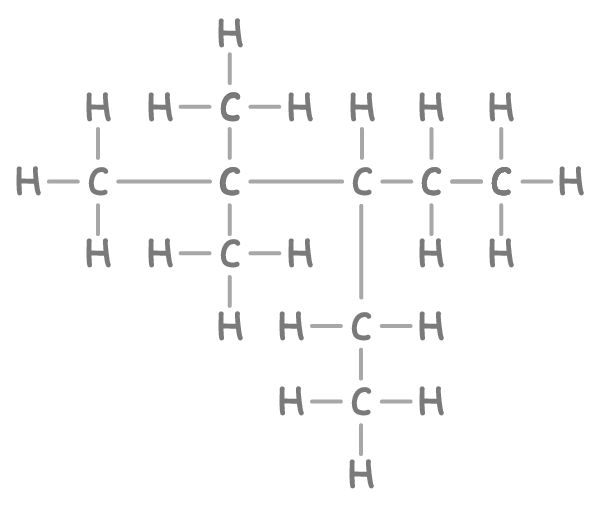
Find the longest continuous carbon chain and use this to determine the root name, as per the following table:
| Number of C atoms | Root name |
|---|---|
| 1 | Meth- |
| 2 | Eth- |
| 3 | Prop- |
| 4 | But- |
| 5 | Pent- |
| 6 | Hex- |
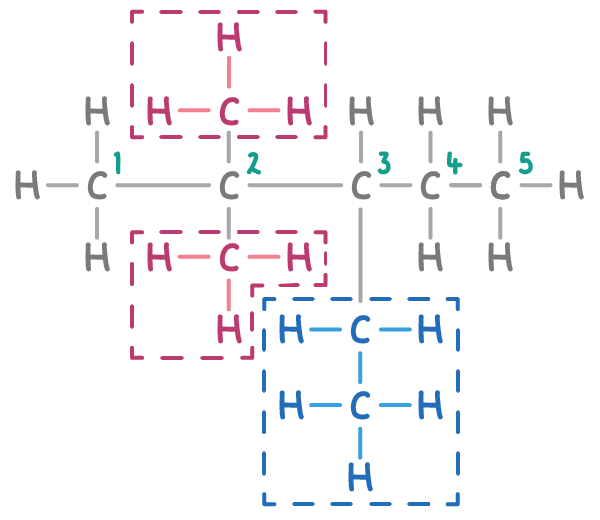
For instance, in the illustrated compound below, the longest continuous carbon chain comprises 5 carbons, hence the stem name is pent-.
Step 2: Naming alkyl substituents
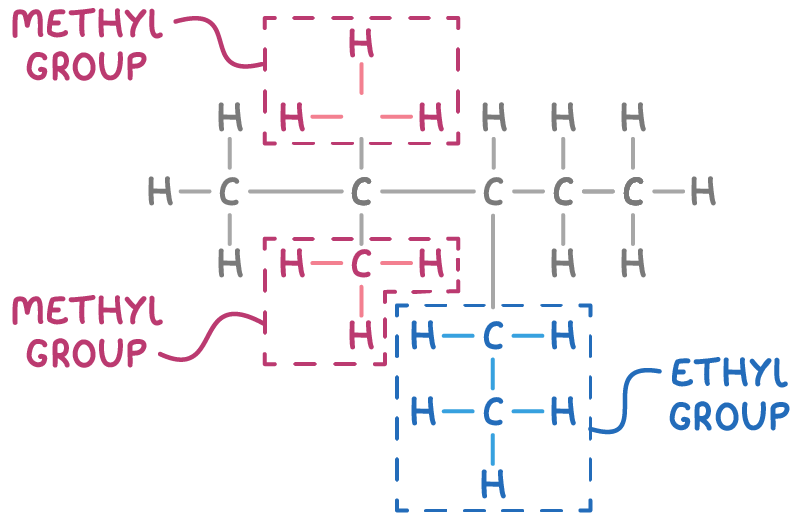
Identify and name alkyl substituents. These are named by changing the -ane ending of the alkane to -yl, as per the following table:
| Substituent | Condensed formula |
|---|---|
| Methyl | -CH_3_ |
| Ethyl | -CH_2_CH_3_ |
| Propyl | -CH_2_CH_2_CH_3_ |
For example, the compound illustrated contains methyl (-CH3) and ethyl (-CH2CH3) groups.
Step 3: Numbering the longest carbon chain
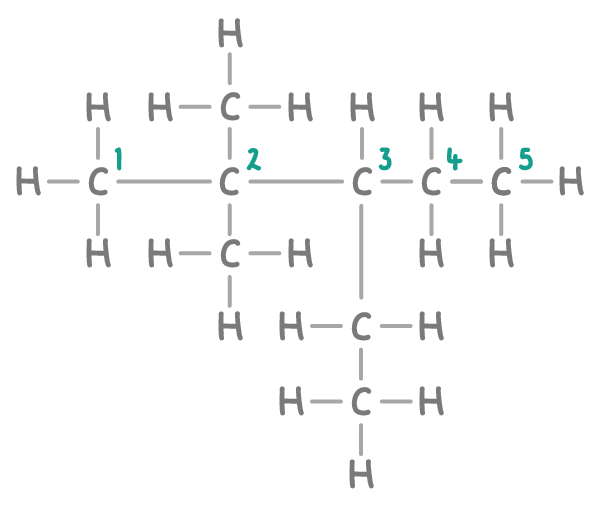
Number the carbons in the parent chain so substituents have the lowest possible number (locant).
In our example, numbering the 5 carbon atoms with the methyl and ethyl groups being assigned the lowest number results in a sequence from 1 to 5.
Step 4: Adding substituent prefixes
- Name the substituents alphabetically before the root, indicating the carbon number to which they are attached.
- Use a hyphen between the number and substituent name.
In the compound shown, there is an ethyl group on carbon 3 and methyl groups on carbon 2.
Step 5: Using multipliers
Name multiple identical substituents using the following prefixes:
- di- for 2.
- tri- for 3.
- tetra- for 4.
These multipliers do not affect the alphabetical order of the side chains. Separate locants with commas.
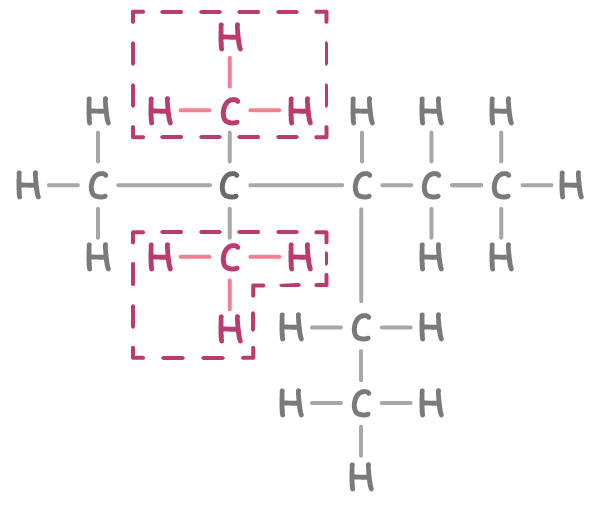
In our example, the presence of two identical methyl groups is indicated by the prefix di-.
Step 6: Putting together the complete name
Combine all the information from the previous steps to name the compound systematically.
Thus, the compound's name is 3-ethyl-2,2-dimethylpentane, comprising of:
- 3-ethyl- = Ethyl group on carbon 3.
- 2,2-dimethyl- = Two methyl groups on carbon 2.
- pent = Stem for 5 carbons.
- ane = Suffix for alkanes.
Naming alkenes
Alkenes are unsaturated hydrocarbons containing a carbon-carbon double bond. They have the general formula CnH2n.
The steps for naming alkenes are very similar to alkanes, except:
- The suffix becomes -ene instead of -ane.
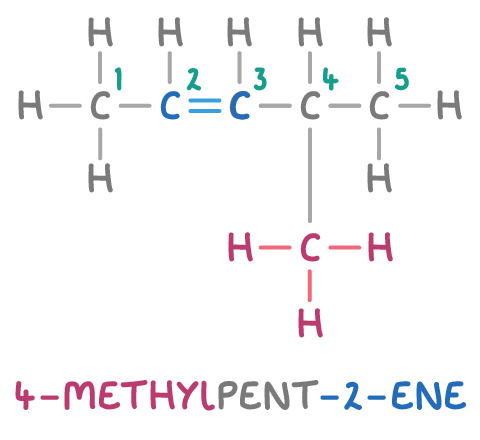
- The carbon chain is numbered to give the C=C bond the lowest locant, even if this gives substituents higher locants
For example:
Naming halogenoalkanes
Halogenoalkanes contain one or more halogen atoms (F, Cl, Br, I) bonded to an alkyl group.
The halogens are named as substituents using the prefixes:
| Halogen | F | Cl | Br | I |
|---|---|---|---|---|
| Prefix | fluoro- | chloro- | bromo- | iodo- |
The steps for naming halogenoalkanes are:
- Name the parent alkane chain.
- Identify halogens and use the prefixes above.
- Number the carbon chain to give the substituent the lowest locant. The C=C double bond is still the highest priority.
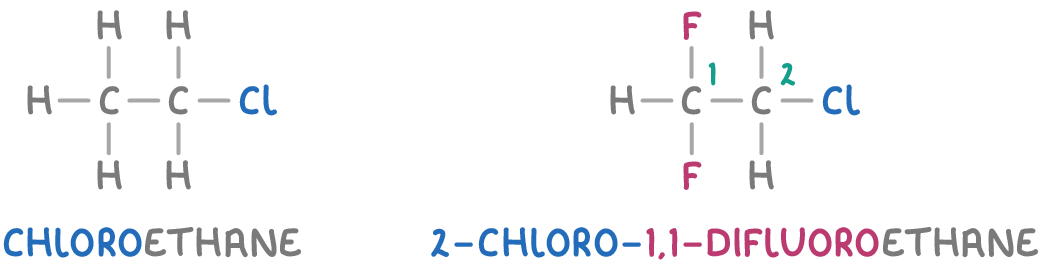
- No locant is needed for derivatives of methane (CH4) or ethane (CH3CH3) with only one halogen atom.
- Multiple halogens are listed in alphabetical order.
For example:
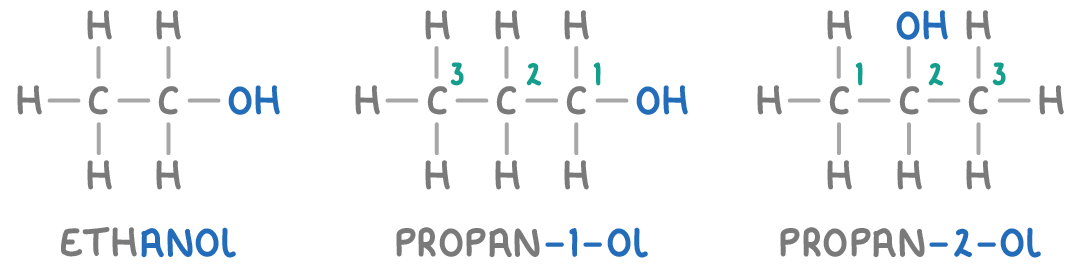
Naming alcohols
Alcohols contain an -OH hydroxyl functional group.
The steps for naming alcohols are:
- Name the parent alkane chain.
- Change the suffix from -ane to -anol.
- Number the carbon chain to give -OH the lowest locant. The hydroxyl group takes priority over C=C bonds and alkyl substituents.
- No number is needed for methanol or ethanol as the position of -OH does not change the structure.
- For alcohols with 3 or more carbons, use locants to specify the position of -OH.
For example:
Naming aldehydes and ketones
Aldehydes and ketones both contain a C=O carbonyl functional group but its position differs:
- In aldehydes, the C=O is always at the end of the carbon chain (attached to C1).
- In ketones, the C=O is never at the end of the carbon chain.
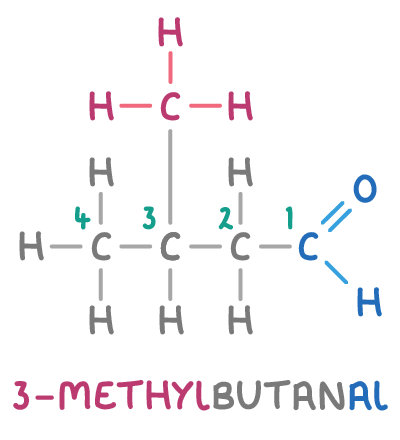
The steps for naming aldehydes are:
- Name the parent alkane chain.
- Change the suffix to -al. No number is needed as the aldehyde group is always at the end.
- Number any substituents starting from the C=O carbon.
For example:
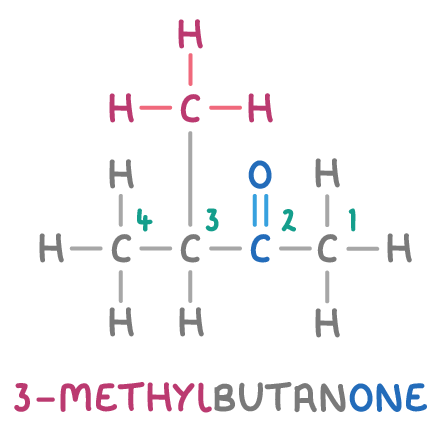
The steps for naming ketones are:
- Name the parent alkane chain.
- Change the suffix to -one.
- Number the carbon chain to give the C=O the lowest locant.
For example:
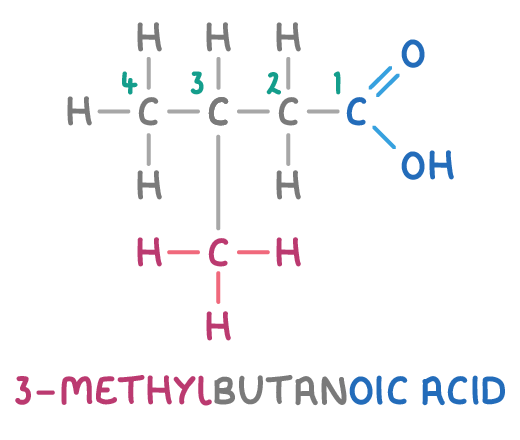
Naming carboxylic acids
Carboxylic acids contain a -COOH carboxyl functional group, which is always at the end of the carbon chain.
The steps for naming carboxylic acids are:
- Name the parent alkane chain.
- Change the suffix from -ane to -oic acid.
- Number any substituents starting from the -COOH carbon.
- The -COOH carbon is included when determining the longest carbon chain.
For example: