12.1 - Exothermic & Endothermic Reactions
- 1
The difference between heat and temperature
- 2
Exothermic and endothermic reactions
- 3
Interpreting energy profiles
Heat and temperature are distinct concepts
While heat and temperature are closely related, they represent different physical quantities:
Temperature (T)
- Temperature is a measure of the average kinetic energy of the particles in a substance.
- It is an example of a state function - The change in temperature depends only on the initial and final states, not the pathway between them.
- Temperature change (ΔT) is calculated as: ΔT = Tfinal $-$ Tinitial.
- The SI unit for temperature is kelvin (K). 0 K is defined as absolute zero, the theoretical temperature at which all particle motion ceases.
Heat (q)
- Heat is thermal energy that is transferred from a warmer object to a cooler one due to the temperature difference between them.
- Heat can be transferred via conduction, convection or radiation.
- When an object gains heat, the average kinetic energy and thus the temperature of its particles increases.
- The SI unit for heat is joule (J).
The key difference is that heat refers to the transfer of thermal energy, while temperature is a measure of the average kinetic energy of particles in a substance at a given time.
Enthalpy change
The enthalpy change ($\Delta H$) is defined as the heat transferred at constant pressure between a closed reaction system and its surroundings during a reaction. Enthalpy changes are typically measured in kJ mol-1.
The enthalpy change is defined from the perspective of the system:
- If the reaction system loses heat to its surroundings, $\Delta H$ is negative.
- If the reaction system gains heat from its surroundings, $\Delta H$ is positive.
Exothermic and endothermic reactions
Chemical reactions involve the breaking and forming of bonds, which is accompanied by energy changes. Reactions can be classified as exothermic or endothermic based on the direction of heat flow between the reaction system and the surroundings.
Exothermic reactions
- Heat is released from the reaction system to the surroundings.
- The temperature of the surroundings increases.
- The enthalpy change (ΔH) is negative.
- Products have lower enthalpy than reactants, making them more thermodynamically stable.
For example, the combustion of methane is exothermic:
CH4(g) + 2O2(g) ➔ CO2(g) + 2H2O(l) ΔH = -890 kJ mol-1
Endothermic reactions
- Heat is absorbed by the reaction system from the surroundings.
- The temperature of the surroundings decreases.
- The enthalpy change (ΔH) is positive.
- Products have higher enthalpy than reactants, making them less thermodynamically stable.
For example, the thermal decomposition of calcium carbonate is endothermic:
CaCO3(s) ➔ CaO(s) + CO2(g) ΔH = +178 kJ mol-1
Energy profiles visualise enthalpy changes
Enthalpy profile diagrams show how the potential energy levels of reactants and products change during a reaction.
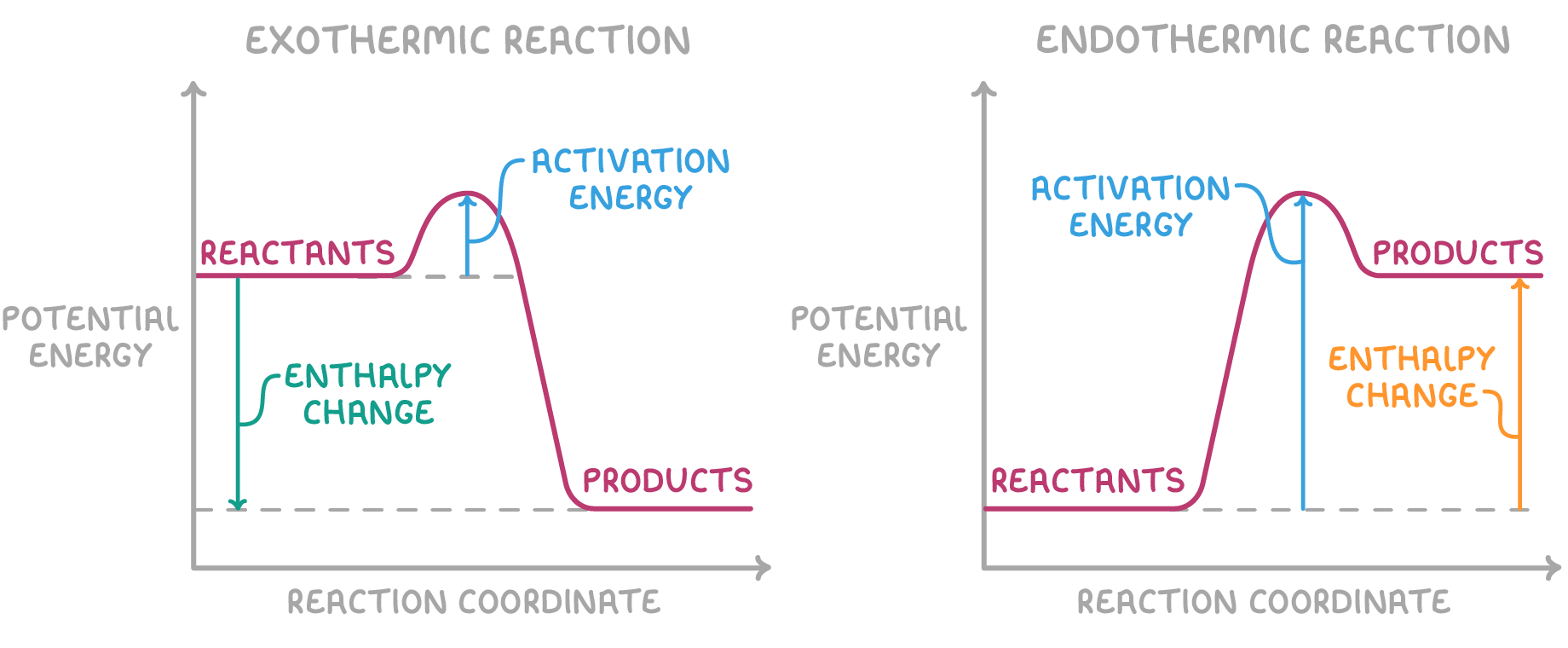
Key features include:
- The activation energy is the minimum energy needed for a reaction to occur.
- In exothermic reactions, the products have lower potential energy (and are more stable) than the reactants. The ΔH arrow points upwards.
- In endothermic reactions, the products have higher potential energy (and are less stable) than the reactants. The ΔH arrow points downwards.