19.3 - Properties of Acids & Bases
- 1
The structure and properties of Brønsted–Lowry acids
- 2
Classification of acids as monoprotic, diprotic, or triprotic
- 3
The strength and dissociation of acids
- 4
Trends in acid strength and acid-base equilibria
- 5
The structure and properties of Brønsted–Lowry bases
Structure and properties of Brønsted–Lowry acids
Brønsted–Lowry acids are molecules that can donate protons (H+ ions). They contain at least one exchangeable hydrogen atom that can dissociate from the molecule. These exchangeable hydrogens are usually bonded to highly electronegative atoms like oxygen, halogens, or sulfur.
Examples of acids with exchangeable hydrogens (shown in blue) include:
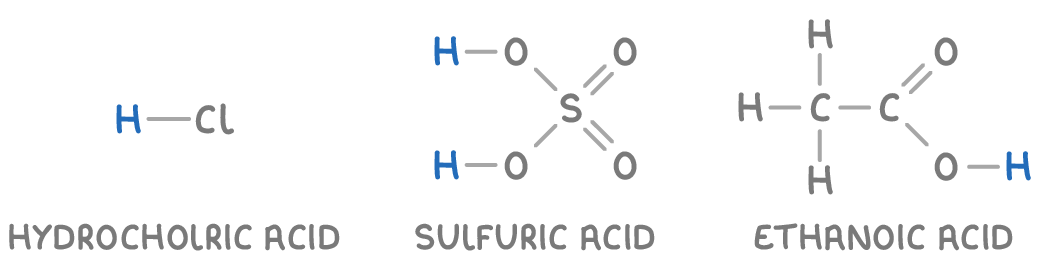
When an acid dissolves in water, the exchangeable hydrogens dissociate to form H⁺(aq) ions, while the remaining molecule forms an anion called the acid residue:
HCl(aq) ➔ H+(aq) + Cl-(aq)
CH3COOH(aq) ⇌ H+(aq) + CH3COO-(aq)
The tendency for exchangeable hydrogens to dissociate depends on the difference in electronegativity (Δχ) between the hydrogen atom and the atom it is bonded to:
- C and H have similar electronegativities (Δχ = 0.4) - So C-H bonds are not very polar and the hydrogens do not dissociate easily.
- O is much more electronegative than H (Δχ = 1.2) - So O-H bonds are highly polar. The bonding electrons are drawn towards the oxygen atom, giving the hydrogen a partial positive charge and allowing it to dissociate readily.
Classifying acids as monoprotic, diprotic, or triprotic
Acids are classified based on the number of exchangeable hydrogen atoms they possess:
- Monoprotic acids - Have one exchangeable hydrogen e.g., HCl, CH3COOH.
- Diprotic acids - Have two exchangeable hydrogens e.g., H2SO4.
- Triprotic acids - Have three exchangeable hydrogens e.g., H3PO4.
Diprotic and triprotic acids are classed as polyprotic.
Note that organic acids often contain both exchangeable and non-exchangeable hydrogens. For example, methanoic (HCOOH) acid and ethanoic (CH3COOH) acid are monoprotic despite containing a total of two and four hydrogen atoms respectively.
Acid strength and dissociation
Acids can be categorised as strong or weak based on how completely they dissociate in aqueous solution:
- Strong acids (e.g. HCl, HBr, HI, HNO3 and H2SO4) - Dissociate completely and irreversibly:
HCl(aq) ➔ H+(aq) + Cl-(aq)
- Weak acids (e.g. CH3COOH) - Only partially dissociate, establishing an equilibrium:
CH3COOH(aq) ⇌ H+(aq) + CH3COO-(aq)
It is important to distinguish between acid strength and acid concentration. For example, a dilute solution of a strong acid will still dissociate completely:
| Concentrated | Dilute | |
|---|---|---|
| Strong | 10 mol dm-3 HCl | 0.1 mol dm-3 HCl |
| Weak | 10 mol dm-3 CH3COOH | 0.1 mol dm-3 CH3COOH |
Polyprotic acids dissociate in a stepwise manner, with the first proton dissociating much more readily than subsequent protons:
H2SO4(aq) ⇌ H+(aq) + HSO4-(aq) (1st dissociation)
HSO4-(aq) ⇌ H+(aq) + SO42-(aq) (2nd dissociation)
This is because the anion becomes increasingly negatively charged after each proton dissociation, making it harder to remove further protons due to stronger electrostatic attractions.
Trends in binary acid strength and acid-base equilibria
The strength of binary acids (acids containing only two elements) increases as you move across a period and down a group.
This trend arises from the decreasing base strength of the conjugate bases. The position of the acid-base equilibrium depends on the relative strengths of the conjugate acid-base pairs involved, always favouring the side with the weaker conjugate species.
For example, in period 3:
- PH3 is not acidic - Its conjugate base (PH2-) is a very strong base, so the equilibrium lies entirely to the left:
PH3(aq) + H2O(l) ⇌ PH2-(aq) + H3O+(aq)
- H2S is a weak acid - Its conjugate base (HS⁻) is a moderately strong base, so the equilibrium lies mostly to the left:
H2S(aq) + H2O(l) ⇌ HS-(aq) + H3O+(aq)
- HCl is a strong acid - Its conjugate base (Cl⁻) is a very weak base, so the equilibrium lies entirely to the right:
HCl(aq) + H2O(l) ➔ Cl-(aq) + H3O+(aq)
Structure and properties of bases
Most inorganic bases are metal hydroxides containing a metal cation bonded to one or more hydroxide (OH-) anions.
The nature of this bond depends on the electronegativity of the metal:
- Group 1 and group 2 metals - Form ionic hydroxides due to their low electronegativities e.g. NaOH.
- Transition metals - Form covalent hydroxides with polar covalent metal-OH bonds e.g. Fe(OH)2).
Ionic metal hydroxides are strong bases. Most are readily soluble in water and dissociate completely:
NaOH(aq) ➔ Na+(aq) + OH-(aq)
In contrast, covalent metal hydroxides are generally insoluble weak bases that only react with acids.
Ammonia (NH_3_) is an important inorganic base that does not contain a metal. In aqueous solution it acts as a weak base, accepting protons from acids or water to form ammonium (NH_4_^+^) ions:
NH3(aq) + H+(aq) ⇌ NH4+(aq)
NH3(aq) + H2O(l) ⇌ NH4+(aq) + OH-(aq)
Organic derivatives of ammonia, called amines, contain one or more hydrocarbon substituents on the nitrogen atom and act as weak bases like ammonia. For example, methylamine (CH3NH2) accepts protons from acids or water:
CH3NH2(aq) + H+(aq) ⇌ CH3NH3+(aq)
CH3NH2(aq) + H2O(l) ⇌ CH3NH3+(aq) + OH-(aq)
Conjugate acid-base pairs
The conjugate bases of weak acids can also behave as bases themselves. For example, the ethanoate anion from ethanoic acid can react with protons to re-form the acid:
CH3COO-(aq) + H+(aq) ⇌ CH3COOH(aq)
The equilibrium lies far to the right because ethanoic acid is a weak acid, so forming it is thermodynamically favourable.
In water, ethanoate reacts to produce hydroxide ions:
CH3COO-(aq) + H2O(l) ⇌ CH3COOH(aq) + OH-(aq)
This involves two conjugate acid-base pairs:
- CH3COO-(aq) (base) / CH3COOH (conjugate acid).
- H2O (acid) / OH- (conjugate base).
The equilibrium lies to the left because water is a weaker acid than ethanoic acid.
Anions of polyprotic acids act as bases, for example:
CO32-(aq) + H+(aq) ⇌ HCO3-(aq)
HCO3-(aq) + H+(aq) ⇌ H2CO3(aq)
This is the reverse of the stepwise dissociation of polyprotic acids.