8.1 - Metallic Bonding
- 1
The structure of metals
- 2
How metallic bonds are formed
- 3
Factors affecting the strength of metallic bonds
- 4
The properties of metals and their uses
- 5
Properties of transition elements
Metals have metallic lattice structures
Metals exist as giant lattice structures made up of:
- Positively charged metal cations (e.g. Na+, Mg2+)
- Delocalised electrons that move freely between the cations
The outer electrons of metal atoms leave to become delocalised, resulting in positively charged metal cations.
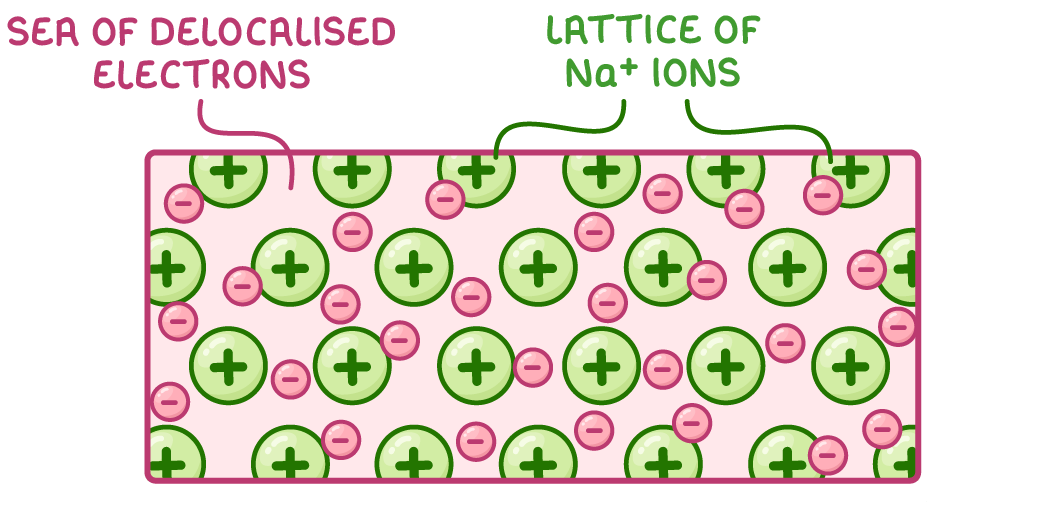
A 2D model of sodium’s giant metallic lattice structure is shown above.
Metallic bonding occurs between metal cations and delocalised electrons
- Metallic bonding refers to the electrostatic attractions between positively charged metal ions (e.g. Na+, Mg2+) and negatively charged delocalised electrons.
- These metallic bonds are very strong and hold the metals in their lattice structure.
Strength of metallic bonds
The strength of metallic bonds determines the melting point of a metal. The stronger the metallic bonds, the higher the melting point.
The strength of these bonds is influenced by three main factors:
- Number of delocalised electrons per atom:
- Metals with a higher number of delocalised electrons per atom tend to form stronger metallic bonds.
- The increased number of delocalised electrons allows for stronger electrostatic attractions between the electrons and the metal cations.
- Charge of the metal cation:
- A higher cation charge results in stronger electrostatic attractions between the cation and the delocalised electrons.
- Radius of the metal cation:
- Smaller metal cations have a higher charge density, which allows them to hold the delocalised electrons closer to the nucleus.
- This proximity enhances the electrostatic attractions between the cation and the electrons, resulting in a stronger metallic bond.
Melting point decreases down a group
As we move down a group, the melting point of metals decreases due to increasing ionic radius. A larger ionic radius results in weaker electrostatic forces of attraction between the cations and delocalised electrons, leading to weaker metallic bonds.
| Group 1 metal | Charge of the cation | Ionic radius (10^-12^ m) | Melting point (°C) |
|---|---|---|---|
| Li | 1+ | 76 | 181 |
| Na | 1+ | 102 | 98 |
| K | 1+ | 138 | 63 |
For example, in group 1, lithium has the highest melting point, followed by sodium and potassium. The increasing size of the cations from lithium to potassium leads to weaker metallic bonds and lower melting points.
Melting point increases across a period
When comparing the melting points of metals across a period, we observe an increase in melting point from left to right. This trend can be attributed to:
- Decreasing ionic radius - Smaller cations result in stronger electrostatic attractions, strengthening the metallic bonds.
- Increasing ionic charge - A higher ionic charge enhances the electrostatic attraction, further strengthening the metallic bonds.
- Greater number of delocalised electrons per ion - More delocalised electrons per ion contribute to stronger metallic bonds.
| Period 3 metal | Charge of the cation | Ionic radius (10^-12^ m) | Melting point (°C) |
|---|---|---|---|
| Na | 1+ | 102 | 98 |
| Mg | 2+ | 72 | 650 |
| Al | 3+ | 54 | 660 |
For example, in period 3, the melting point increases from sodium to magnesium to aluminium due to the combined effect of decreasing ionic radius, increasing ionic charge, and a greater number of delocalised electrons per ion, all contributing to stronger metallic bonds.
Properties explained by metallic bonding
The properties of metals result from their metallic bonding and lattice structure:
- High melting and boiling points - The strong electrostatic forces of attraction between the positively charged metal cations and the sea of delocalised electrons must be overcome for the lattice to break apart; this requires large amounts of energy.
- Good conductors of electricity and heat - The delocalised electrons can flow freely through the lattice to transfer charge and heat energy.
- Malleable and ductile - Layers of the cation lattice can slide over one another when the metal is hammered or pulled because there are no bonds locking individual cations together.
- Insoluble - The strength of the metallic bonding prevents water or other solvent molecules from pulling the cations away from the lattice structure and dissolving the metal.
Uses of metals
The characteristic properties of metals make them suitable for a wide range of applications:
- Metals with high melting points, such as tungsten and molybdenum, are used in high-temperature applications like light bulb filaments and furnace components.
- Metals like copper and aluminum are used in electrical wiring and components due to their excellent electrical conductivity.
- Metals with high thermal conductivity, such as copper and aluminum, are used in heat exchangers, radiators, and cookware to efficiently transfer heat.
- Malleable metals like gold, silver, and copper are used in jewelry making and decorative applications because they can be easily shaped without breaking.
Properties of transition elements
Transition elements, found in the d-block of the periodic table, have partially filled d sublevels. This unique electronic configuration gives rise to their characteristic properties, such as high melting points and excellent electrical conductivity.
- High melting points
- In transition elements, the electrons in the d sublevel become delocalised, in addition to the electrons in the outer level.
- This increased electron density strengthens the electrostatic forces of attraction between the cations and the surrounding sea of electrons.
- Consequently, transition elements generally have higher melting points compared to group 1 and group 2 metals.
- Electrical conductivity
- The presence of a large number of delocalised electrons in transition elements contributes to their excellent electrical conductivity.
- When a potential difference is applied to a transition metal sample, the abundant delocalised electrons can easily move along the sample, facilitating the flow of electric current.