22.3 - Lewis Acids & Bases
- 1
The definitions of Lewis acids and bases
- 2
Comparing Lewis theory to Brønsted-Lowry theory
- 3
The relationship between Lewis theory and nucleophiles/electrophiles
- 4
Reactions between Lewis acids and bases
Defining Lewis acids and bases
Lewis acid-base theory is a general approach to classifying substances based on their ability to accept or donate electron pairs.
- Lewis acid - An electron pair acceptor. Examples include H3O+, CH3+ and Cu2+.
- Lewis base - An electron pair donor. Examples include NH3, H2O and Cl-.
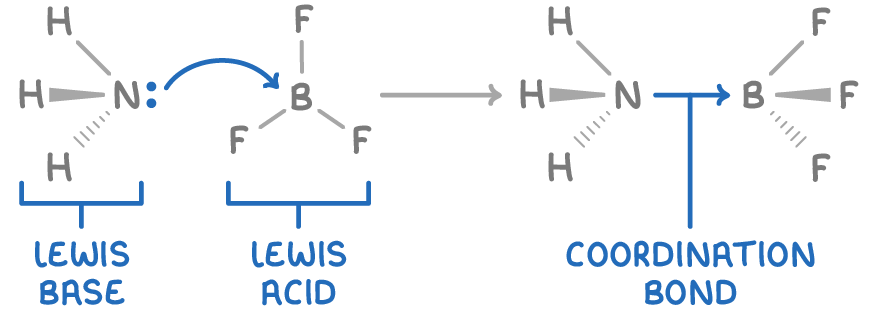
When a Lewis acid reacts with a Lewis base, they form a coordination bond - a covalent bond formed by the donation of a lone pair from the Lewis base to the Lewis acid.
Comparing Lewis theory to Brønsted-Lowry theory
Lewis acid-base theory is more general than Brønsted-Lowry theory.
- Brønsted-Lowry theory focuses on proton transfer.
- Lewis theory considers the transfer of electron pairs.
Brønsted-Lowry bases like OH- and NH3 are also Lewis bases, as they can donate a lone pair to form a bond with H+ (a Lewis acid).
However, Lewis theory can also explain reactions that don't involve proton transfer. For example:
H3N: + BF3 ➔ H3N→BF3
Here, NH3 is a Lewis base (electron pair donor) and BF3 is a Lewis acid (electron pair acceptor), but no proton transfer occurs.
Lewis acids and bases in organic reactions
Lewis acid-base theory is closely related to the concept of nucleophiles and electrophiles in organic chemistry.
- Nucleophile - An electron-rich species with a lone pair, which can act as a Lewis base.
- Electrophile - An electron-deficient species that can accept a pair of electrons, acting as a Lewis acid.
In the reaction between BF3 and NH3:
- NH3 acts as a nucleophile (Lewis base), donating its lone pair.
- BF3 is an electrophile (Lewis acid), accepting the electron pair into its vacant 2p orbital.
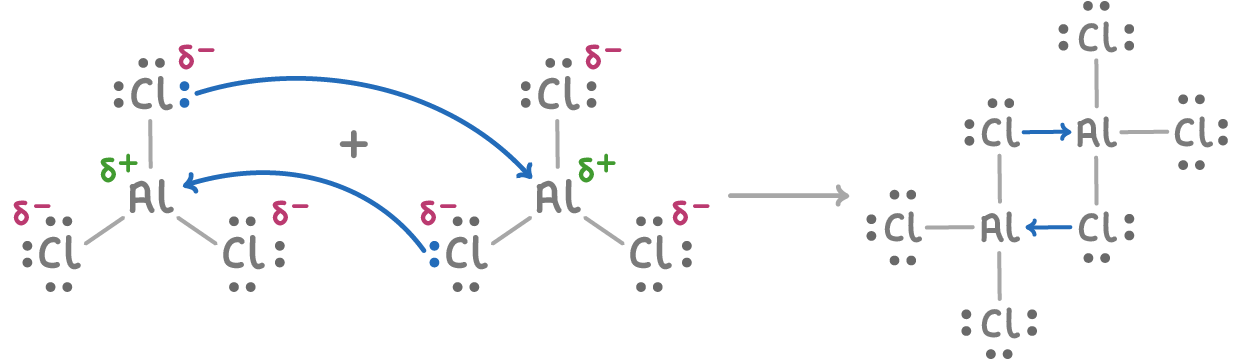
Some compounds can act as both Lewis acids and bases. For example, AlCl3 can form dimers (Al2Cl6) where:
- The electron-deficient Al atom in each AlCl_3_, acting as a Lewis acid, accepts a lone pair from a Cl atom in the adjacent AlCl_3_ molecule
- At the same time, a Cl atom in each AlCl_3_, acting as a Lewis base, donates a lone pair to the Al atom in the adjacent AlCl_3_ molecule.