10.8 - Transition Element Complexes
- 1
What transition metal complexes are
- 2
The splitting of d orbitals in complexes
- 3
The absorption of visible light by complexes
- 4
Factors affecting the colours of complexes
Transition metals form coloured complexes with ligands
Transition metals can form brightly coloured compounds called complexes when they bond to molecules or ions known as ligands.
- Ligands have a lone pair of electrons that they donate to the transition metal cation.
- This forms a special type of covalent bond called a coordination bond between the ligand and the metal ion.
- The transition metal cation is called the central ion and is surrounded by the ligands.
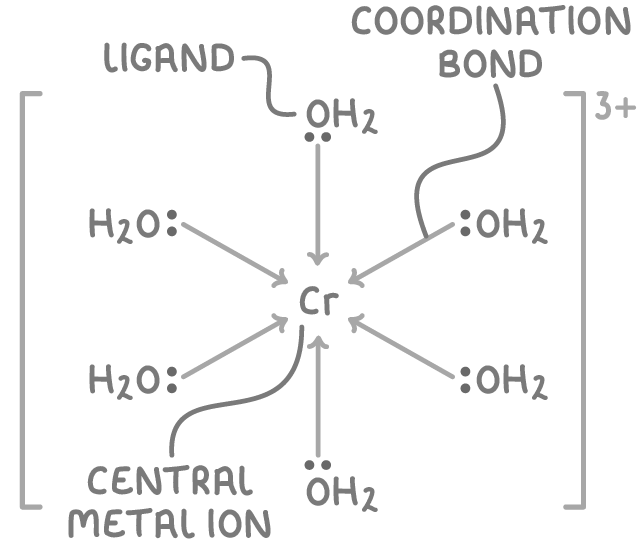
For example, the complex ion [Cr(H2O)6]3+ contains:
- A central Cr3+ cation.
- Six water molecules acting as ligands.
- Each water donates a lone pair to the chromium to form a coordination bond.
- The complex appears violet in solution.
Ligands split the d orbitals in complexes
In an isolated transition metal cation, the five d orbitals all have the same energy - they are degenerate.
However, when ligands coordinate to the metal ion to form a complex, the d orbitals split into two sets with different energies.
- Some of the d orbitals are raised in energy as they point directly towards the ligands.
- The remaining d orbitals are lowered in energy.
- The two sets of d orbitals are no longer degenerate.
The diagram below illustrates the splitting of the d-orbitals in the octahedral complex ion [Cu(H2O)6]2+:
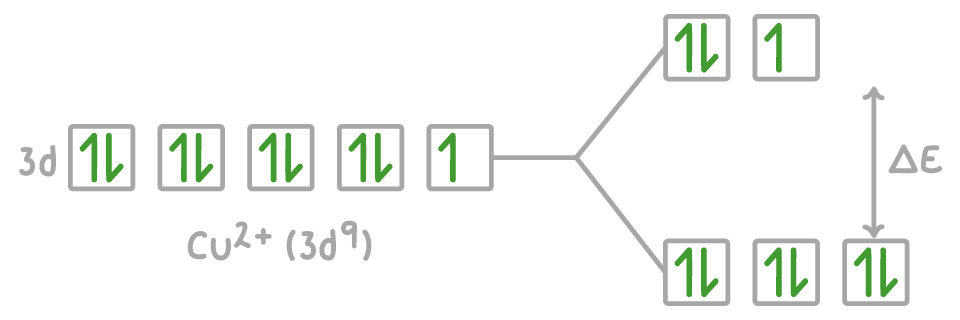
The energy gap (ΔE) between the higher and lower sets of orbitals falls within the visible light portion of the electromagnetic spectrum. This allows complexes to absorb visible light and appear coloured.
The colour of a complex depends on the absorbed and reflected light
The energy gap between the split d-orbitals allows electrons in the lower energy orbitals to be promoted to the higher energy orbitals by absorbing light of a specific wavelength.
The wavelength of light absorbed corresponds to the energy required to promote an electron between the split d-orbitals (ΔE).
The complex appears the complementary colour to the light absorbed. Complementary colours are on opposite sides of the colour wheel.
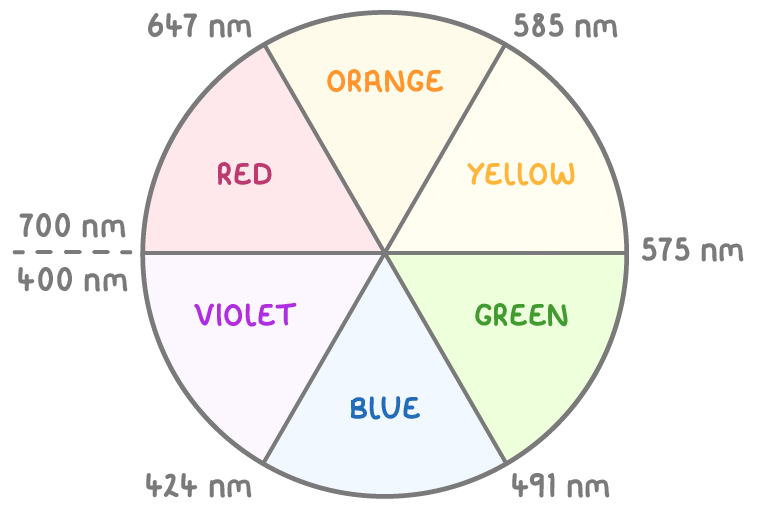
For example:
- [Cr(H2O)6]3+ appears violet because it absorbs yellow light when electrons are promoted between the split d-orbitals.
- Violet and yellow are complementary colours on the colour wheel.
The larger the energy gap between the split d orbitals, the higher the frequency (and shorter the wavelength) of light absorbed.
This follows from the equations relating wavelength (λ), frequency (f), the speed of light (c) and energy (E):
$c = f \times \lambda$
Where:
- $c$ = speed of light in a vacuum (3.00 × 10^8^ m s^-1^).
- $f$ = frequency of the light (s^-1^).
- $\lambda$ = wavelength of the light (m).
And:
$\Delta{E} = h \times f$
Where:
- $\Delta{E}$ = energy gap between split d-orbitals (J).
- $h$ = Planck's constant (6.63 × 10^-34^ J s).
Worked example 1 - Calculating wavelength of light absorbed
Calculate the wavelength of light (in nm) absorbed by a transition metal complex with an energy gap of 2.50 × 10⁻¹⁹ J. Give your answer to 3 significant figures.
Planck's constant, h = 6.63 x 10⁻³⁴ J s.
Speed of light in a vacuum, c = 3.00 x 10⁸ m s-1.
Step 1: Equation for calculating frequency (f)
$f=\frac{ΔE}{h}$
Step 2: Substitution and correct evaluation
$f=\frac{(2.50\times10^{-19})}{(6.63\times10^{-34})}=3.77\times10^{14}\text{ s}^{-1}$
Step 3: Equation for calculating wavelength (λ)
$\lambda=\frac{c}{f}$
Step 4: Substitution and correct evaluation
$\lambda = \frac{(3.00 \times 10^8)}{(3.77\times10^{14})} = 7.96 \times 10^{-7}\text{ m}$
Step 4: Conversion of m into nm
To convert from m into nm, multiply by 109
$7.96 \times 10^{-7}\text{ m} = 796\text{ nm}$
Worked example 2 - Calculating the energy gap between split d orbitals
The complex ion [CuCl4]2- appears orange, which has a wavelength of 647 nm on the visible light spectrum.
Calculate the energy gap (in J) between the split d-orbitals in [CuCl4]2-. Give your answer to 3 significant figures.
Planck's constant, h = 6.63 x 10⁻³⁴ J s.
Speed of light in a vacuum, c = 3.00 x 10⁸ m s-1.
Step 1: Identify the absorbed wavelength
Since [CuCl4]2- appears orange, it must be absorbing light with a wavelength complementary to orange on the colour wheel, which is blue light (491 nm).
Step 2: Conversion of nm into m
To convert from nm into m, divide by 109
$491\text{ nm} = 4.91\times10^{-7}\text{ m}$
Step 3: Equation for calculating frequency (f)
$f = \frac{c}{\lambda}$
Step 4: Substitution and correct evaluation
$f = \frac{(3.00 \times 10^8)}{(4.91 \times 10^{-7})} = 6.11 \times 10^{14}$ s⁻¹
Step 5: Equation for calculating energy gap (ΔE)
$\Delta{E} = h\times{f}$
Step 6: Substitution and correct evaluation
$\Delta{E} = (6.63 \times 10^{-34}) \times (6.11 \times 10^{14}) = 4.05 \times 10^{-19}\text{ J}$
Factors affecting the colours of complexes
Three factors influence the colour of a transition metal complex:
- Identity of the metal ion
- Different metal ions will give different colours with the same ligands.
- This is because each metal has a unique set of d orbital energies.
- Identity of the ligands
- Some ligands cause a larger splitting of the d orbitals than others.
- Ligands that form stronger coordinate bonds create a bigger energy gap.
- A larger ΔE means light of a higher energy (shorter wavelength) is absorbed.
- This leads to the complementary colour of the complex having a longer wavelength.
- Charge on the metal ion
- The same metal can have different oxidation states in complexes.
- For example, Fe2+ and Fe3+ complexes with identical ligands will be different colours.
- Higher charged cations have d orbitals lower in energy, affecting ΔE.