5.2 - The Ideal Gas Equation
- 1
Temperature, pressure, and volume relationships for ideal gases
- 2
The combined gas law
- 3
The ideal gas equation
Temperature, pressure, and volume relationships for ideal gases
To investigate the relationship between temperature, pressure, and volume for a fixed mass of an ideal gas, we can analyse graphs relating these variables. These graphs demonstrate how changes in one variable affect the others when the remaining variable is held constant.
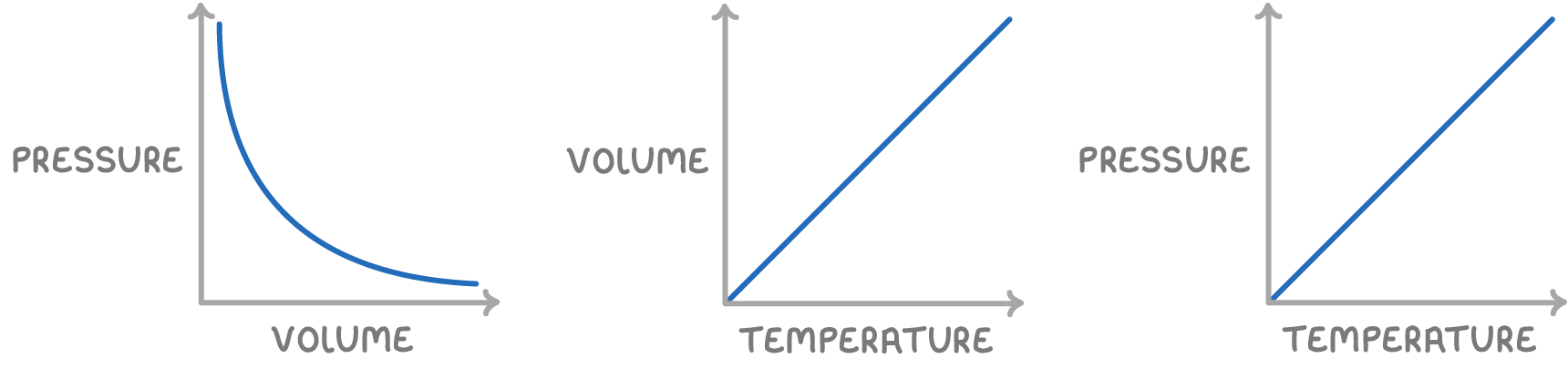
The graphs illustrate the following relationships:
- At constant temperature - Pressure is inversely proportional to volume.
- At constant pressure - Volume is directly proportional to temperature (K).
- At constant volume - Pressure is directly proportional to temperature (K).
The combined gas law
The combined gas law is derived from the individual relationships between pressure, volume, and temperature of a fixed amount of gas. As we have seen, pressure is inversely proportional to volume and directly proportional to absolute temperature.
By combining these two relationships, we can relate the pressure, volume, and temperature of a gas at two different states using the following equation:
$\frac{p_1 V_1}{T_1}=\frac{p_2 V_2}{T_2}$
Where:
- p = Pressure (Pa)
- V = Volume (m3)
- T = Temperature (K)
The subscripts 1 and 2 represent the initial and final states of the gas, respectively. This law assumes that the amount of gas remains constant throughout the process.
Worked example 1 - Calculating the volume of gas in a balloon
A weather balloon filled with 36.0 dm3 of helium at 27°C and a pressure of 98.0 kPa is released at sea level. The balloon eventually reaches an altitude of 32,000 m, where the pressure is 450 Pa and the temperature is $-$40°C.
Calculate the volume, in m3, of the gas in the balloon under these conditions. Give your answer to 2 significant figures.
Step 1: Conversion of °C into K
To convert from °C into K, add 273
27°C = 300 K
$-$40°C = 233 K
Step 2: Conversion of kPa into Pa
To convert from kPa into Pa, multiply by 1,000
98.0 kPa = 98,000 Pa
Step 3: Equation
$\frac{p_1 V_1}{T_1}=\frac{p_2 V_2}{T_2}$
Step 4: Rearrange equation
${V_2}=\frac{p_1 V_1 T_2}{T_1 p_2}$
Step 5: Substitution and correct evaluation
${V_2}=\frac{98,000\times36.0\times233}{300\times450}=6,100\text{ dm}^3$
Step 6: Conversion of dm3 into m3
To convert from dm3 into m3, divide by 1,000
6,100 dm3 = 6.1 m3
Therefore, the volume of the gas in the balloon at an altitude of 32,000 m is approximately 6.1 m3.
The ideal gas equation
While the combined gas law relates pressure, volume, and temperature at two different states, the ideal gas equation introduces two new variables: the amount of gas in moles (n) and the universal gas constant (R).
This equation provides a more general relationship between pressure, volume, temperature, and the amount of gas:
pV = nRT
Where:
- p = pressure (Pa)
- V = volume (m3)
- n = moles of gas
- R = the gas constant, 8.31 J K-1 mol-1
- T = temperature (K)
Worked example 2 - Calculating the volume of an ideal gas
A sealed container holds 0.150 moles of an ideal gas at a pressure of 120 kPa and a temperature of 358 K.
Calculate the volume of the container in m3.
The gas constant R = 8.31 J K-1 mol-1.
Step 1: Conversion of kPa into Pa
To convert from kPa into Pa, multiply by 1,000
120 kPa = 120,000 Pa
Step 2: Rearrange ideal gas equation
$\text{V} = \frac{\text{nRT}}{\text{p}}$
Step 3: Substitution and correct evaluation
$\text{V }= \frac{0.150\times8.31\times358}{120,000}=3.72\times10^{-3}\text{ m}^3$
Worked example 3 - Calculating relative molecular mass of an ideal gas
A sealed container with a volume of 1,100 cm3 is filled with 3.18 g of an ideal gas at a temperature of 60.0°C and a pressure of 250 kPa.
Calculate the relative molecular mass (Mr) of the gas.
The gas constant R = 8.31 J K-1 mol-1
Step 1: Conversion of °C into K
To convert from °C into K, add 273
60.0°C = 333.0 K
Step 2: Conversion of cm3 into m3
To convert from cm3 into m3, divide by 1,000,000
1,100 cm3 = 1.100 x 10⁻³ m3
Step 3: Conversion of kPa into Pa
To convert from kPa into Pa, multiply by 1,000
250 kPa = 250,000 Pa
Step 4: Rearrange ideal gas equation
$\text{n } = \frac{\text{pV}}{\text{RT}}$
Step 5: Substitution and correct evaluation
$\text{n } = \frac{250,000\times1.100\times10^{-3}}{8.31\times333.0}\text{ = 0.0994 mol}$
Step 6: Calculate relative molecular mass
$\text{M}_\text{r }=\frac{\text{m}}{\text{n}}=\frac{3.18}{0.0994}=32.0\text{ g mol}^{-1}$
Therefore, the relative molecular mass is 32.0