22.2 - Electrophilic Addition Reactions in Alkenes
- 1
What electrophiles are and how they react
- 2
Electrophilic addition reactions of alkenes with halogens, hydrogen halides, and water
- 3
The mechanism of electrophilic addition reactions
- 4
Using the stability of carbocation intermediates to predict the major product
Electrophiles are electron-pair acceptors
An electrophile is an electron-deficient species that readily accepts a pair of electrons from a nucleophile to form a covalent bond.
Types of electrophiles include:
- Cations - Positively charged ions e.g. the methyl cation, CH3+.
- Neutral molecules with a partial positive charge (δ+) - Electron deficiency is caused by the polarisation of a bond due to an electronegative atom, e.g., boron trifluoride, BF3.
- Compounds with carbonyl or carboxyl groups - The carbon atom of the carbonyl group is electron-deficient and susceptible to nucleophilic attack, e.g., aldehydes, ketones, and carboxylic acids.
Electrophilic addition reactions of alkenes
Alkenes are unsaturated hydrocarbons containing a carbon-carbon double bond. The high electron density of the double bond makes it susceptible to electrophilic attack, resulting in electrophilic addition reactions.
Electrophilic addition of halogens:
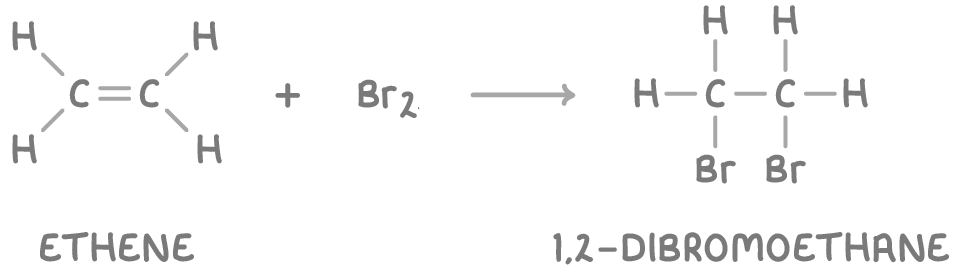
Halogens (X2) add across the C=C bond to form disubstituted halogenoalkanes (CnH2nX2).
For example, ethene reacts with bromine to form 1,2-dibromoethane:
Electrophilic addition of hydrogen halides:
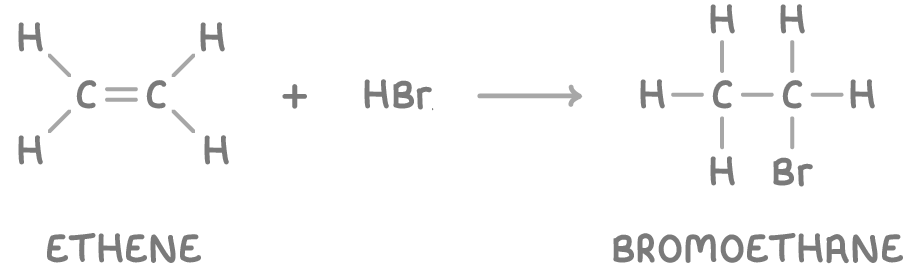
Hydrogen halides (HX) add across the C=C bond to form monosubstituted halogenoalkanes (CnH2n+1X).
Symmetrical alkenes produce one product e.g., ethene reacts with hydrogen bromide to form bromoethane.
Unsymmetrical alkenes produce two products e.g., propene reacts with hydrogen bromide to form a mixture of 1-bromopropane and 2-bromopropane.

Electrophilic addition of water (hydration):
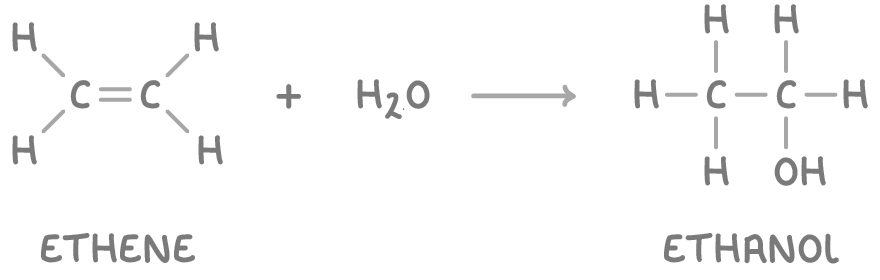
Water adds across the C=C bond in acidic conditions to form alcohols (CnH2n+1OH).
Symmetrical alkenes produce one product e.g., ethene reacts with water to form ethanol:
Unsymmetrical alkenes produce two products e.g., propene reacts with water to form a mixture of propan-1-ol and propan-2-ol.

Mechanisms of electrophilic addition
Let's look at the mechanisms for the three types of electrophilic addition reactions covered.
Addition of halogens to symmetrical alkenes
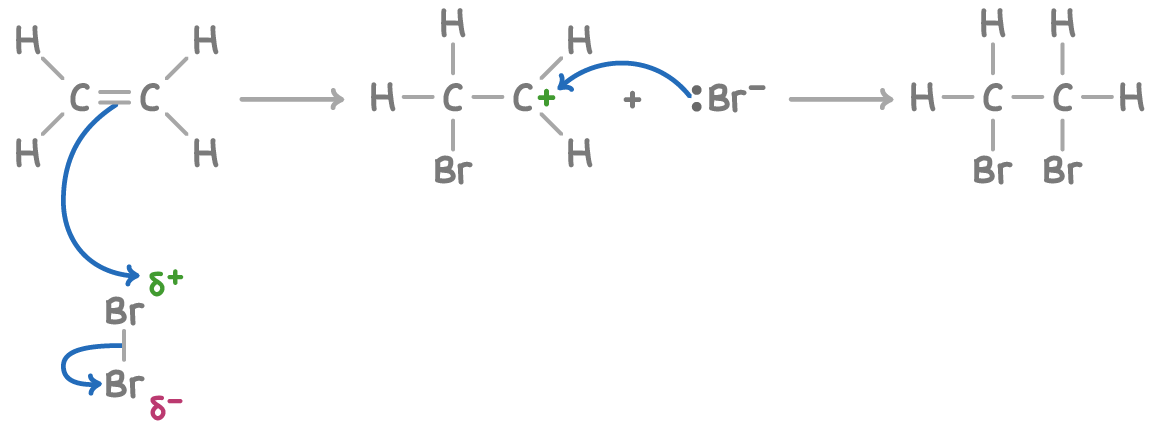
Using ethene and bromine as an example:
- The Br2 polarises as it approaches the electron-rich C=C double bond, inducing a temporary dipole.
- The partially positive Br atom attacks the C=C double bond while the Br2 molecule splits heterolytically, forming Br-.
- The Br+ bonds to one carbon atom, making the other carbon atom positive and forming a carbocation intermediate.
- The Br- anion then attacks the carbocation, forming the product 1,2-dibromoethane.
Addition of hydrogen halides to symmetrical alkenes
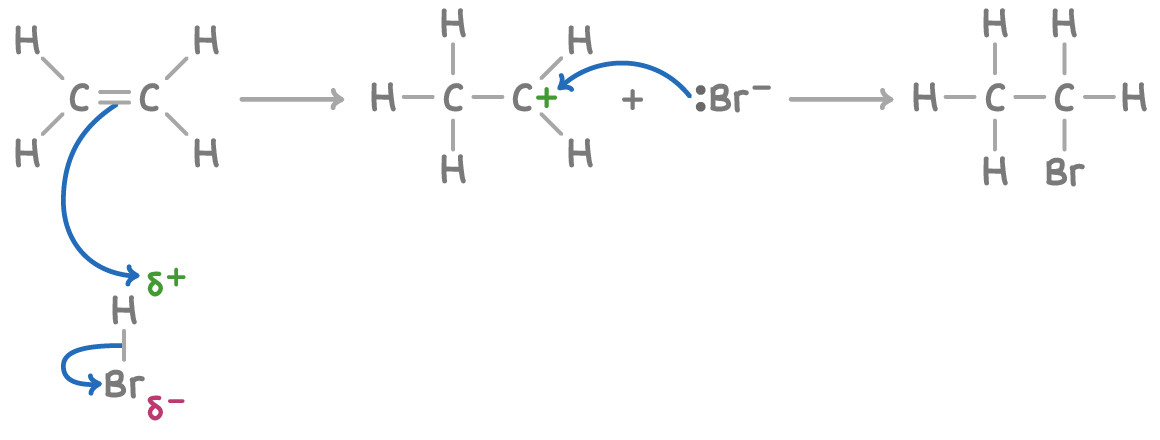
The mechanism is very similar, but the H-X bond is already polar. Using ethene and HBr as an example:
- The partially positive H atom attacks the C=C double bond while the HBr molecule splits heterolytically, forming Br-.
- The H+ cation bonds to one carbon atom, making the other carbon atom positive and forming a carbocation intermediate.
- The Br- anion attacks the carbocation, forming the product bromoethane.
Addition of water to symmetrical alkenes
This hydration mechanism has an extra protonation step. Using ethene as an example:
- The H+ from the acid attacks the C=C double bond, forming a carbocation intermediate as one of the C-C bonds breaks.
- A water molecule (the nucleophile) attacks the positively charged carbon atom of the carbocation.
- The protonated alcohol (an oxonium ion) then deprotonates, forming ethanol and regenerating H+.
The regenerated H+ acts as a catalyst in this reaction.

Major product forms via most stable carbocation
In electrophilic addition reactions of unsymmetrical alkenes with hydrogen halides and water, the major product can be predicted by considering the relative stability of possible carbocation intermediates.
Carbocations can be classified into three types based on the degree of alkyl substitution:
- Primary carbocations - These have one alkyl group attached to the positively charged carbon and are the least stable.
- Secondary carbocations - These have two alkyl groups at the carbocation centre and offer moderate stability.
- Tertiary carbocations - These have three alkyl groups and are the most stable.
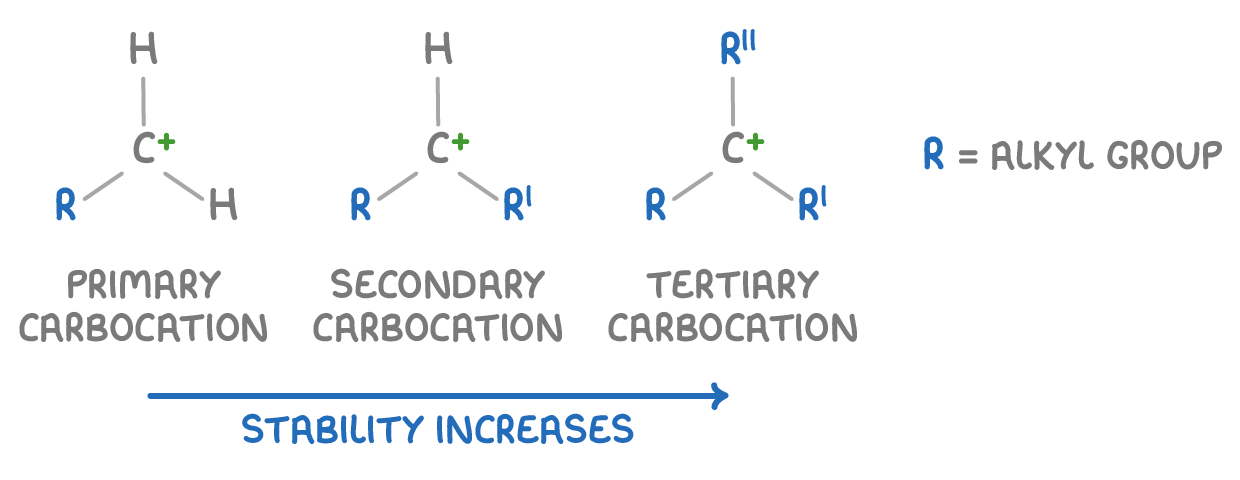
Alkyl groups stabilise the positive charge on the carbocation through inductive effects. The more alkyl groups attached to the carbocation centre, the more stable the carbocation becomes.
Markovnikov's rule states that when an electrophile is added to an unsymmetrical alkene, it will preferentially bond to the carbon atom with the fewest alkyl groups attached. This forms the most stable carbocation intermediate and thus the major product.
For example, in the reaction of propene with HBr there are 2 possible products: 1-bromopropane and 2-brompropane.
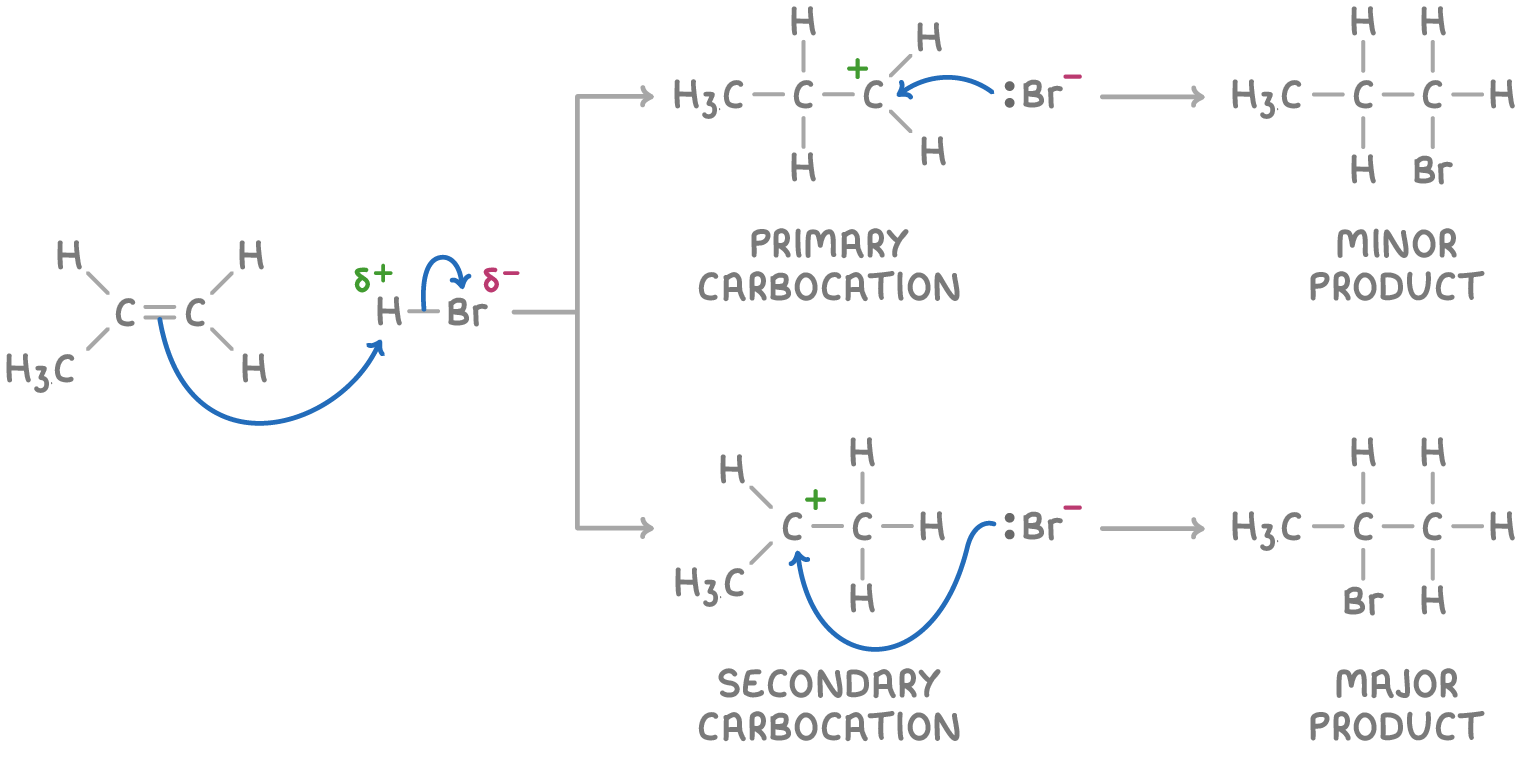
According to Markovnikov's rule, the major product is 2-bromopropane, as it is formed via the more stable secondary carbocation intermediate. 1-bromopropane is the minor product as it is formed via the less stable primary carbocation intermediate.
Worked example 1 - Determining the major addition product
Predict the major product when 2-methylbut-2-ene reacts with H2O.
Step 1: Determine structure of 2-methylbut-2-ene
2-methylbut-2-ene: (CH3)2C=CHCH3
Step 2: Determine potential carbocation intermediates
When H2O adds to 2-methylbut-2-ene, two types of carbocations can form:
- Carbocation at C2: (CH3)2C+CH2CH3 (tertiary carbocation).
- Carbocation at C3: (CH3)2CHC+H(CH3) (secondary carbocation).
Step 3: Apply Markownikoff's rule
Tertiary carbocations (like the one at C2) are more stable than secondary carbocations (like the one at C3) due to greater alkyl group substitution.
According to Markownikoff's rule, the major product will be formed via the more stable carbocation. In this case, it's the tertiary carbocation at C2.
Step 4: Predict major product
The major product of the addition of H2O to 2-methylbut-2-ene is 2-methylbutan-2-ol:
(CH3)2C=CHCH3 + H2O ➔ (CH3)2C(OH)CH2CH3