6.6 - Comparing Radiation Dose
Where your radiation dose comes from
- Everyone is exposed to radiation all the time, from both natural and artificial sources.
- The dose a person receives depends on where they live and what they do.
Natural background radiation
- Radon gas - Areas built on certain rock types release more radon from the ground, raising the dose.
- Cosmic rays - Radiation from space; the dose increases with altitude, so people living high up receive more.
- Naturally occurring radioactive materials in food, soil, and building materials.
Artificial (man-made) sources
- Medical exposures, such as X-rays and CT scans.
- Fallout from past nuclear weapons testing.
- Waste from the nuclear industry.
Dose from activities and jobs
- Flying or working as an airline pilot increases cosmic ray exposure.
- Working in a nuclear power station or in medical radiography.
Comparing doses from different sources and activities
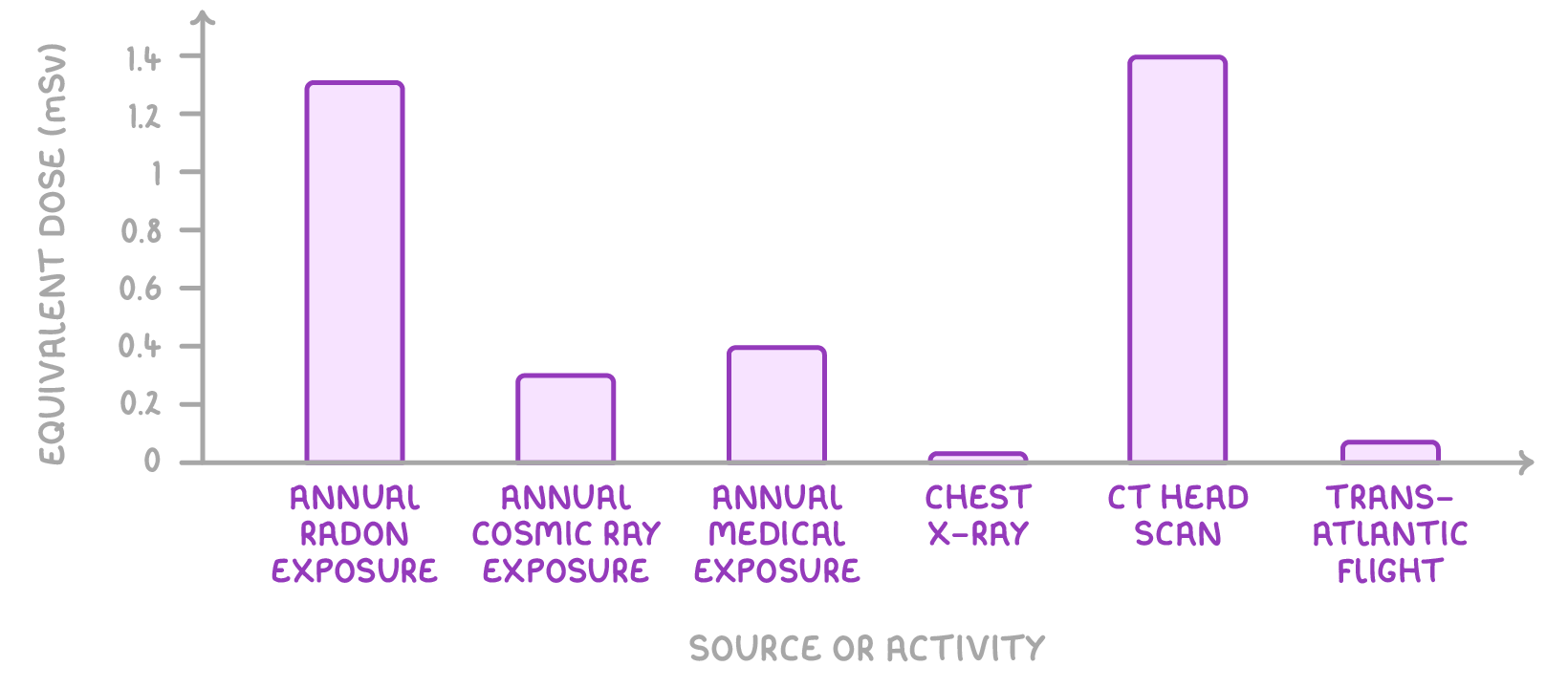
Comparing equivalent doses shows which sources contribute most to a person's total exposure.
Background radiation sources
| Background radiation source | Equivalent dose (mSv) |
|---|---|
| Annual radon exposure | 1.3 |
| Annual cosmic ray exposure | 0.3 |
| Annual medical exposure | 0.4 |
Doses from activities
| Activity | Equivalent dose (mSv) |
|---|---|
| Chest X-ray | 0.014 |
| CT head scan | 1.4 |
| Transatlantic flight | 0.08 |
What the comparison shows
- Radon is the largest single natural contributor.
- A single CT head scan delivers a dose comparable to a whole year of radon exposure.
- A chest X-ray gives a far smaller dose than a CT scan.
Effective dose and dose limits
- Effective dose measures the overall long-term risk of a radiation exposure.
- It takes into account which tissues or organs absorb the radiation, because some are more easily damaged than others.
Legal dose limits
Legal limits cap the effective dose people may receive in a year:
- Average annual background radiation (UK) - 2.2 mSv
- Annual limit for a member of the public - 1 mSv
- Annual limit for a radiation worker - 20 mSv
Notes on the limits:
- The worker limit is higher because their jobs involve handling radioactive sources.
- The public limit is the extra dose allowed on top of natural background radiation.
TermDefinition
Cosmic raysRadiation from space that contributes to a person's natural background radiation dose.
Effective doseA measure of the overall long-term risk from being exposed to radiation, which takes into account which tissues or organs absorb it.