3.7 - Relays & Capacitors
A relay is a switch operated by an electromagnet
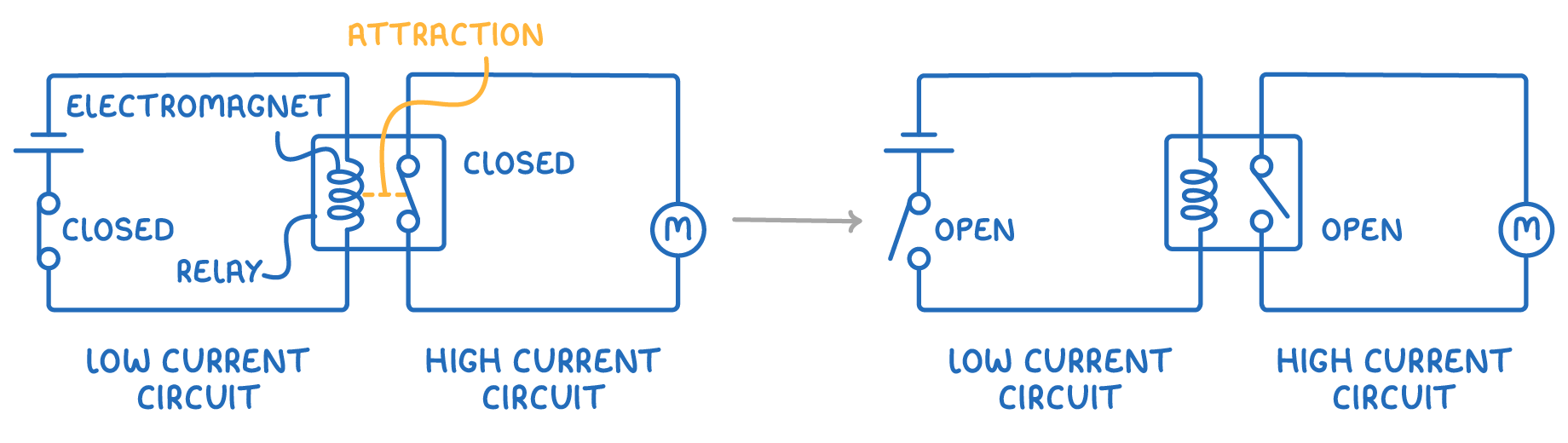
- A relay is an electrically operated switch that allows a low-current, low-potential-difference circuit to control a separate high-current, high-potential-difference circuit.
- The two circuits are electrically isolated, protecting both the user and the low-current circuit components from high currents and voltages.
- Example: a car's starter motor needs a very high current, but the driver only turns a key in a safe, low-current circuit isolated by a relay.
How a relay works
- Closing the switch in the low-current circuit sends current through the relay coil (an electromagnet), generating a magnetic field.
- The magnetic field attracts an iron contact, which closes the switch in the high-current circuit.
- Opening the low-current switch turns off the electromagnet, so the high-current switch springs open and breaks the high-current circuit again.
Capacitors store charge
- A capacitor is a component that stores electric charge.
- Connecting a capacitor to a power supply (such as a battery) causes charge to build up on it.
Charging
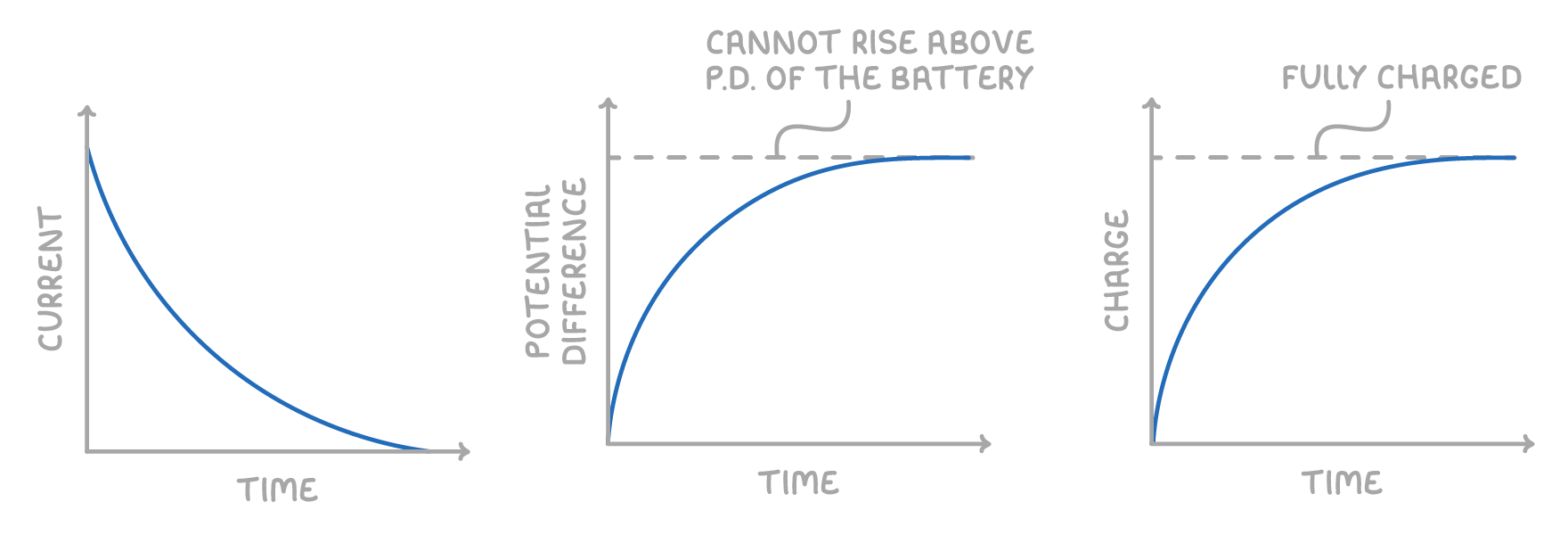
- The charging current decreases as the capacitor charges.
- As more charge is stored, the potential difference across the capacitor increases.
- When the potential difference across the capacitor equals the battery's, current stops and the capacitor is fully charged.
Discharging
- When the battery is removed and the circuit is completed, the capacitor discharges.
- The discharging current decreases over time in the same way as the charging current, but flows in the opposite direction.
Uses of capacitors
Capacitors store only a small amount of charge and can't provide a steady current, but they can release charge very quickly (e.g. in a camera flash).
Loudspeakers, microphones and motors convert energy
- Loudspeaker - Converts electrical energy into sound energy by turning electrical signals into vibrations of a cone.
- Microphone - Converts sound energy into electrical energy when sound waves vibrate a diaphragm, generating electrical signals.
- Motor - Converts electrical energy into kinetic energy in a rotating coil, often wasting some energy as thermal energy and sound.
TermDefinition
RelayAn electrically operated switch that lets a small current in one circuit switch on a much larger current in a separate circuit.
CapacitorA component that stores electric charge and can release it very quickly.