2.4 - Space Travel - Mechanics
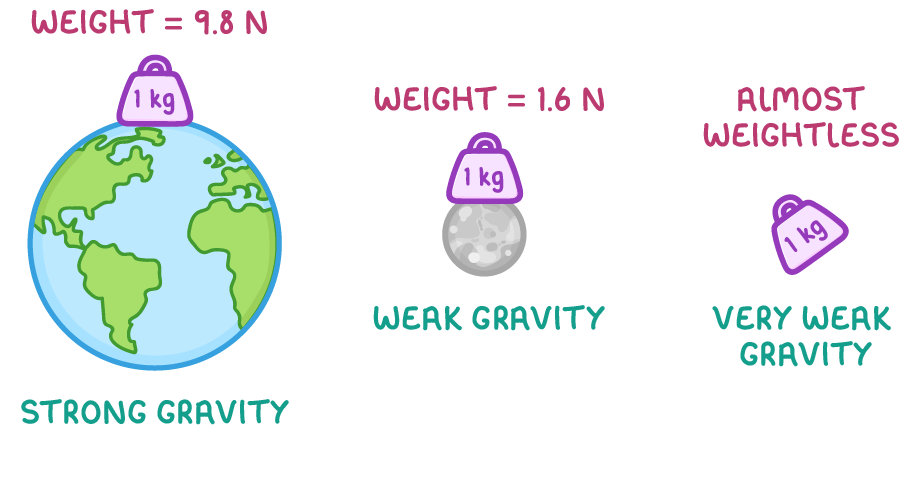
Weight changes with location, but mass does not
- Mass is a measure of how much matter an object contains. It does not change when the object is moved to a different planet or into space.
- Weight is the force of gravity acting on an object. It depends on the gravitational field strength () at the object's location:
- Because isn't the same everywhere, an object has different weights in different places:
- On a planet or moon with a stronger gravitational field strength, the object weighs more.
- The further an object is from a planet or moon, the weaker becomes, so the object weighs less.
- Far enough from any planet or star, is effectively zero, so the object is weightless.
- On Earth's surface, is about 9.8 N/kg.
Worked example - Weight of an astronaut on the Moon
An astronaut has a mass of 75 kg. The gravitational field strength on the surface of the Moon is 1.6 N/kg. Calculate the astronaut's weight on the Moon.
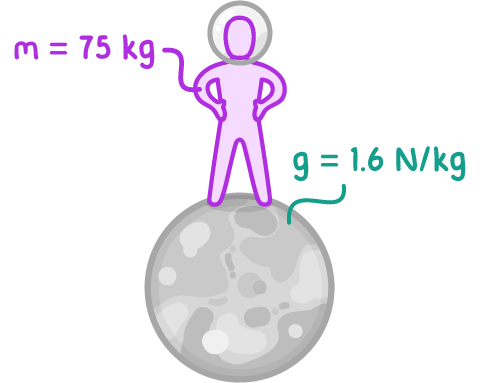
Step 1 - Formula
Step 2 - Substitution and calculation
Step 3 - Interpretation
The astronaut's mass is still 75 kg on the Moon, the same as on Earth. But the weight is only 120 N - far less than the roughly 735 N the same astronaut would weigh on Earth (where is about 9.8 N/kg) - because the Moon's gravitational field strength is much weaker.
Newton's second law and rocket lift-off and landing
Newton's second law (F = ma) relates the resultant force on an object to its mass and acceleration.
Lift-off
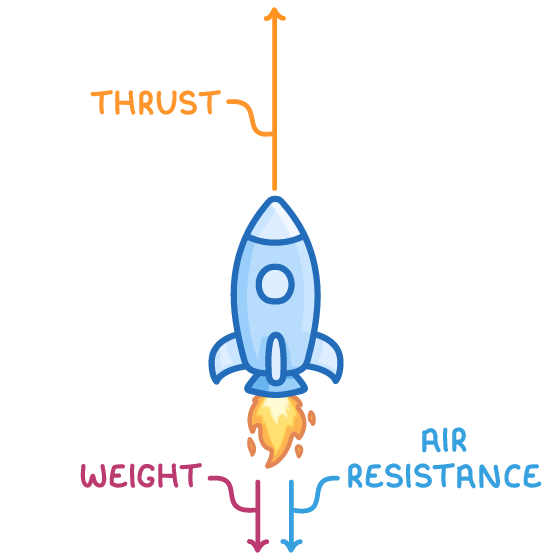
- To lift off and accelerate upwards, a rocket needs an upward resultant force.
- The upward force from the engines (thrust) must be greater than the rocket's weight.
- Once moving, air resistance acts downwards, opposing motion. To keep accelerating, thrust must be greater than the weight and air resistance combined.
- As the rocket climbs:
- Air resistance falls as the atmosphere thins.
- Weight falls as fuel is burned (reducing mass) and g weakens with distance from Earth.
Landing
- To land safely, a spacecraft must decelerate.
- Firing the engines so the thrust points upwards creates an upward resultant force, which decelerates the descent.
- Parachutes can also be used in an atmosphere to increase air resistance and decelerate the spacecraft.
Newton's third law and rocket propulsion
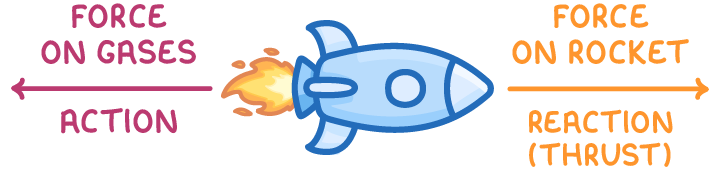
Newton's third law states that when two objects interact, the forces they exert on each other are equal in size and opposite in direction.
How thrust is produced
- When a rocket burns fuel, it exerts a backwards force on the hot exhaust gases, pushing them out of the bottom.
- The exhaust gases exert an equal and opposite forwards force on the rocket.
- This forwards force is the thrust. The two forces are often labelled the action and the reaction.
Why a rocket accelerates in space
- In space there's no air resistance, and far from any planet there's negligible weight, so thrust is the only force acting on the rocket.
- This unbalanced thrust produces a forwards acceleration (F = ma), allowing a rocket to accelerate with nothing external to push against.
TermDefinition
MassThe amount of matter in an object, measured in kilograms.
WeightThe force acting on an object due to gravity, measured in newtons.
ThrustThe driving force from an engine, such as the forward force on a rocket from the exhaust gases it pushes out.
Newton's third lawThe law that whenever two objects interact, the forces they exert on each other are equal in size and opposite in direction.