3.2 - Charge, Current & Time
Current is a flow of charge
- An electric current is a flow of electric charge, and is the rate of flow of charge.
- In metals, the moving charge is carried by free electrons.
- Current is measured in amperes (A).
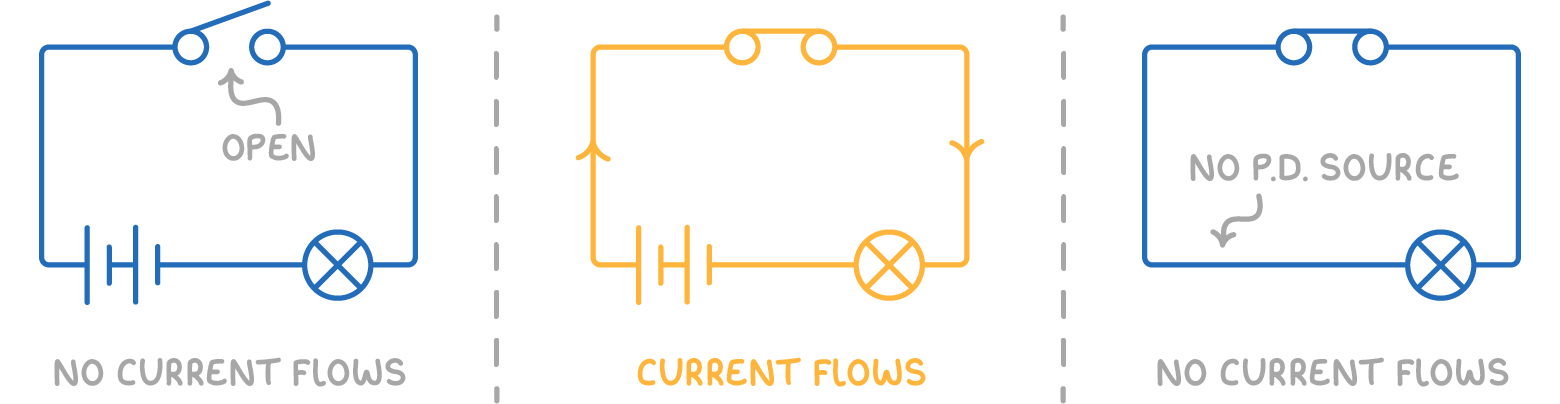
Conditions for current to flow
- The circuit is complete (a closed loop), with no gaps.
- There is a source of potential difference (p.d.), such as a cell or battery, to push the charge around.
Calculating charge - Q = It
- Charge is measured in coulombs (C).
- A current of 1 ampere flows when a charge of 1 coulomb passes a point each second.
Formula for charge flow
Where:
- = Charge, in coulombs (C)
- = Current, in amperes (A)
- = Time, in seconds (s)
Worked example - Charge passed through a lamp
A current of 1.5 A flows through a lamp for 2.0 hours. How much charge passes through the lamp?
Step 1 - Convert the time to seconds
Step 2 - Substitute into Q = It
So 10,800 coulombs of charge pass through the lamp.
Conventional current and electron flow
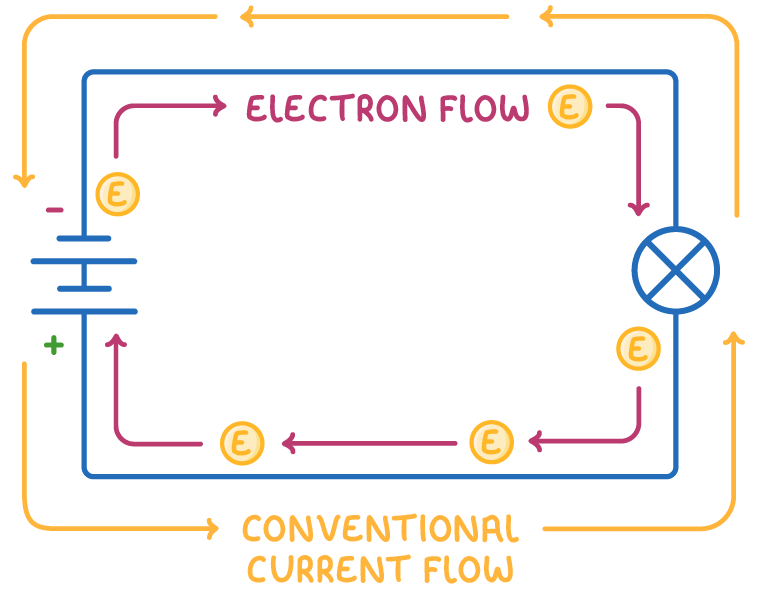
- Conventional current flows from the positive terminal to the negative terminal.
- Electrons are negatively charged, so they flow the opposite way: from the negative terminal to the positive terminal.
- Current was originally defined before electrons were discovered, so conventional current is still the direction drawn on circuit diagrams.
TermDefinition
CurrentThe rate of flow of electric charge.
Conventional currentThe direction of current from the positive terminal to the negative terminal of a supply, opposite to the direction in which electrons flow.