1.3 - Speed, Velocity & Displacement
Distance and displacement
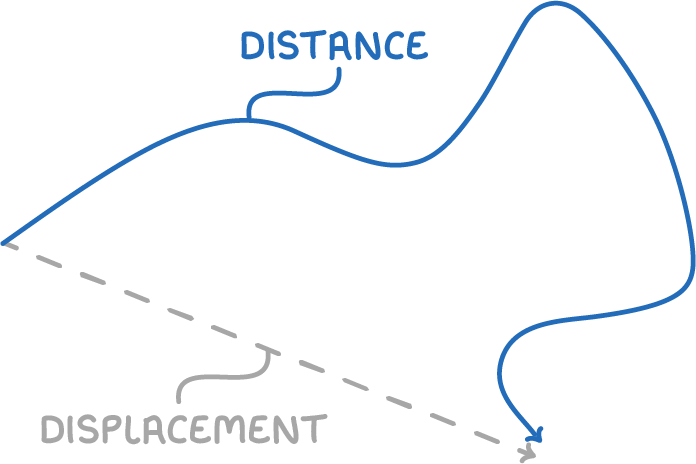
- Distance is how far an object has moved. It's a scalar quantity - it has a size but no direction.
- Displacement is a vector quantity - it measures the distance and direction in a straight line from the start point to the finish point (e.g. 5 metres north).
- Direction can be given relative to a point (e.g. towards the school) or as a bearing - a three-digit angle measured clockwise from north (e.g. 035°).
- For the same journey, the two values can differ: walking 5 m north then 5 m south gives a distance of 10 m, but a displacement of 0 m because you finish where you started.
Speed and velocity
- Speed is the distance an object travels per unit time (how fast it is going). It's a scalar quantity with no direction.
- Velocity is the speed of an object in a given direction (e.g. 20 m/s at 060°). It's a vector quantity.
Constant speed, changing velocity
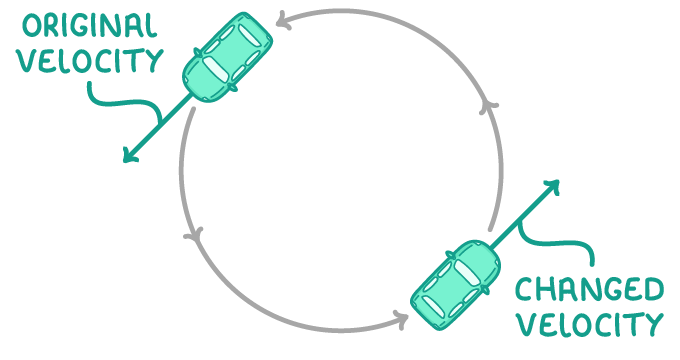
- Because velocity includes direction, an object can travel at a constant speed while its velocity changes by changing direction.
- An object moving in a circle at a constant speed has a constantly changing velocity because its direction is always changing (e.g. a car going round a roundabout).
Average speed
Objects rarely travel at a steady speed, so the value usually quoted is the average (mean) speed.
Scalar and vector quantities
- A scalar quantity has a size (magnitude) only (e.g. speed, distance, mass, energy, temperature, and time).
- A vector quantity has both a size and a direction (e.g. force, velocity, displacement, acceleration, weight, and momentum).
Drawing and signing vectors
- A vector is drawn as an arrow: the length shows the size of the quantity, and the way it points shows the direction.
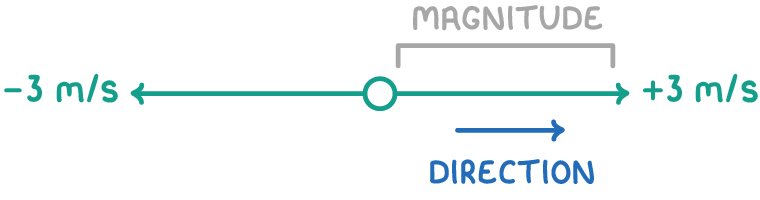
- When working with vectors along a straight line, take one direction as positive and the opposite as negative.
- Example: a car moving one way has a velocity of 3 m/s; moving the opposite way it has a velocity of -3 m/s. Its speed is 3 m/s in both cases.
Calculating speed from distance and time
For an object moving at a constant speed (or velocity):
Distance (or displacement) = speed (or velocity) × time
Average speed over a whole journey
When speed varies across a journey:
To measure the speed of an object moving at constant speed: time how long it takes to travel a measured distance, then divide the distance by the time.
Worked example - Speed and time of a cat
A cat walks 25 m along a straight path in 50 s. Find its speed, then how long it would take to walk 100 m at that same speed.
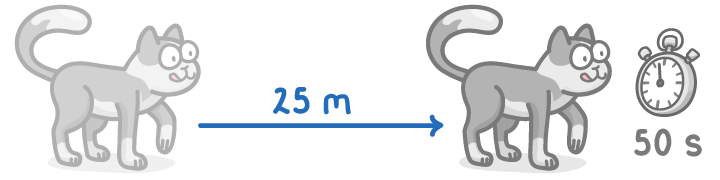
Step 1 - Find the speed
Step 2 - Rearrange for time
Step 3 - Find the time to walk 100 m
So the cat walks at 0.5 m/s and takes 200 s to cover 100 m.
Worked example - Average speed and average velocity
A runner runs around three sides of a rectangular field measuring 300 m by 150 m, starting at one corner and finishing at the far corner of the same long side. The whole run takes 300 s. Find the average speed and the average velocity.
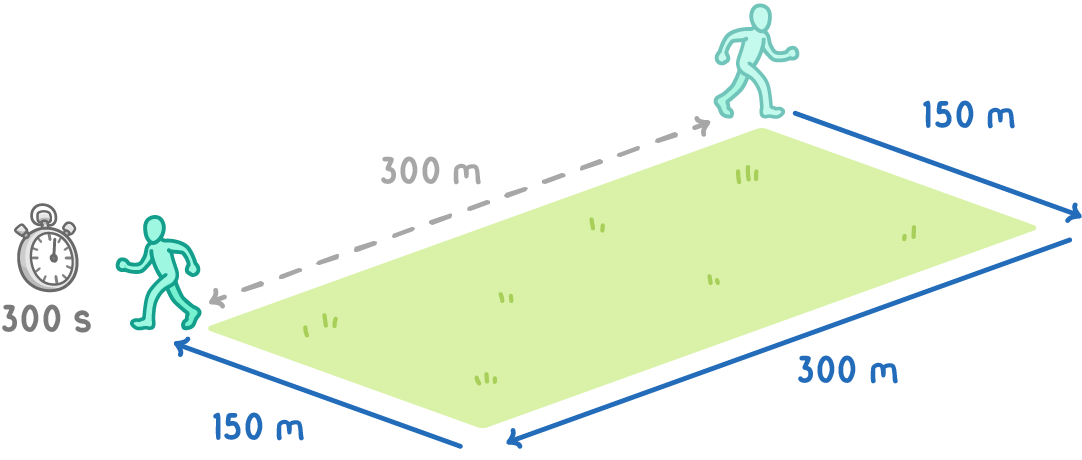
Step 1 - Find total distance and displacement
- Total distance = 150 + 300 + 150 = 600 m
- Displacement (straight line from start to finish) = 300 m along the fourth side, towards the finish corner
Step 2 - Average speed (uses total distance)
Step 3 - Average velocity (uses displacement, has direction)
So the average velocity is 1 m/s towards the finish corner.
Step 4 - Interpretation
The two answers differ because distance and displacement differ for this journey. If the runner had run the fourth side as well and finished where they started, the distance would be 900 m but the displacement would be 0 m, so average velocity would be 0 m/s - even though average speed would not.
Instantaneous and average speed
- Average speed - The total distance travelled divided by the total time taken over a journey.
- Instantaneous speed - The speed at a particular moment (e.g. the reading on a speedometer).
- The same distinction applies to velocity: an object has both an instantaneous velocity and an average velocity.