1.19 - Projectile Motion
What a projectile is and why its path curves
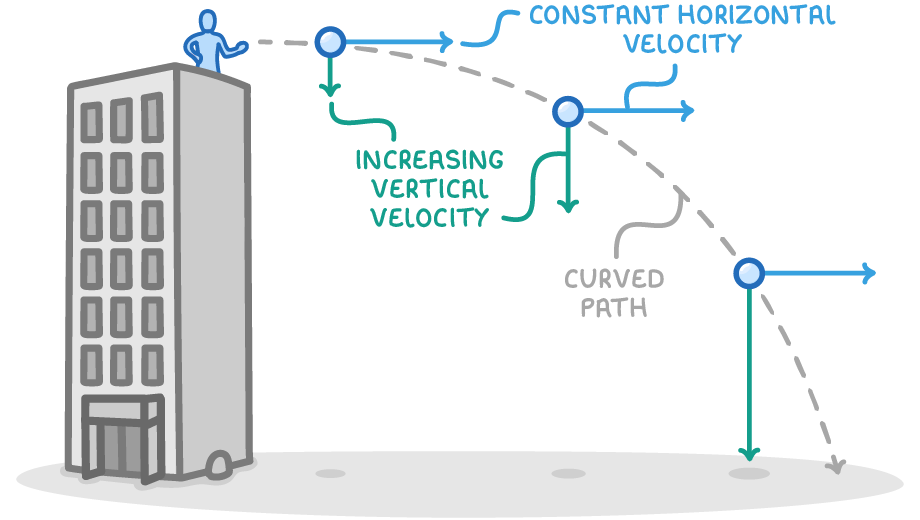
- A projectile is an object that's only acted on by gravity once it's moving (air resistance is assumed to be negligible).
- An object dropped from rest is a projectile, and so is an object launched horizontally.
Why a horizontally launched projectile curves
- Its horizontal velocity stays constant because no horizontal force acts on it.
- It has a constant vertical acceleration downwards, due to gravity, so its vertical velocity increases as it falls.
Treating horizontal and vertical motion separately
The horizontal and vertical motions of a projectile are independent, so they're calculated separately.
Horizontal motion - Constant velocity
Where:
- = Horizontal velocity, in metres per second (m/s)
- = Horizontal displacement, in metres (m)
- = Time, in seconds (s)
Vertical motion - Constant acceleration
Where:
- = Final vertical velocity, in metres per second (m/s)
- = Initial vertical velocity, in metres per second (m/s); for a projectile launched horizontally,
- = Vertical acceleration, in metres per second squared (m/s2), equal to
- = Time, in seconds (s)
Worked example - Horizontally launched projectile
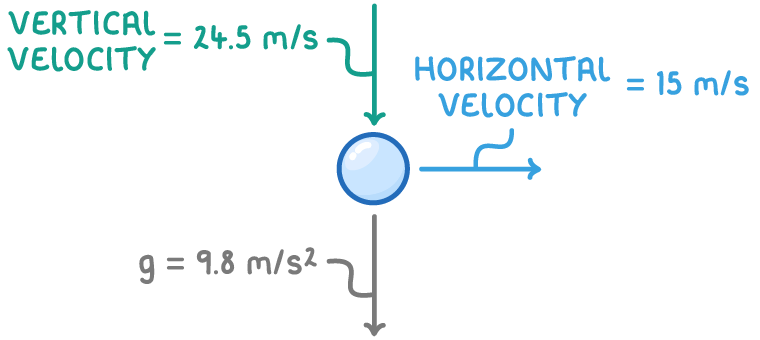
A stone is thrown horizontally from the top of a cliff at 15 m/s. Its vertical velocity just as it hits the ground below is 24.5 m/s. Take = 9.8 m/s2 and assume no air resistance. Find the time to reach the ground, then the horizontal distance travelled.
Step 1 - Identify the values
- Horizontal velocity, m/s
- Final vertical velocity, m/s
- Initial vertical velocity, m/s (launched horizontally)
- Vertical acceleration, m/s2
Step 2 - Find the time using the vertical motion
Step 3 - Find the horizontal distance
The horizontal velocity is constant, so use :
Velocity-time graphs for a projectile
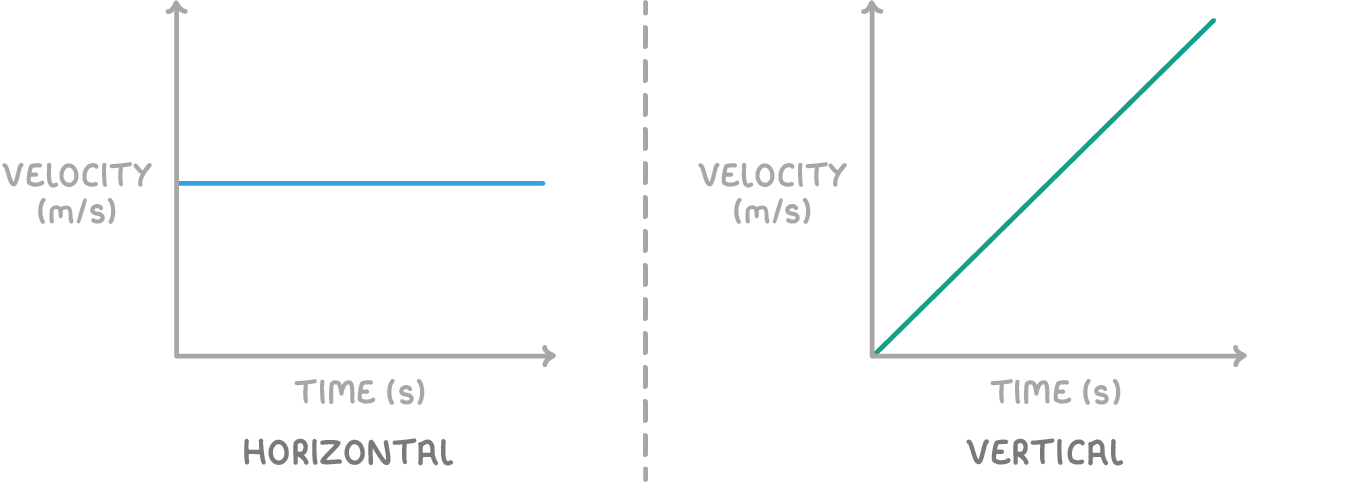
A projectile launched horizontally is represented by two separate velocity-time graphs:
- The horizontal graph is a flat horizontal line, showing constant horizontal velocity.
- The vertical graph is a straight line sloping upwards, showing constant vertical acceleration of .
Area under each graph
- Area under the horizontal graph = range (horizontal distance travelled).
- Area under the vertical graph = height (vertical distance travelled).
Satellites as projectiles
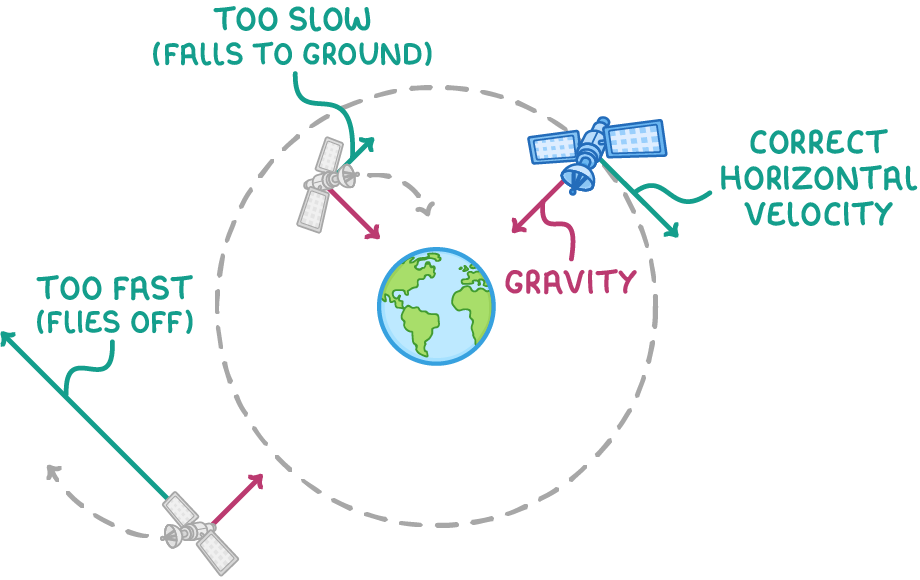
- A satellite is a projectile in free-fall around Earth: the only force acting on it is its weight due to gravity.
- Because space is a vacuum, there's no air resistance and its horizontal velocity stays constant.
Why a satellite orbits
- The Earth's surface is curved.
- A satellite launched fast enough follows a curved path that matches the curvature of the Earth.
- It falls towards Earth without ever getting closer to the surface, keeping it in orbit.
Orbital speed
- Too slow - The satellite falls back to Earth.
- Too fast - The path doesn't curve enough and the satellite escapes into space.
- Correct speed - The satellite stays in a stable orbit.
TermDefinition
ProjectileAn object that is only acted on by gravity once it is moving.
RangeThe horizontal distance travelled by a projectile.