3.12 - Transistors
Transistors are electronic switches
- A transistor acts as an automatic switch: it switches on automatically when its input potential difference reaches a certain level.
- This makes them useful for automatically controlling circuits - for example, turning on street lights when it gets dark.
Two types to know
- npn transistor - Also called a bipolar transistor.
- n-channel enhancement mode MOSFET - MOSFET for short.
The npn transistor
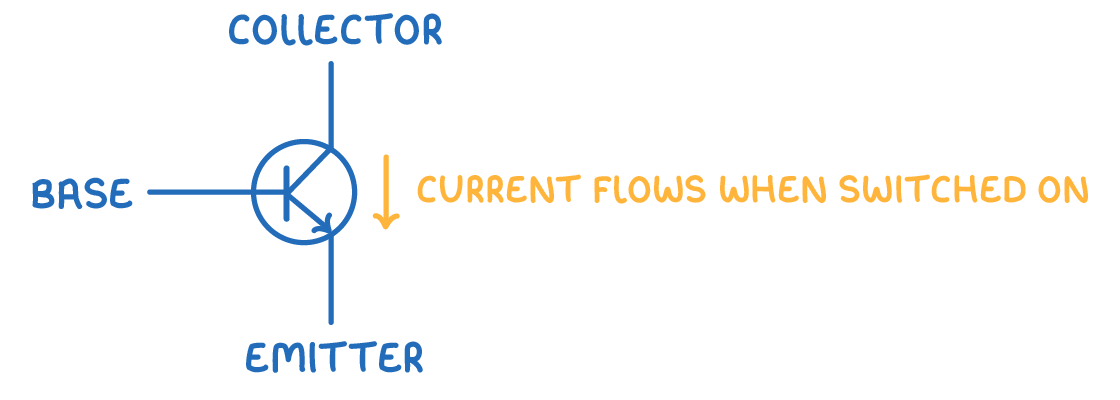
- An npn (or bipolar) transistor has three connections: a base, a collector, and an emitter.
- The input potential difference (p.d.) is the p.d. between the base and the emitter.
- If this input p.d. is greater than a certain value, the transistor switches on and current can flow between the collector and the emitter.
- If the input p.d. is below that value, the transistor is off and no current flows between the collector and the emitter.
The MOSFET transistor
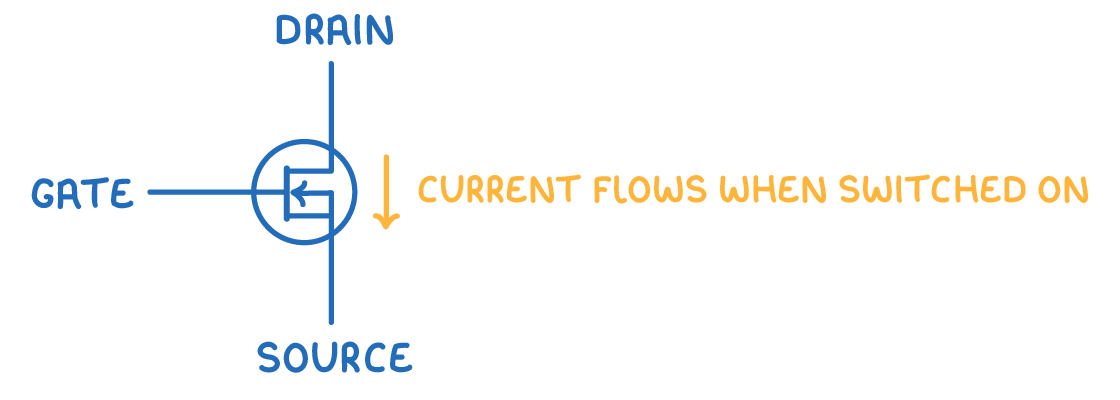
- An n-channel enhancement mode MOSFET has three connections: a gate, a drain, and a source.
- The input potential difference (p.d.) is the p.d. between the gate and the source.
- If this input p.d. is greater than a certain value, the transistor switches on and current can flow between the drain and the source.
- If the input p.d. is below that value, the transistor is off and no current flows between the drain and the source.
Using a transistor to switch a device on automatically
A transistor can be combined with a sensor in a potential divider to switch a device on automatically when conditions change.
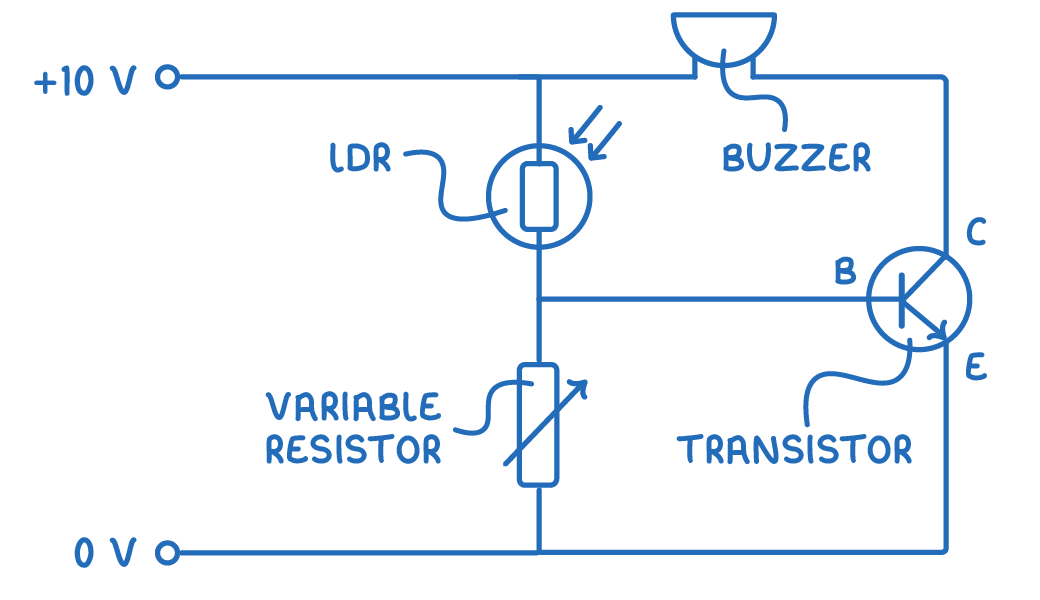
Switching on a buzzer when it gets light
A light-dependent resistor (LDR) and a variable resistor form a potential divider, with the transistor input taken across the variable resistor:
- As the light level increases, the resistance of the LDR decreases.
- In the potential divider, a smaller share of the resistance on the LDR means a larger share on the variable resistor - so the p.d. across the variable resistor increases.
- When this input p.d. reaches a certain value, it switches the transistor on, turning on the buzzer.
- Changing the resistance of the variable resistor changes the light level at which the buzzer turns on.
Switching on a heater when it gets cold
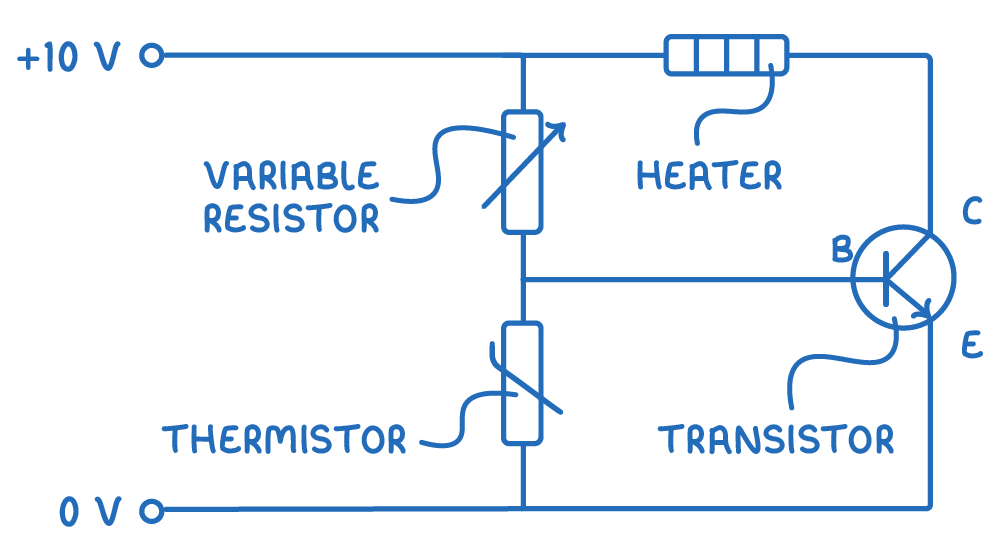
- The same idea can turn on a heater when the temperature drops too low.
- Here the potential divider uses a thermistor and a variable resistor.
- When the temperature drops, the resistance of the thermistor increases.
- Taking the transistor input across the thermistor means the input p.d. rises as the temperature falls, so the transistor switches on and turns on the heater.
TermDefinition
TransistorAn electronic component that acts as an automatic switch when its input potential difference reaches a certain level.
npn transistorA type of transistor with three connections called a base, a collector and an emitter.
MOSFETA type of transistor with three connections called a gate, a drain and a source.