3.12 - Seismic Waves
Earthquakes produce seismic waves - P, S and surface waves
- An earthquake produces seismic waves that travel out through the Earth.
- At a boundary between layers of different properties (such as density), part of the wave is absorbed and part is refracted.
- Where properties change gradually, the wave changes speed gradually and follows a curved path.
- Where properties change suddenly, the speed changes abruptly and the path takes a sharp kink.
The three types of seismic wave
| P-waves | S-waves | Surface waves | |
|---|---|---|---|
| Type | Longitudinal | Transverse | Travel along the Earth's surface |
| Travels through | Solids and liquids | Solids only | Along the surface, moving the ground up and down |
| Speed | Faster than S-waves | Slower than P-waves | Slowest of the three; cause the most damage |
Because P-waves and S-waves travel differently through different materials, comparing where each type is and isn't detected reveals what the inside of the Earth is made of.
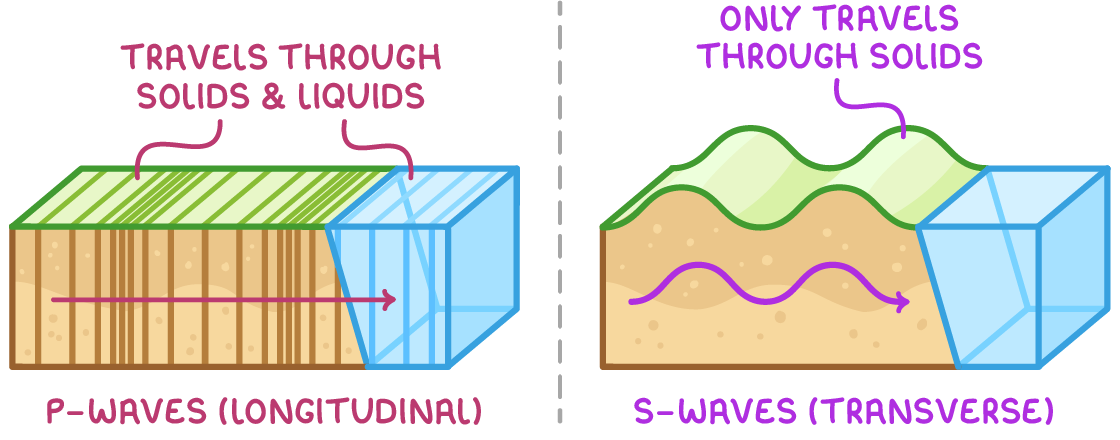
Surface waves are not shown: they travel along the surface, not through the Earth.
Seismometers and the Earth's internal structure
- Seismometers detect seismic waves at the Earth's surface.
- When an earthquake happens, scientists record:
- The time the waves take to reach each seismometer.
- Which parts of the surface receive no waves at all.
- By studying how the waves are absorbed and refracted, they work out where the Earth's properties change sharply to identify the boundaries between its layers.
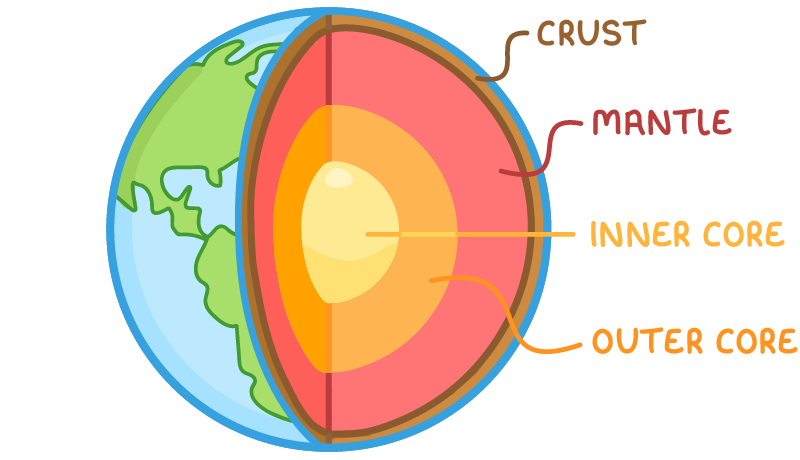
The current model of the Earth
- A thin crust at the surface.
- An almost-solid mantle beneath it that flows very slowly.
- A liquid outer core.
- A solid inner core.
P-wave and S-wave shadow zones reveal the core
P-waves
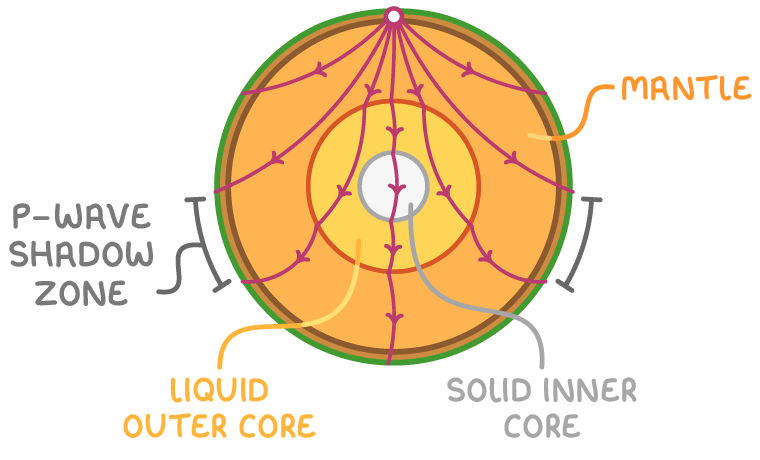
- P-waves travel through both solids and liquids, so they pass right through the core.
- As they cross the mantle and the core, refraction bends their paths.
- At the curved boundaries this leaves a ring-shaped P-wave shadow zone where no P-waves arrive, seen in cross-section as a band on each side of the Earth.
- Measuring its size and position reveals the structure of the core.
S-waves
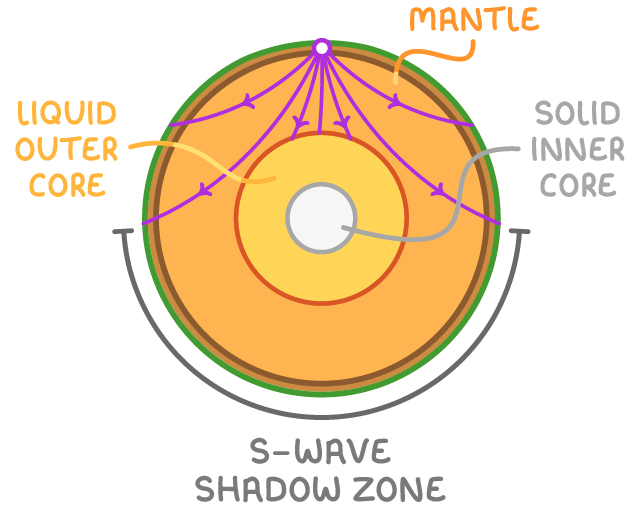
- S-waves are transverse and cannot travel through a liquid, so they can't pass through the liquid outer core at all.
- This leaves a large S-wave shadow zone on the far side of the Earth, where no S-waves are detected.
- The disappearance of S-waves is the key evidence that the outer core is liquid, and the size of the shadow zone reveals the size of the core.
Seismograms and the P-S time lag locate an earthquake
- A seismogram is the trace a seismometer records of the waves it detects.
- The wave types arrive in order of speed:
- Faster P-waves arrive first.
- Then the S-waves.
- Finally the slowest surface waves.
- The P-S time lag is the time difference between the arrival of the first P-wave and the first S-wave.

Using the time lag to locate the epicentre
- The further the seismometer is from the earthquake, the larger the time lag - so the lag gives the distance from the seismometer to the earthquake.
- That distance is drawn as a circle centred on the seismometer: the earthquake lies somewhere on the circle.
- Repeating this for three or more seismometers gives intersecting circles.
- The single point where they all overlap is the earthquake's epicentre.
TermDefinition
Seismic wave
P-wave
S-wave
Surface wave
Seismometer
Shadow zone
Seismogram
Epicentre