6.1 - Atomic Structure & Isotopes
Atomic number, mass number and isotopes
The number of protons determines which element an atom is (e.g. every carbon atom has 6 protons).
Atomic number and mass number
- Atomic number (proton number) - The number of protons in the nucleus, symbol .
- Mass number (nucleon number) - The total number of protons and neutrons in the nucleus, symbol .
- In a neutral atom, the atomic number also equals the number of electrons.
- Number of neutrons = .
Nuclide notation
A nucleus is written with the mass number above the atomic number, in front of the chemical symbol:
Where:
- = Chemical symbol
- = Mass number
- = Atomic number
For example, has 6 protons and 14 - 6 = 8 neutrons.
Isotopes
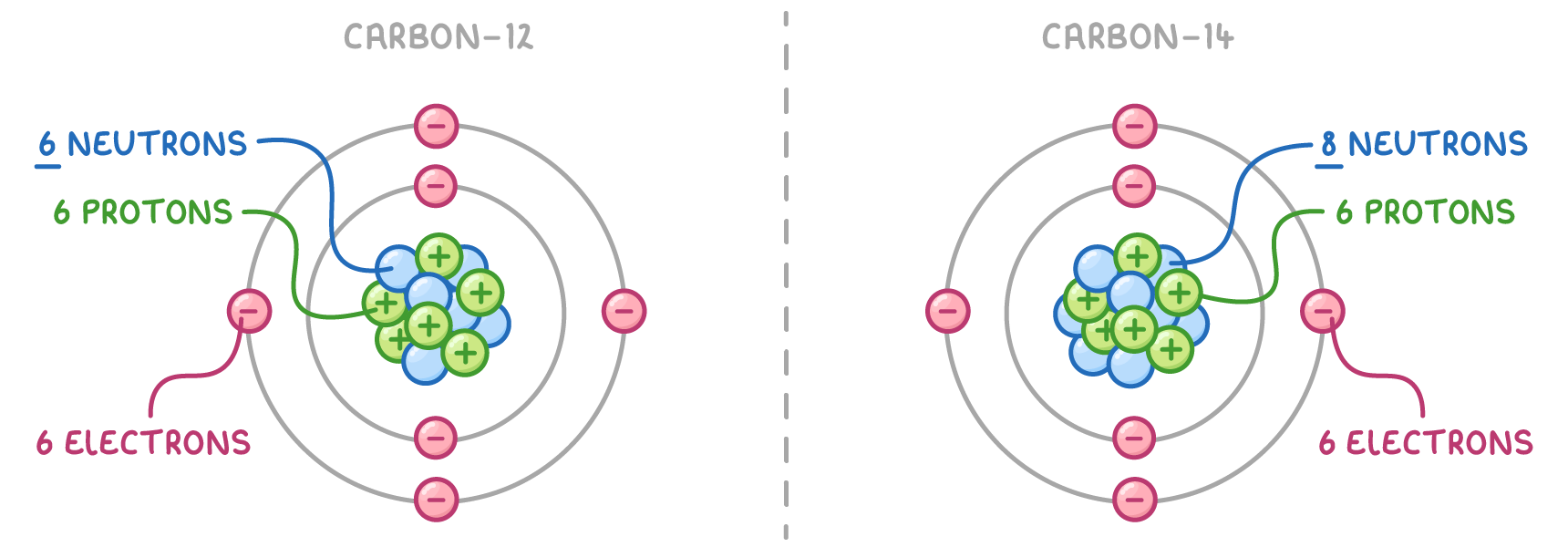
- Isotopes are atoms of the same element with the same number of protons but different numbers of neutrons (same atomic number, different mass numbers).
- Example: carbon-12 has 6 protons and 6 neutrons, while carbon-14 has 6 protons and 8 neutrons.
- Most elements have multiple isotopes, but usually only one or two are stable.
TermDefinition
Atomic numberThe number of protons in the nucleus of an atom.
Mass numberThe total number of protons and neutrons in the nucleus of an atom.
IsotopeOne of two or more forms of the same element whose atoms have the same number of protons but different numbers of neutrons.