6.9 - Fossil Fuels & Nuclear Energy
How power stations generate electricity
Most electricity is generated in power stations where a fuel heats water into steam, the steam turns a turbine, and the turbine drives a generator.
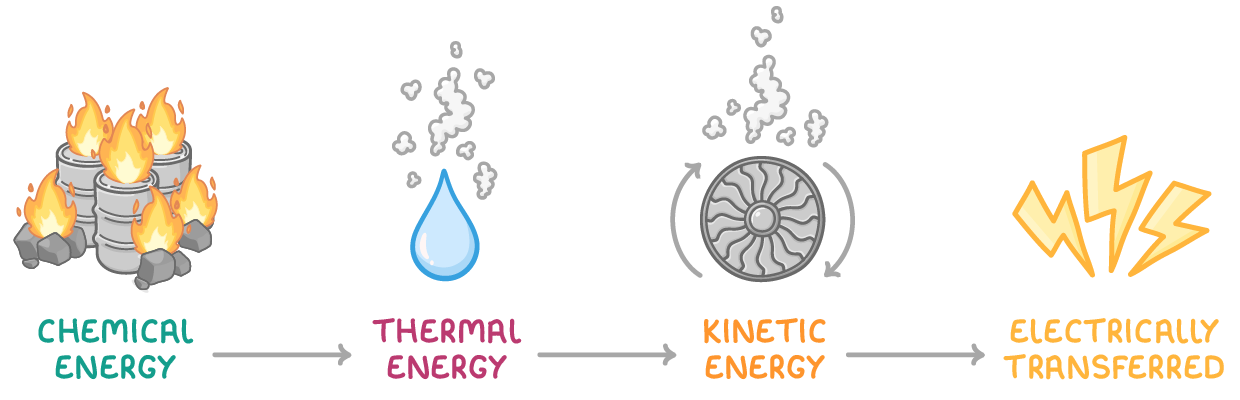
A fossil fuel power station
- The fuel is burnt. Energy is transferred from the chemical store of the fuel by heating.
- This heats water in a boiler until it boils into steam (gaining energy in its thermal store).
- The steam turns a turbine, transferring energy to the turbine's kinetic store.
- The spinning turbine turns a generator, which transfers energy away electrically through the national grid.
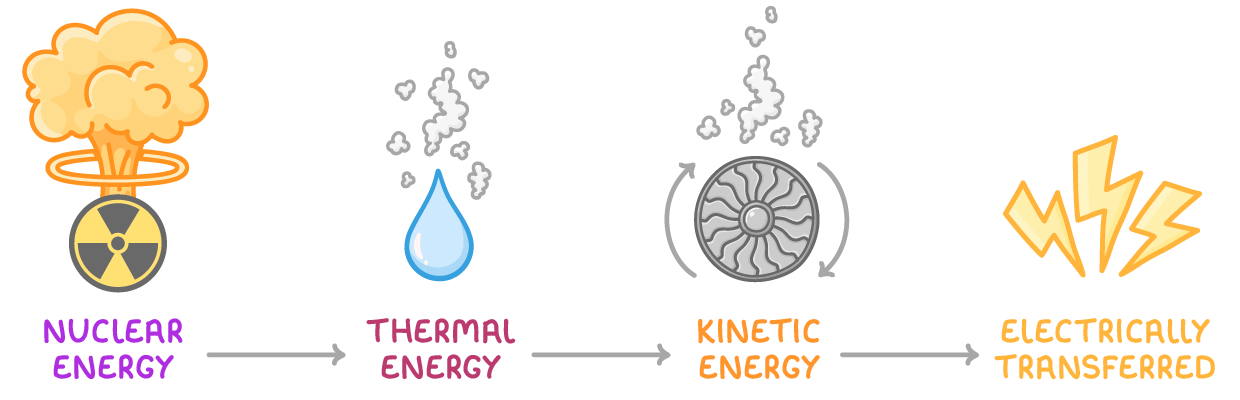
A nuclear power station
- Works the same way as a fossil fuel station, but the heat to make steam comes from a nuclear reaction rather than burning.
- In the reactor, nuclear fuel such as uranium splits in a process called nuclear fission, releasing a large amount of energy.
- The energy starts in the nuclear store of the fuel rather than a chemical store.
Nuclear fusion as a possible energy source
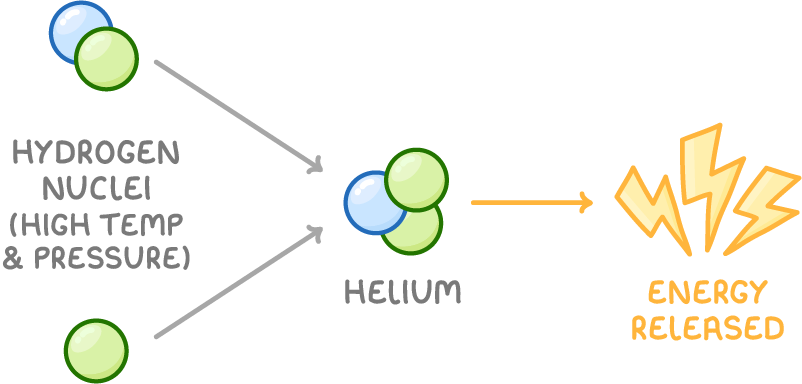
- Nuclear fusion occurs when two light nuclei collide at high speed and join to form a single heavier nucleus (e.g. hydrogen nuclei fusing into helium).
- The heavier nucleus has slightly less mass than the starting nuclei. The lost mass is converted into energy, which is released.
- Fusion is the process that powers stars, including the Sun.
Compared with fission, fusion:
- Releases more energy per kilogram of fuel
- Produces very little radioactive waste
- Uses fuels that are abundant and easy to obtain (such as isotopes of hydrogen)
The challenges
- Fusion requires extremely high temperatures and pressures (around 10,000,000 °C).
- Positively charged nuclei repel each other (electrostatic repulsion). High temperatures give the nuclei enough kinetic energy to overcome this repulsion and fuse, and high pressures pack the nuclei closely together so that they collide often.
- No material can withstand these temperatures without vaporising, making reactors difficult and expensive to design.
- Experimental reactors currently use more energy to maintain the required conditions than the fusion reactions produce.
TermDefinition
Nuclear fissionThe splitting of a large, unstable nucleus into two smaller nuclei, releasing energy.
Nuclear fusionThe joining of two light nuclei to form a heavier nucleus, releasing energy.