3.1 - Circuits Introduction
Current, potential difference and resistance
Three quantities describe what's happening in an electric circuit:
- Current - The rate of flow of electric charge. In a metal, the charge is carried by electrons. Symbol .
- Potential difference (voltage) - The energy transferred per unit of charge, which pushes charge around the circuit. Symbol .
- Resistance - How much a component opposes the flow of charge. Symbol .
Conditions for current to flow
Charge only flows as a current when both conditions are met:
- The circuit is complete (closed) with no gaps.
- There is a source of potential difference, such as a cell or battery.
In a single closed loop, current has the same value everywhere.
How the three are linked
Current through a component depends on both the potential difference across it and its resistance:
- Increasing the potential difference increases the current (if resistance is fixed).
- Increasing the resistance decreases the current (if potential difference is fixed).
Conductors, insulators and current direction
- Conductors let charge pass through easily (e.g. metals like copper and aluminium, and graphite).
- Insulators do not let charge pass through easily (e.g. plastic, rubber, wood, glass).
Free electrons
- In a metal, the outermost electrons are free to move through the structure (free electrons or delocalised electrons).
- An electric current in a metal is the flow of these free electrons.
- Insulators have no (or almost no) free electrons, so charge cannot flow through them.
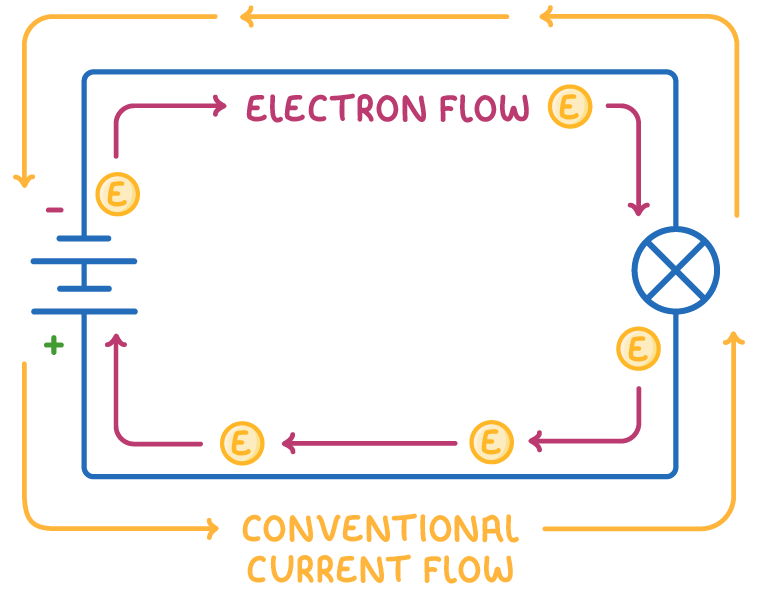
The direction of current
- Conventional current flows from the positive terminal to the negative terminal.
- Free electrons are negatively charged, so they flow the opposite way, from negative to positive.
Circuit diagrams and standard symbols
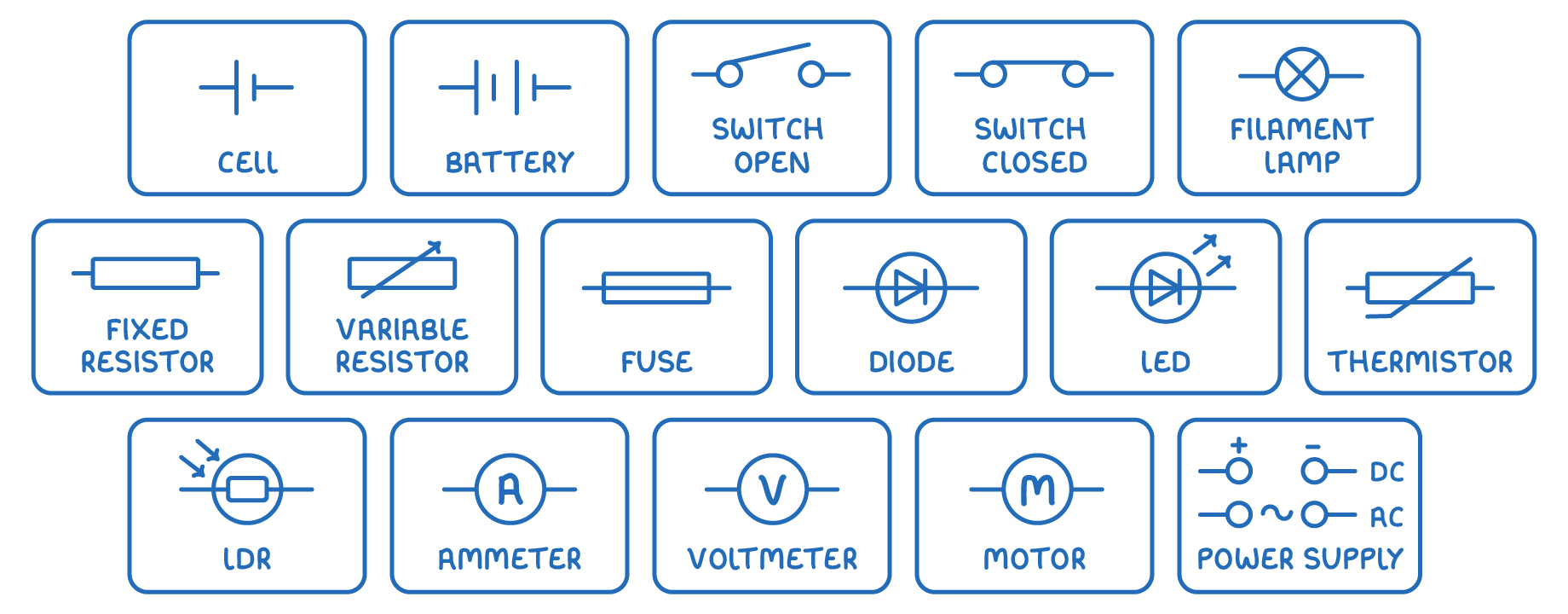
Circuits are drawn using standard symbols connected by straight lines:
- Cell and battery (two or more cells joined together)
- Switch (open and closed)
- Filament lamp
- Fixed resistor and variable resistor
- Fuse
- Diode and LED (light-emitting diode)
- Thermistor and LDR (light-dependent resistor)
- Ammeter and voltmeter
- Power supply
- Motor
In a cell symbol, the long line is the positive terminal and the short line is the negative terminal.
Potential difference as energy per unit charge
- Potential difference (p.d.) and voltage are the same thing.
- The potential difference of a power supply is the energy given to the charge carriers per unit charge.
- The potential difference across a component is the energy transferred by each unit of charge as it passes through that component.
- One volt is one joule per coulomb (1 V = 1 J/C).
TermDefinition
CurrentThe rate of flow of electric charge.
ResistanceHow much a component opposes the flow of charge through it, equal to the potential difference across it divided by the current through it.
Electrical conductorA material that allows electric charge to flow through it easily.
Electrical insulatorA material that does not allow electric charge to flow through it easily.
Conventional currentThe direction of current from the positive terminal to the negative terminal of a supply, opposite to the direction in which electrons flow.