5.10 - Electromagnetism
The magnetic field around a current-carrying wire
- Whenever an electric current flows through a wire, a magnetic field is created around it.
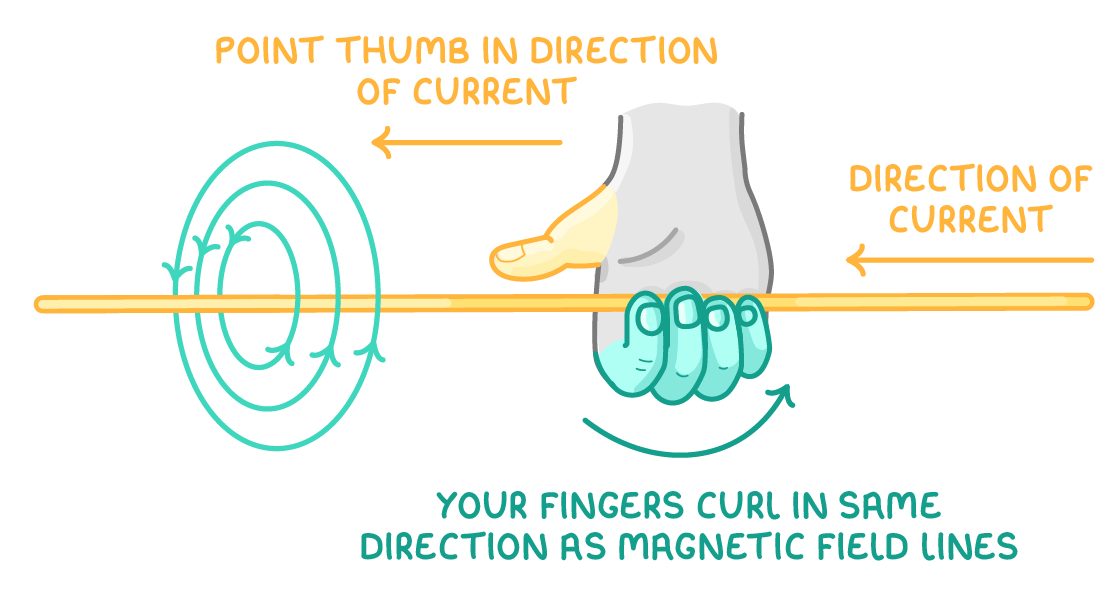
- Around a long, straight current-carrying wire the field is made up of concentric circles, lying in planes perpendicular to the wire, with the wire at their centre.
- This pattern can be shown with small plotting compasses placed around the wire: as current flows, each compass lines up along a circle, tracing the field direction.
The right-hand thumb rule
- Point the thumb of the right hand in the direction of the current and curl the fingers around the wire.
- The fingers then point in the direction of the magnetic field.
- Reversing the current reverses the field.
Field strength
The field strength depends on two things:
- Size of the current - A larger current produces a stronger field.
- Distance from the wire - The field is stronger closer to the wire and weaker further away.
Solenoids and electromagnets
Coiling the wire strengthens the field
- The magnetic field of a single current-carrying wire is fairly weak. It can be made much stronger by wrapping the wire into a coil.
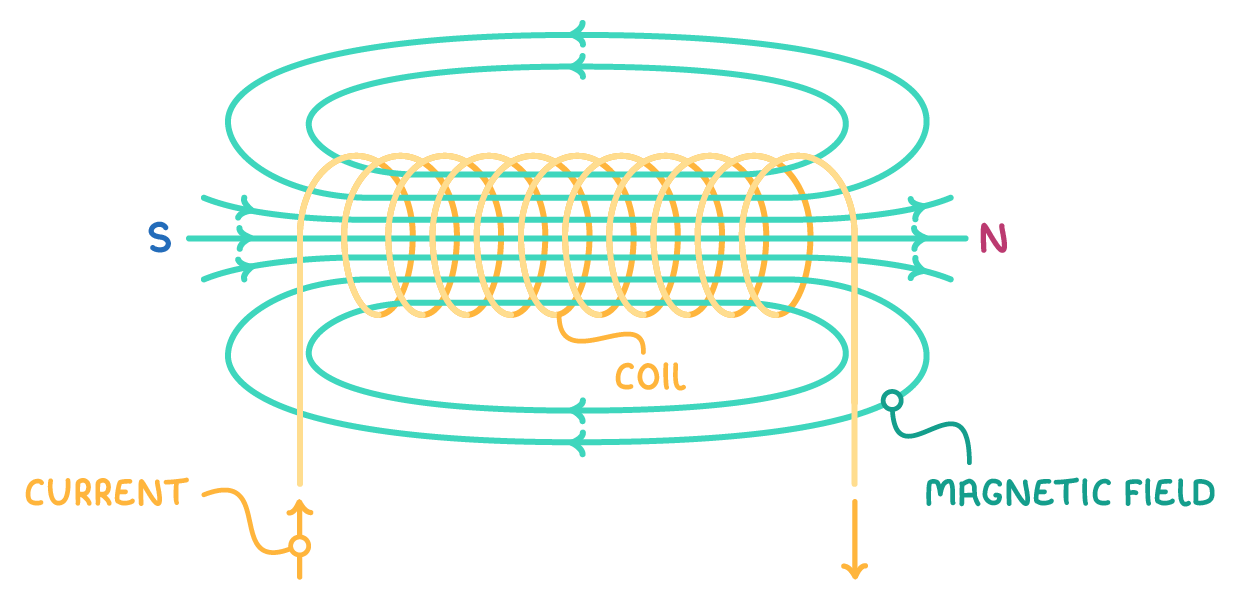
- A coil of wire is called a solenoid.
- The field lines around each turn line up and add together, giving:
- A strong, uniform field inside the solenoid, where the field lines are parallel and evenly spaced.
- A field outside the coil that has the same shape as a bar magnet's.
- One end of the solenoid behaves as a north pole and the other as a south pole. Reversing the current reverses the poles.
- To find the north pole, curl the fingers of the right hand around the coil in the direction of the current. The thumb then points to the north pole (the right-hand grip rule).
Increasing the field strength
- Increasing the current through the coil.
- Increasing the number of turns of wire.
- Adding an iron core inside the coil.
The electromagnet
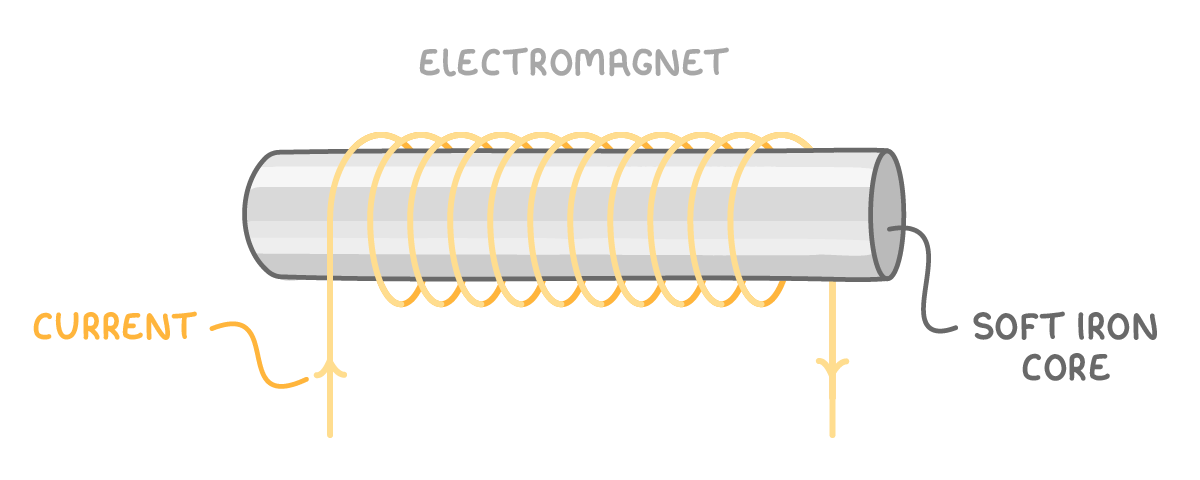
- Placing a soft iron core inside the solenoid greatly increases the magnetic field.
- The soft iron is easily magnetised to become an induced magnet while the current flows, and quickly loses its magnetism when the current is switched off.
- An electromagnet is a solenoid with an iron core: a magnet whose field can be switched on and off, and varied in strength by changing the current.
Plotting the field of a solenoid
- Place a piece of card across the middle of the solenoid.
- With a current flowing, sprinkle iron filings or use a plotting compass on the card to trace the magnetic field lines.
TermDefinition
Solenoid
Electromagnet