3.6 - Absorbing & Emitting Radiation
Infrared emission and absorption
- Every object constantly emits and absorbs infrared radiation from its surface.
- The hotter an object is, the more infrared radiation it emits in a given time.
Emission vs absorption sets the temperature
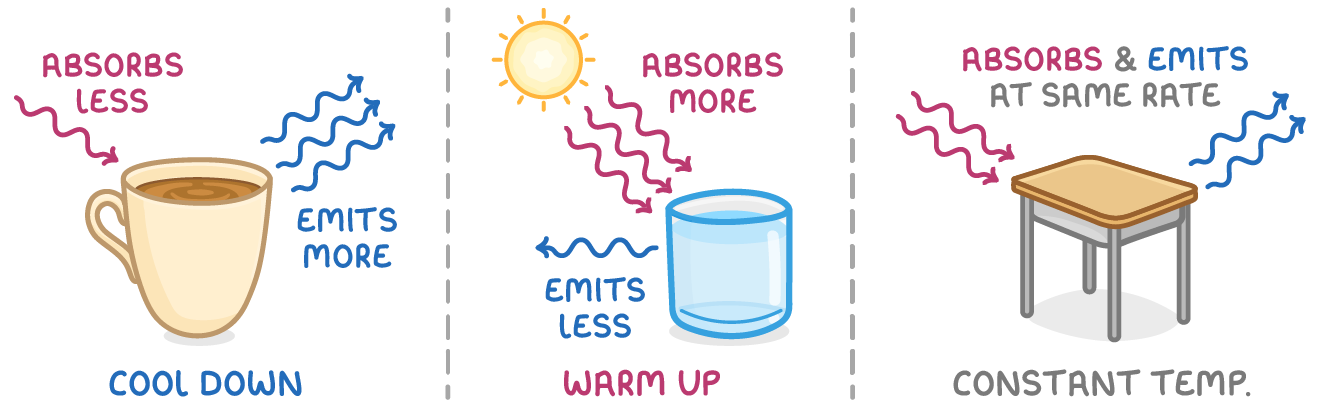
- Emits more than it absorbs - The object cools down (e.g. a mug of hot tea cooling).
- Emits less than it absorbs - The object warms up (e.g. a glass of iced water on a warm day).
- Emits at the same rate as it absorbs - The object stays at the same temperature.
How surfaces affect emission and absorption
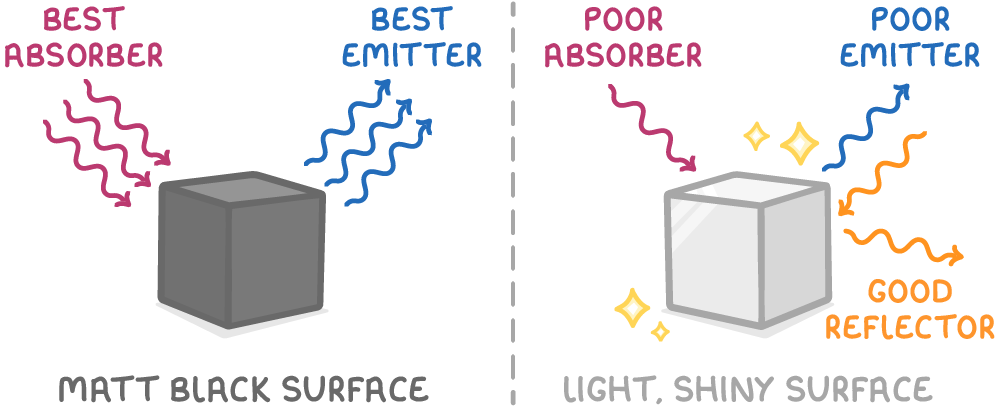
- A matt black surface is the best absorber and the best emitter of radiation.
- A light, shiny surface is a poor absorber and a poor emitter, but the best reflector of radiation.
Perfect black bodies
- A perfect black body absorbs all the radiation that hits it - none is reflected and none is transmitted through it.
- Because a perfect absorber is also the best possible emitter, a perfect black body is also the best possible emitter of radiation.
- The radiation emitted covers a continuous range of wavelengths.
Intensity and temperature
- Intensity is the power emitted per unit area (how much energy is transferred to a given area each second).
- The intensity and the spread of wavelengths emitted depend only on the body's temperature.
- Real objects are not perfect black bodies, but they follow the same pattern of emission.
How temperature changes the radiation curve
- An object emits radiation across a continuous range of wavelengths.
- How that radiation is spread across wavelengths depends on the object's temperature.
As the temperature increases
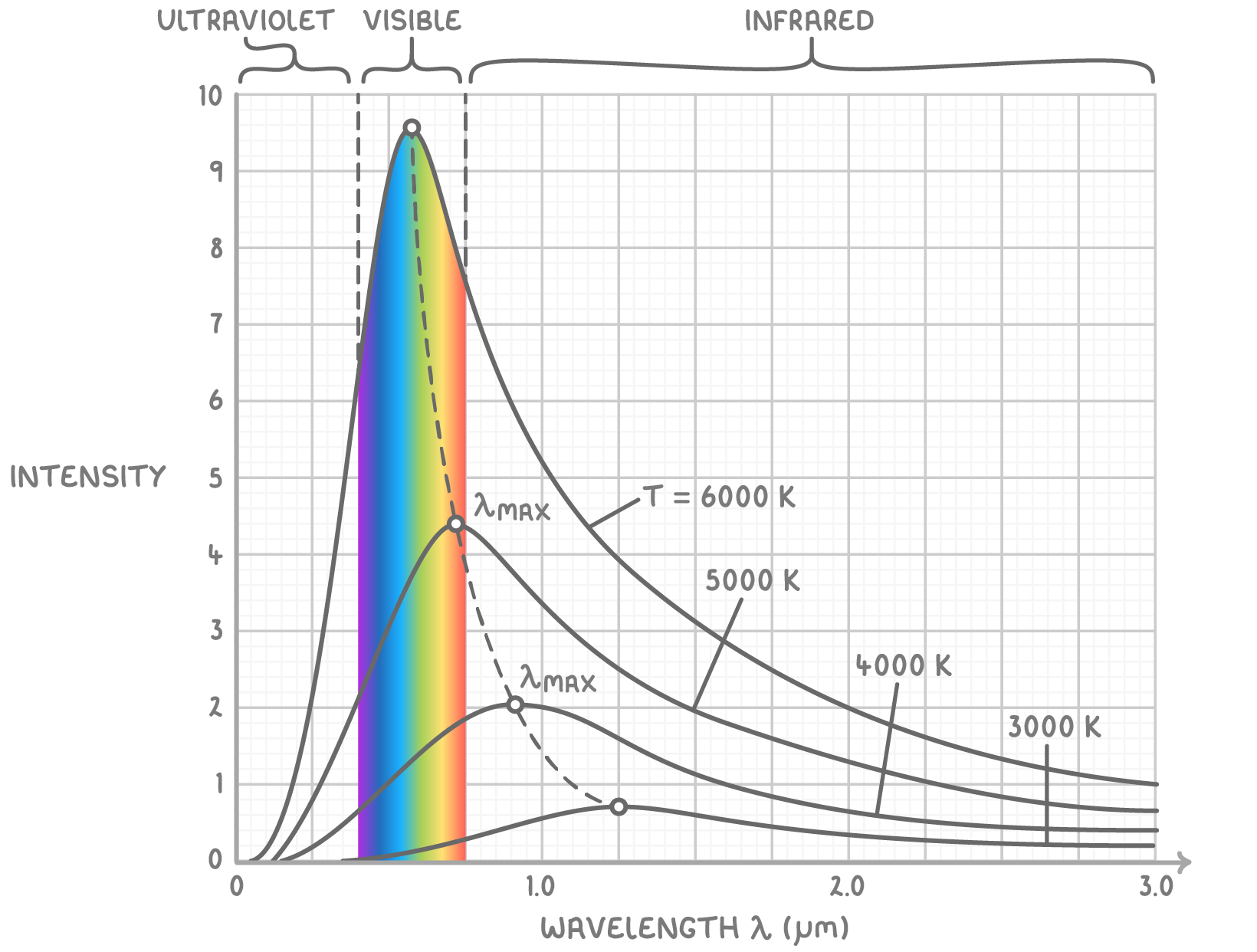
- The intensity of every wavelength increases.
- The intensity increases more rapidly for shorter wavelengths than for longer ones.
- The peak wavelength (the wavelength emitted with the highest intensity) decreases, shifting the peak towards shorter wavelengths.
Visible changes with heating
- At everyday temperatures, the peak wavelength lies in the infrared.
- As an object gets hotter, it begins to glow red and then white as more of its radiation moves into the visible light spectrum.
TermDefinition
Perfect black body
Intensity
Peak wavelength