6.9 - Alternators
Alternators generate alternating current
- A generator uses movement to induce a current, doing the reverse of a motor.
- An alternator is a generator that produces an alternating current.
How an alternator works
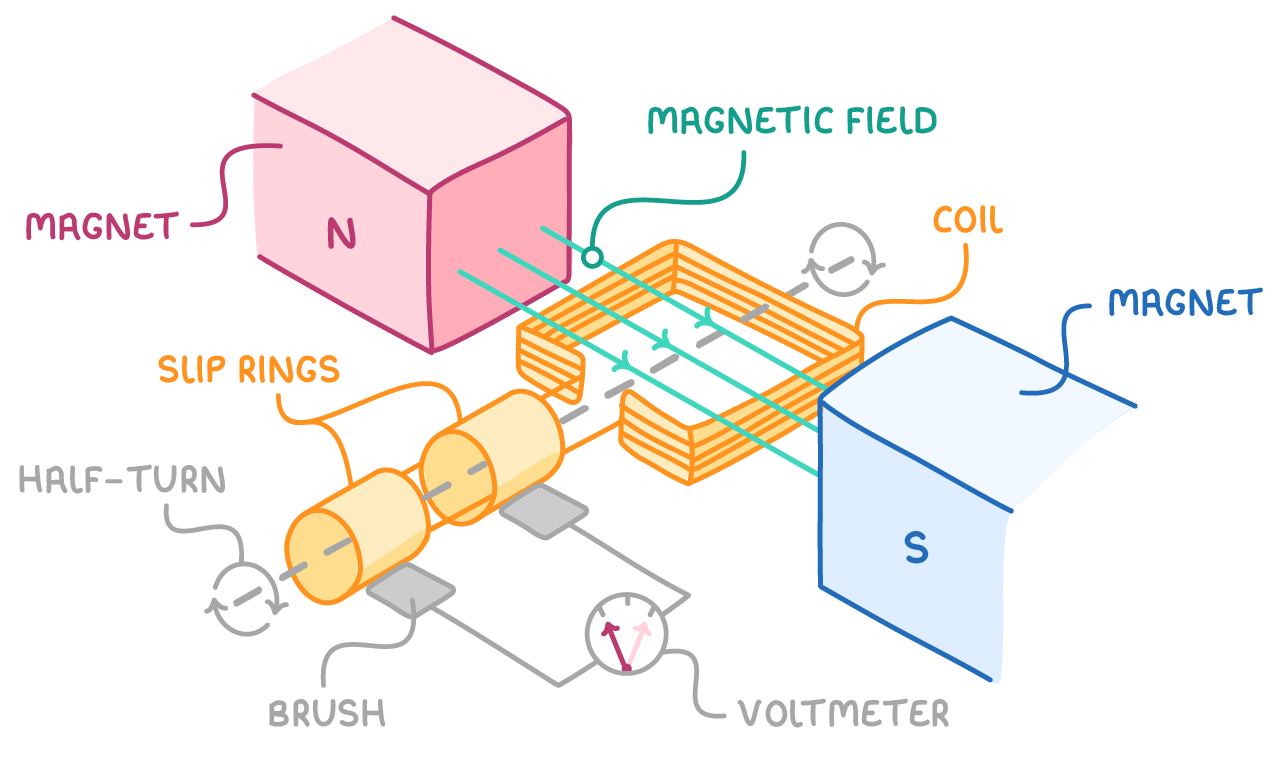
- A coil of wire rotates in a magnetic field, or a magnet rotates inside a coil of wire.
- As the coil (or magnet) turns, it cuts through the magnetic field lines, inducing a potential difference across the ends of the coil.
- If the coil is part of a complete circuit, this drives a current.
- The induced potential difference changes direction every half turn, because each side of the coil reverses the direction it moves through the field.
- The output is an alternating potential difference, which drives an alternating current.
Slip rings and brushes
- An alternator uses slip rings and brushes to keep the output alternating.
- A slip ring is fixed to each end of the coil and rotates with it.
- Each slip ring stays in continuous contact with a brush, which doesn't rotate and connects to the rest of the circuit.
- The brushes stay in contact with the same end of the coil throughout, so the connection is never swapped over.
TermDefinition
Generator
Alternator
Slip ring
Dynamo
Split-ring commutator
Oscilloscope