1.19 - Centre of Mass
Centre of gravity
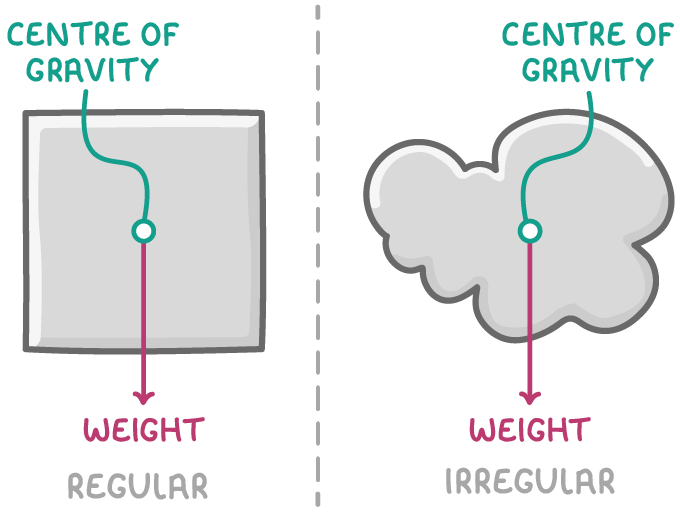
- The centre of gravity of an object is the point through which its entire weight can be considered to act.
- Because the whole weight acts at this point, it's also the point where the object's mass can be thought of as concentrated.
- For a regular, symmetrical shape, the centre of gravity is at its geometric centre (e.g. the centre of a uniform sphere), while an irregular shape has one too, even though symmetry can't be used to find it.
Centre of gravity of regular shapes
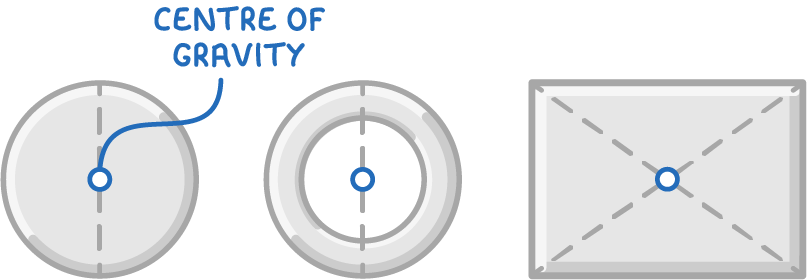
For a regularly shaped object, the centre of gravity sits at its point of symmetry:
- Disc - At the centre of the circle.
- Ring - At the centre of the ring, even though there's no material there.
- Rectangle (such as a rectangular lamina) - At its geometric centre, where the diagonals cross.
Finding the centre of gravity by suspension
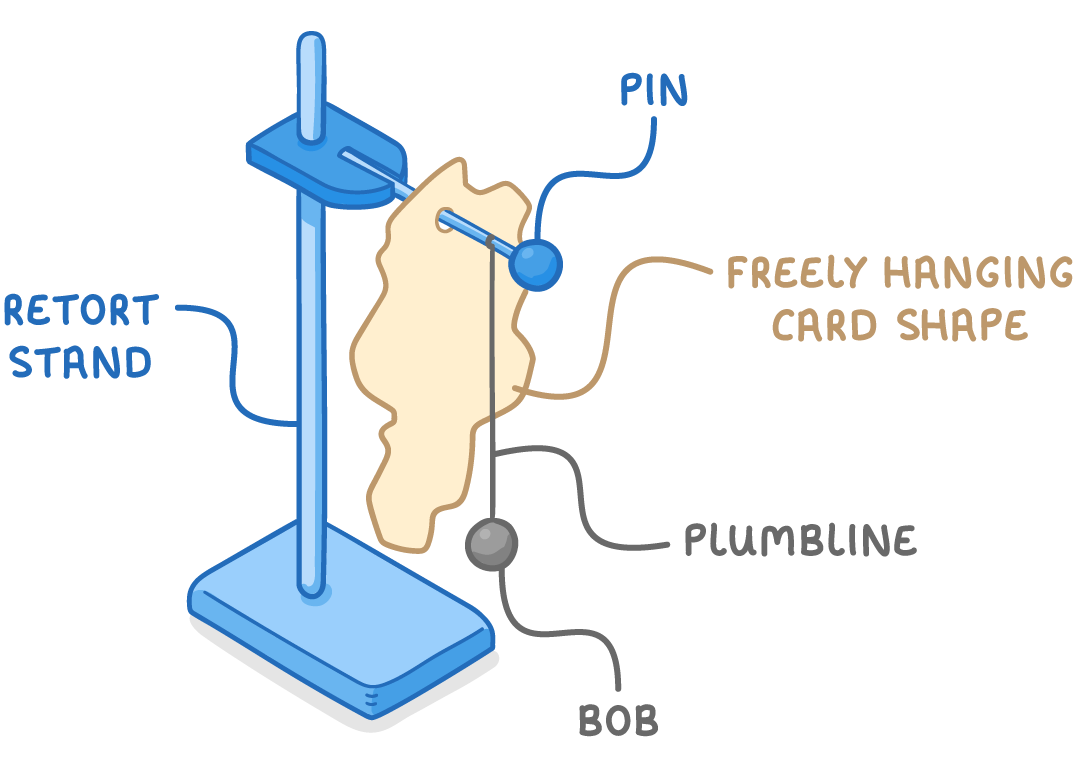
- When an object is hung so it can swing freely, it comes to rest with its centre of gravity vertically below the point of suspension.
- If its centre of gravity is not directly below the pivot, the weight acts at a perpendicular distance from that point, producing a moment that turns the object until the weight acts in line with the pivot.
Locating the centre of gravity of a flat shape
This is used to find the centre of gravity of a flat shape (a plane lamina):
- Suspend the shape from a pivot so it can swing freely, and hang a plumb line from the same point. Wait until both stop moving.
- Draw a line on the shape along the plumb line.
- Repeat with the shape suspended from a different pivot point, drawing a second line.
- The centre of gravity is where the lines cross.
Stability - Centre of gravity and base area
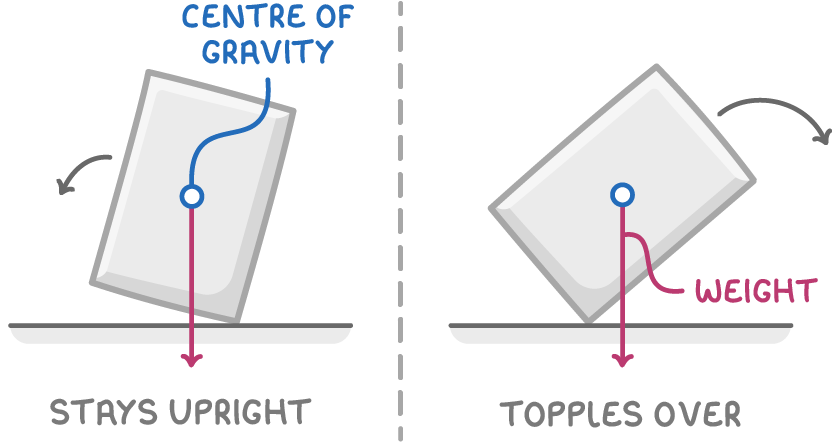
An object is stable (harder to tip over) when it has a low centre of gravity and a wide base area.
Why it depends on moments
The point where the object touches the ground acts as a pivot. When the object is tilted:
- While the centre of gravity stays over the base, the weight produces a moment that turns the object back down onto its base.
- If tilted far enough that the centre of gravity passes outside the edge of the base, the weight produces a moment that turns it the other way, and it topples.
A low centre of gravity and wide base mean the object can be tilted much further before its centre of gravity passes the edge of the base.
TermDefinition
Centre of mass