5.4 - V = IR Equation & I-V Graphs
Formula linking p.d., current and resistance
Where:
- = Potential difference, in volts (V)
- = Current, in amperes (A)
- = Resistance, in ohms (Ω)
The greater the resistance of a component, the smaller the current that flows through it for a given potential difference across it.
Finding the resistance
The equation can be rearranged to find the resistance of a component from measured values of potential difference and current:
Worked example - Current through a resistor
A 5.0 Ω resistor in a circuit has a potential difference of 9.0 V across it. Calculate the current through the resistor.
Step 1 - Identify the values
- Potential difference: V
- Resistance:
Step 2 - Rearrange V = IR to make current the subject
Step 3 - Substitution and calculation
The current through the resistor is 1.8 A.
Ohmic conductors and the I-V characteristic
- An I-V characteristic (or current-voltage characteristic) is a graph showing how the current through a component changes as the potential difference across it is increased.
- The resistance of an ohmic conductor, such as a fixed resistor or a metal wire, does not change with the current through it - as long as its temperature stays constant.
- For an ohmic conductor at constant temperature, the current is directly proportional to the potential difference across it.
Shape of the graph
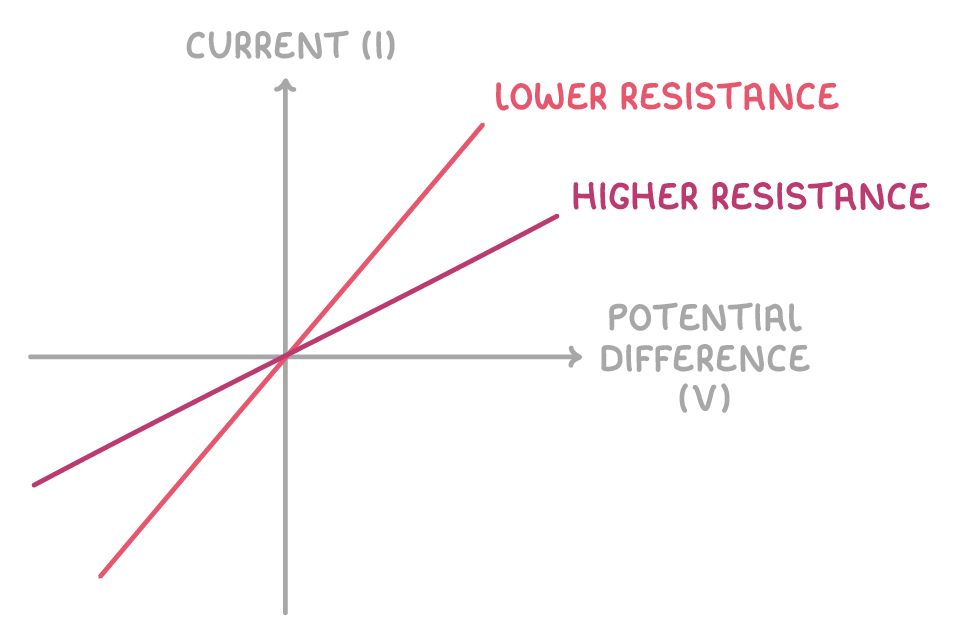
- A component whose resistance stays constant gives a straight line through the origin.
- Components with a straight-line characteristic are called linear components.
- The steeper the line, the lower the resistance.
Finding the resistance from the graph
- Read the potential difference and current at a point and use .
- For a linear component whose line passes through the origin, the resistance is the inverse of the gradient.
I-V characteristics of filament lamps and diodes
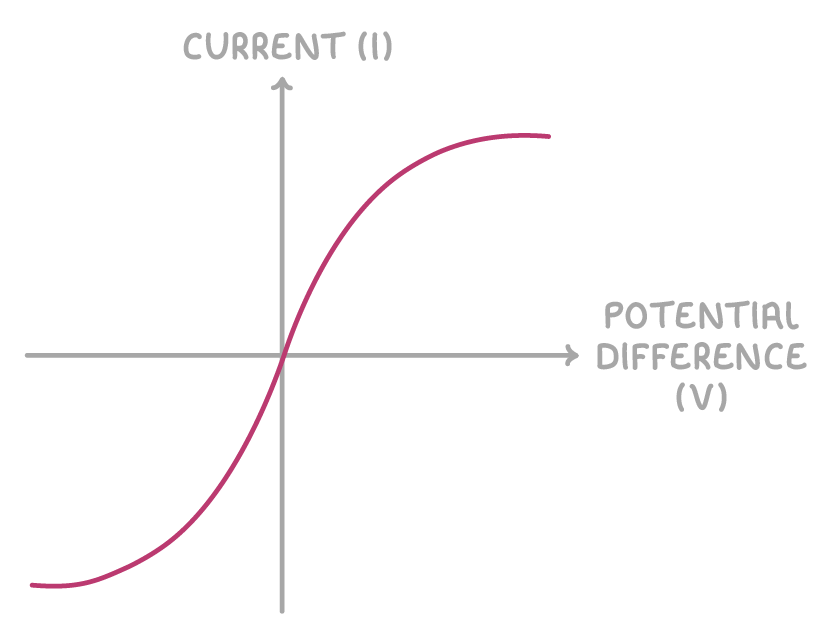
- Some components do not have a constant resistance, so their I-V characteristic is a curve rather than a straight line.
- Components with a curved I-V characteristic are called non-linear components.
The filament lamp
- As the current through a filament lamp increases, the moving charges transfer energy to the thermal energy store of the filament, so the filament heats up.
- As the temperature rises, the metal ions vibrate more, and electrons collide with them more often, so the resistance increases.
- Because the resistance rises, less current flows for each extra volt, so the characteristic gets shallower as the potential difference increases - giving a curve.
The diode
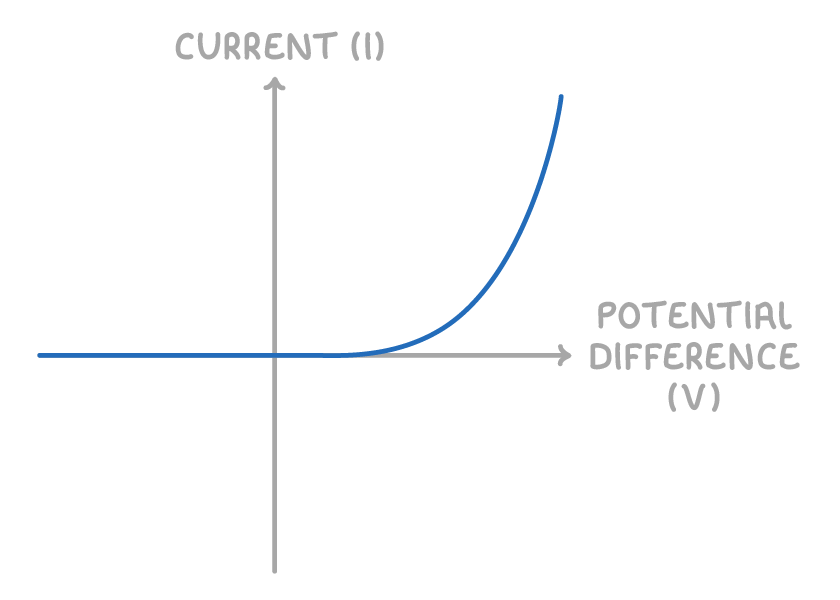
- A diode lets current flow through it in one direction only.
- It has a very high resistance in the reverse direction, so almost no current flows that way.
- The I-V characteristic is flat (zero current) for a reverse potential difference, then curves upwards once the potential difference is in the forward direction.
- A light-emitting diode (LED) is a type of diode that emits light when current flows through it in the forward direction.
TermDefinition
Ohmic conductor
Linear component
Non-linear component
Diode
Light-emitting diode (LED)