2.6 - Sankey Diagrams
Sankey diagrams
A Sankey diagram shows the energy transfers made by a device, making clear how much input energy is transferred usefully and how much is wasted.
How to read a Sankey diagram
- The width of an arrow represents the amount of energy. A wider arrow means more energy. Length doesn't matter - only the width.
- The input arrow enters from the left, showing the total energy supplied.
- Useful energy carries straight on.
- Wasted energy bends away (usually downwards, to thermal energy stores).
- Energy is conserved, so the energy going in equals the energy coming out:
Total energy supplied = useful energy transferred + wasted energy
The width of the input arrow equals the combined width of all output arrows.
Reading a scaled Sankey diagram
- Work out the energy represented by one grid square:
- Count the squares across each arrow.
- Multiply the number of squares by the energy per square to find the energy in that store.
Worked example - Reading a scaled Sankey diagram
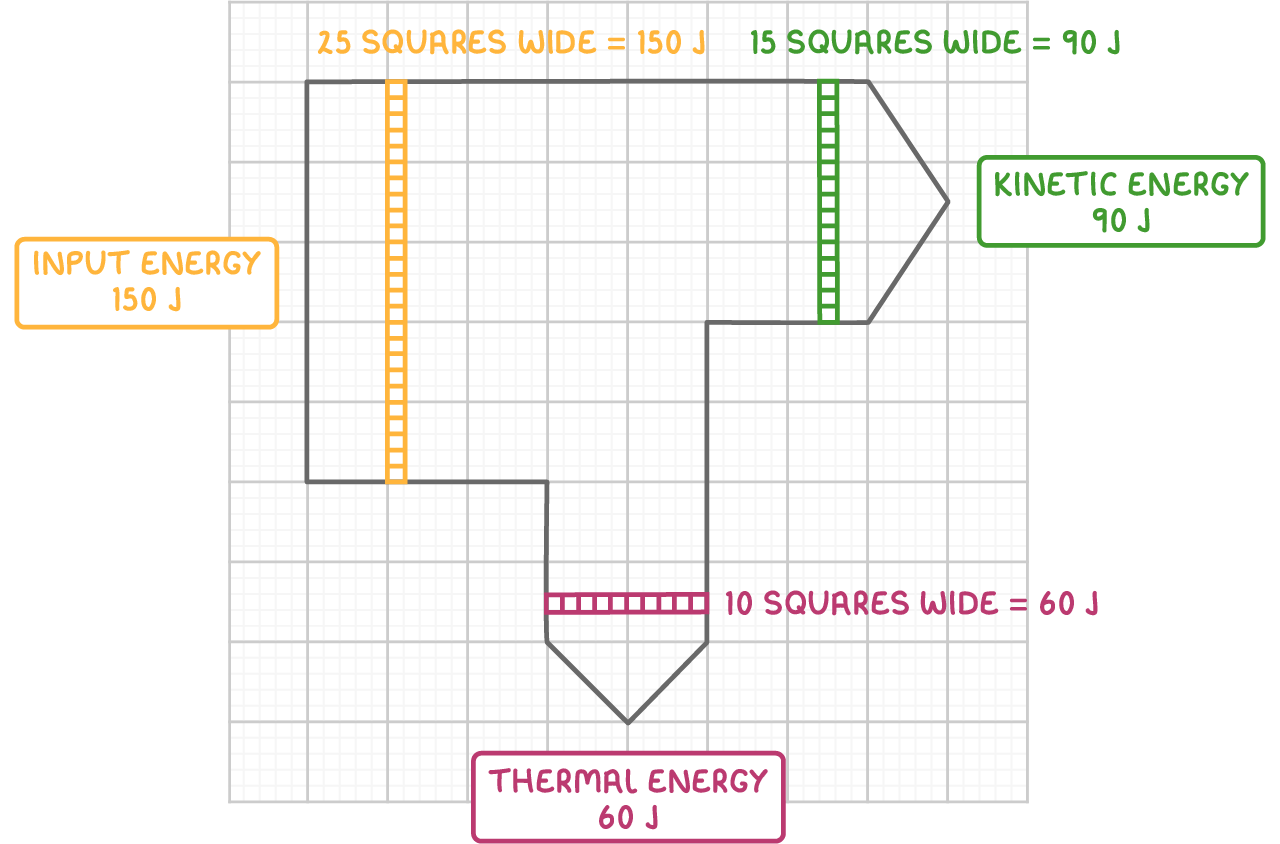
An electric fan is supplied with 150 J of energy. On its Sankey diagram the input arrow is 25 squares wide. The useful kinetic energy arrow is 15 squares wide, and the rest of the energy is wasted to thermal energy stores. Find the energy transferred to the kinetic energy store and the energy wasted.
Step 1 - Find the value of one square
Step 2 - Calculate the useful energy
The useful kinetic energy arrow is 15 squares wide:
Useful energy = 15 × 6 J = 90 J
Step 3 - Calculate the wasted energy
The energy must balance, so the wasted energy is what's left over:
Wasted energy = 150 J - 90 J = 60 J
The wasted-energy arrow would be 60 ÷ 6 = 10 squares wide, which matches the input (15 + 10 = 25 squares).