4.19 - Stopping Distances
Stopping distance = thinking + braking distance
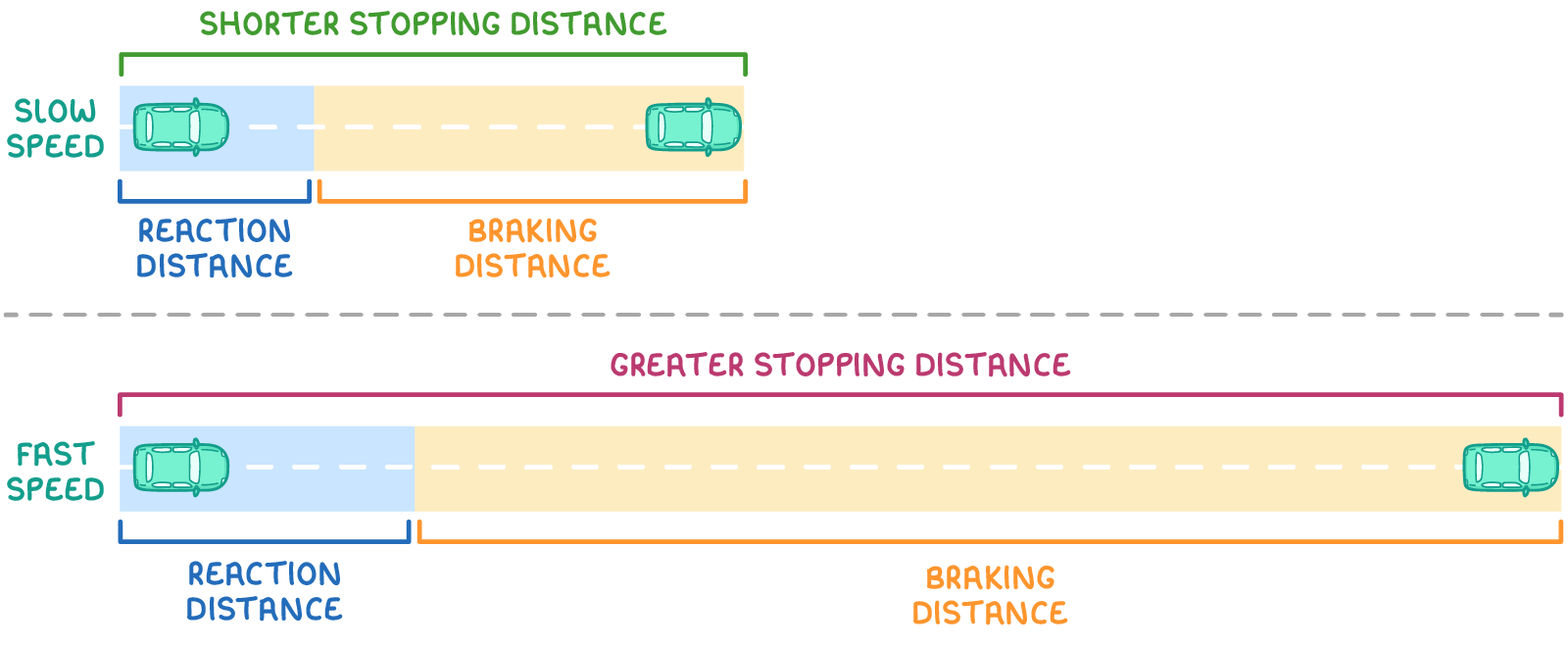
The stopping distance is the total distance a vehicle travels from the moment a driver spots a hazard to when the vehicle comes to a complete stop:
Stopping distance = thinking distance + braking distance
- Thinking distance - The distance the vehicle travels during the driver's reaction time, between noticing the hazard and applying the brakes.
- Braking distance - The distance the vehicle travels once the brakes are applied, while slowing to a stop.
In an emergency stop, the driver applies the maximum braking force to stop in the shortest possible distance.
What increases thinking distance
- Higher speed - The faster the vehicle travels, the further it goes during the reaction time.
- Longer reaction time - Increased by tiredness, alcohol, drugs and distractions.
What increases braking distance
- Higher speed - A faster vehicle travels further before the braking force brings it to a stop.
- Greater mass - A heavier vehicle takes longer to stop under the same braking force.
- Worn or faulty brakes - These can't apply as much braking force.
- Poor road or tyre conditions - Wet or icy roads, dirt, or worn tyres reduce friction, making skidding more likely.
Braking transfers energy to the brakes
- When the brake pedal is pushed, the brake pads press against the wheels.
- The contact causes friction, so work is done between the brakes and the wheels.
- This work transfers energy from the kinetic energy store of the moving car to the thermal energy store of the brakes, causing them to heat up.
Faster cars need a greater braking force
- The faster a car travels, the more kinetic energy it has, so the more work the brakes must do to stop it.
- To stop within a given distance, a faster car needs a greater braking force, which results in a larger deceleration.
Risks of very large decelerations
- The brakes can overheat and lose effectiveness.
- The tyres can lose grip and cause the car to skid.
Braking distance and work done by the brakes
To stop a car, the work done by the braking force must equal the kinetic energy of the car:
Where:
- = Mass of the car, in kilograms (kg)
- = Speed of the car, in metres per second (m/s)
- = Braking force, in newtons (N)
- = Braking distance, in metres (m)
During an emergency stop the braking force is at its maximum, so the braking distance depends directly on kinetic energy:
- Doubling the mass doubles the kinetic energy, doubling the braking distance.
- Speed is squared (), so doubling the speed quadruples the kinetic energy, increasing the braking distance four-fold.
Worked example - Total stopping distance
A car travelling at 20 m/s makes an emergency stop to avoid a hazard. The braking force is 8,000 N. Estimate the total stopping distance. Take the driver's reaction time as 0.5 s and the mass of the car as 1,200 kg.
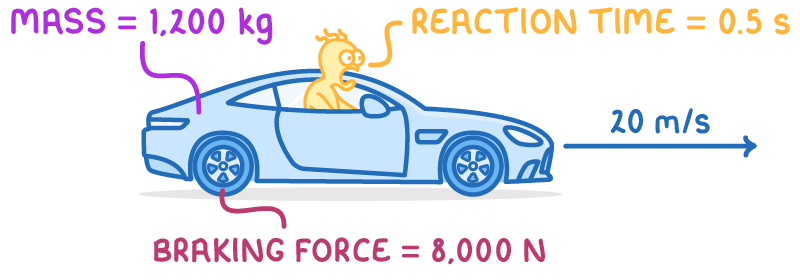
Step 1 - Find the thinking distance
The car travels at a constant speed during the reaction time:
Step 2 - Find the braking distance
Rearrange for braking distance :
Step 3 - Add the two distances
Stopping distance = 10 + 30 = 40 m
Step 4 - Interpretation
Thinking distance is directly proportional to speed, but braking distance is proportional to speed squared. If the speed doubled to 40 m/s, the thinking distance would double to 20 m while the braking distance would quadruple to 120 m, giving a total stopping distance of 140 m.
How speed affects stopping distance
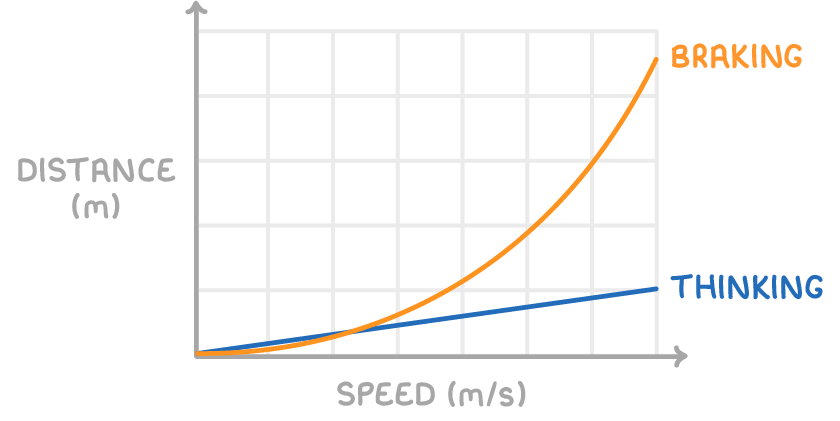
Thinking distance increases linearly with speed
- Because reaction time is roughly constant, distance travelled is directly proportional to speed ().
- Doubling the speed doubles the thinking distance.
- A graph of thinking distance against speed is a straight line.
Braking distance increases with the square of speed
- Braking distance depends on kinetic energy ().
- Doubling the speed increases the braking distance four-fold (22 = 4); trebling it increases the braking distance nine-fold (32 = 9).
- A graph of braking distance against speed curves upwards.
Total stopping distance
- Total stopping distance combines a linear increase and a squared increase.
- At low speeds, thinking distance makes up the larger proportion of stopping distance.
- At high speeds, braking distance dominates.
Worked example - Comparing stopping distances from a graph
The graph shows stopping distance against speed for two cars, A and B. Compare their stopping distances at 30 m/s.
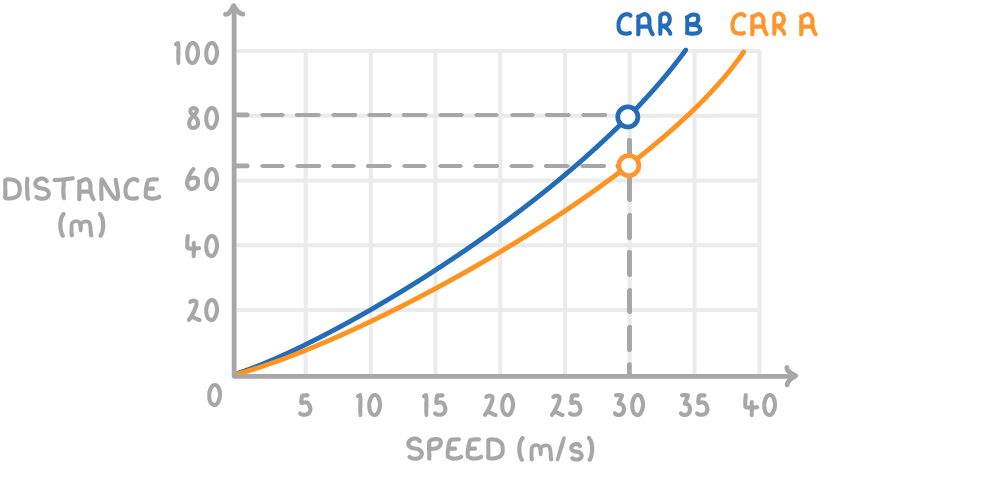
Step 1 - Read the stopping distance for each car at 30 m/s
Read up from 30 m/s on the speed axis to each curve, then across to the distance axis:
- Car A stopping distance = 65 m
- Car B stopping distance = 80 m
Step 2 - Find the difference
80 - 65 = 15 m
At 30 m/s, car B takes 15 m more to stop than car A.
Typical stopping distances for a family car
| Speed | Thinking distance | Braking distance | Stopping distance |
|---|---|---|---|
| 30 mph | 9 m | 14 m | 23 m |
| 50 mph | 15 m | 38 m | 53 m |
| 70 mph | 21 m | 75 m | 96 m |
- Braking distance increases much faster than thinking distance as speed increases, so total stopping distance more than quadruples between 30 mph and 70 mph.
- To avoid collisions, drivers must leave a gap of at least the stopping distance behind the vehicle in front.